
07.09.1917–09.06.2000
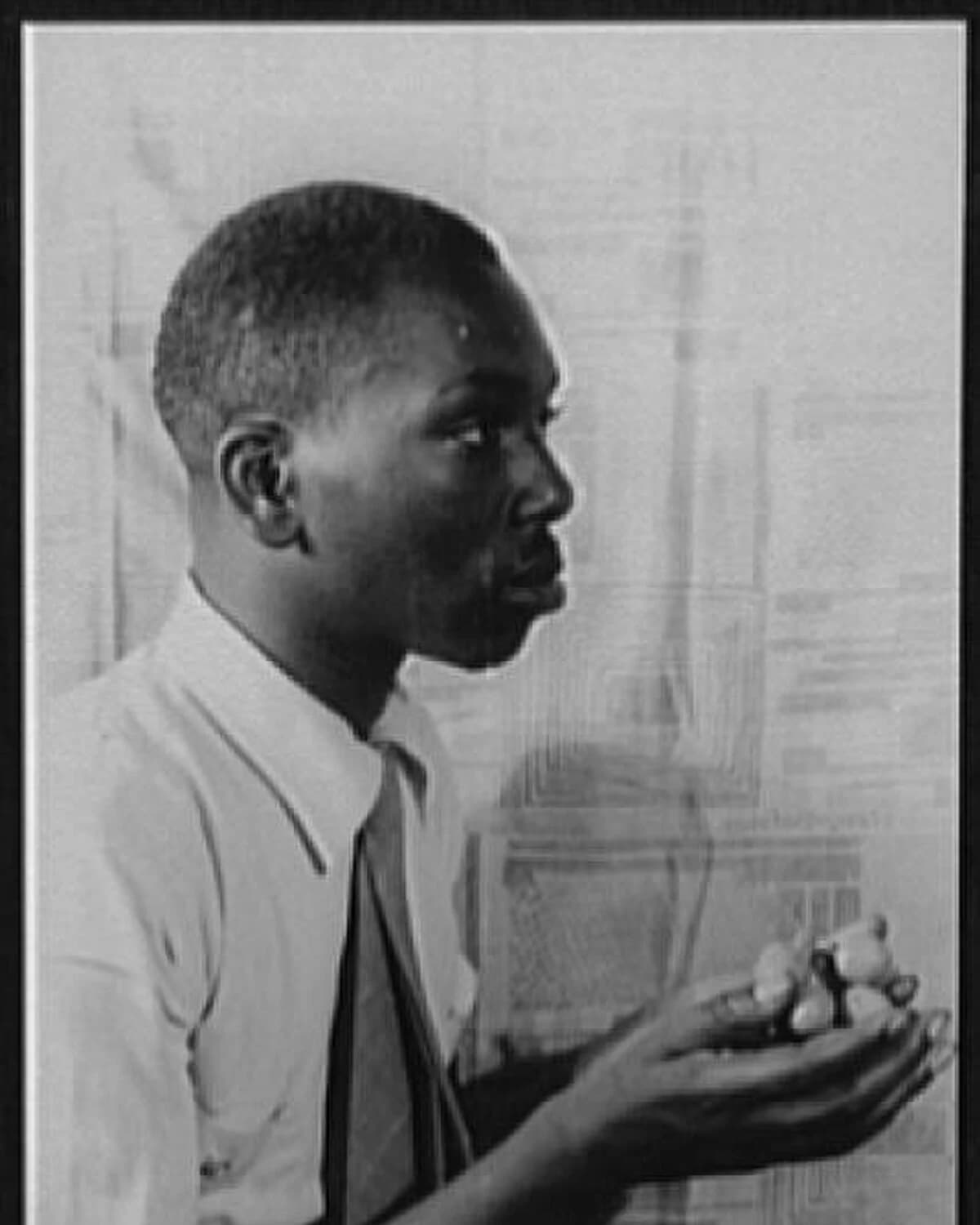
Jacob Lawrence
Jacob Lawrence (1917–2000) grew up in Harlem and at twenty-three became the first African-American artist taken on by a New York gallery: his “Migration Series”, sixty tempera panels on the movement of Black Americans from the South to the North, was split between the Museum of Modern Art and the Phillips Collection. He painted in series, the way stories are told, and taught for sixteen years at the University of Washington in Seattle.
Biography
Tempera dries fast, and Lawrence fitted his method to it: he planned all sixty panels of the “Migration Series” in advance, laid them out side by side and applied one colour at once to every sheet where that colour was needed, then moved on to the next. In this way, in 1940–41, at twenty-three, he painted the story of the Great Migration, the movement of hundreds of thousands of African Americans from the rural South to the cities of the North after the First World War. The series was shown at the Downtown Gallery in Greenwich Village, Lawrence became the first Black artist represented by a New York gallery, some of the panels were printed in Fortune magazine, and then the whole series was bought jointly and divided by number: the odd panels went to the Phillips Collection in Washington, the even ones to the Museum of Modern Art in New York. To my mind this craftsman’s discipline explains his manner better than “dynamic cubism”, as he himself called it.
He was born on 7 September 1917 in Atlantic City, New Jersey, where his parents had themselves come from the rural South. In 1924 they separated, his mother placed Jacob and his younger brother and sister in foster care in Philadelphia, and only at thirteen was he with her again, now in Harlem. To keep the boy occupied his mother enrolled him in after-school classes at the Utopia Children’s Center, and there he drew patterns in crayon, copying them at first from his mother’s carpets. He later said that in the homes of his mother’s generation everything was in colour, so that you could not help thinking of Matisse. At sixteen he left school, worked in a laundry and a printing plant and went to the Harlem Art Workshop, to Charles Alston. Alston sent him on to the Harlem Community Art Center, to the sculptor Augusta Savage, and Savage obtained for him a scholarship to the American Artists School and a paid post with the Works Progress Administration, set up under Roosevelt at the height of the Depression. Harlem, rather than any academy, was his school: he was one of the first artists raised by the African-American community itself.
From the very start he painted in series. At twenty-one his forty-one paintings on Toussaint L’Ouverture, leader of the Haitian slave revolution, hung in an exhibition of African-American artists at the Baltimore Museum of Art; after them came the lives of Harriet Tubman (1938–39) and Frederick Douglass (1939–40). On 24 July 1941 Lawrence married the painter Gwendolyn Knight, also a pupil of Savage; she prepared the gesso panels for him and helped write the captions to the series. In 1941–42 came twenty-two panels on John Brown; when they became too fragile for exhibition, he repeated them in 1977 as silkscreen prints. Of the thirty sheets of 1943 on Harlem, Howard Devree wrote in the New York Times that before them one felt admitted to something elemental.
In October 1943 he was drafted into the Coast Guard. He served as a public affairs specialist on the Sea Cloud, the first ship with a racially integrated crew, under Carlton Skinner, rose to petty officer third class and painted all the while. The forty-eight works made in the service were lost: eight of them were shown by the Museum of Modern Art in 1944 beside the “Migration”, the Coast Guard sent them on tour, and in the general confusion of demobilisation the trail went cold.
After the war came a Guggenheim fellowship (1945), the summer school at Black Mountain College, to which Josef Albers invited him in 1946, and the “War Series”. In 1949 he admitted himself to Hillside Hospital in Queens, spent eleven months there and painted the “Hospital Series”, unlike the rest of his work: there he was concerned with the mental states of the patients, something absent from his pictures before.
In 1954–56 he made thirty panels of “Struggle: From the History of the American People”, covering 1775 to 1817, though he had planned sixty. Instead of titles the panels carry quotations; a slave revolt, for instance, is captioned with the words of a man who sued for his freedom in 1773: “We have no property! We have no wives! No children! We have no city! No country!” In the political climate of the mid-1950s no museum could be found for the series; a private collector bought it and sold it off panel by panel. Three panels are still lost, three more turned up only in 2017, 2020 and 2021; in 2020 the Peabody Essex Museum brought the series together for the first time since 1958, with reproductions in place of the missing ones.
He taught a great deal: at the New School for Social Research, the Art Students League, Pratt Institute, the Skowhegan School. In 1970 he and Gwendolyn moved to Seattle, where the University of Washington first invited him as a visiting artist and then, from 1971 to 1986, kept him as a professor. Large commissions followed: in 1980 “Exploration”, a forty-foot mural on steel panels coated in porcelain enamel for the Blackburn Center of Howard University; in 1983 the eight screen prints of the “Hiroshima Series” for John Hersey’s book, with survivors shown at the moment of the blast; in the early 1990s a mural on Harold Washington for the Chicago library that bears his name. Retrospectives were mounted by the Brooklyn Museum (1960), the Whitney Museum (1974) and the Seattle Art Museum (1986); in 1970 the NAACP gave him the Spingarn Medal, and in 1990 he received the National Medal of Arts. Shortly before his death he said that a painting needs three things: universality, clarity and strength.
Lawrence died on 9 June 2000 in Seattle, at eighty-two; he worked until his last weeks. In 1999 he and his wife had established the Jacob and Gwendolyn Lawrence Foundation; Gwendolyn Knight outlived her husband by five years. His last commission, the mosaic “New York in Transit” in Murano glass, was installed in October 2001 in the Times Square subway station. “The Builders” of 1947 has hung in the Green Room of the White House since 2009.
Profile notes
Profile and sources
Image
Artist image
Carl Van Vechten; Wikimedia Commons; Public domain.
