
28.01.1912–11.08.1956
Jackson Pollock
Jackson Pollock (1912–1956) spread his canvas on the floor of a barn in Springs, Long Island, and poured liquid household enamel onto it from sticks and hardened brushes, working round it from every side. From the “drip” paintings of 1947–1950 critics derived the idea of “action painting”. He began as a pupil of Thomas Hart Benton and first tried liquid paint with the Mexican artist Siqueiros.
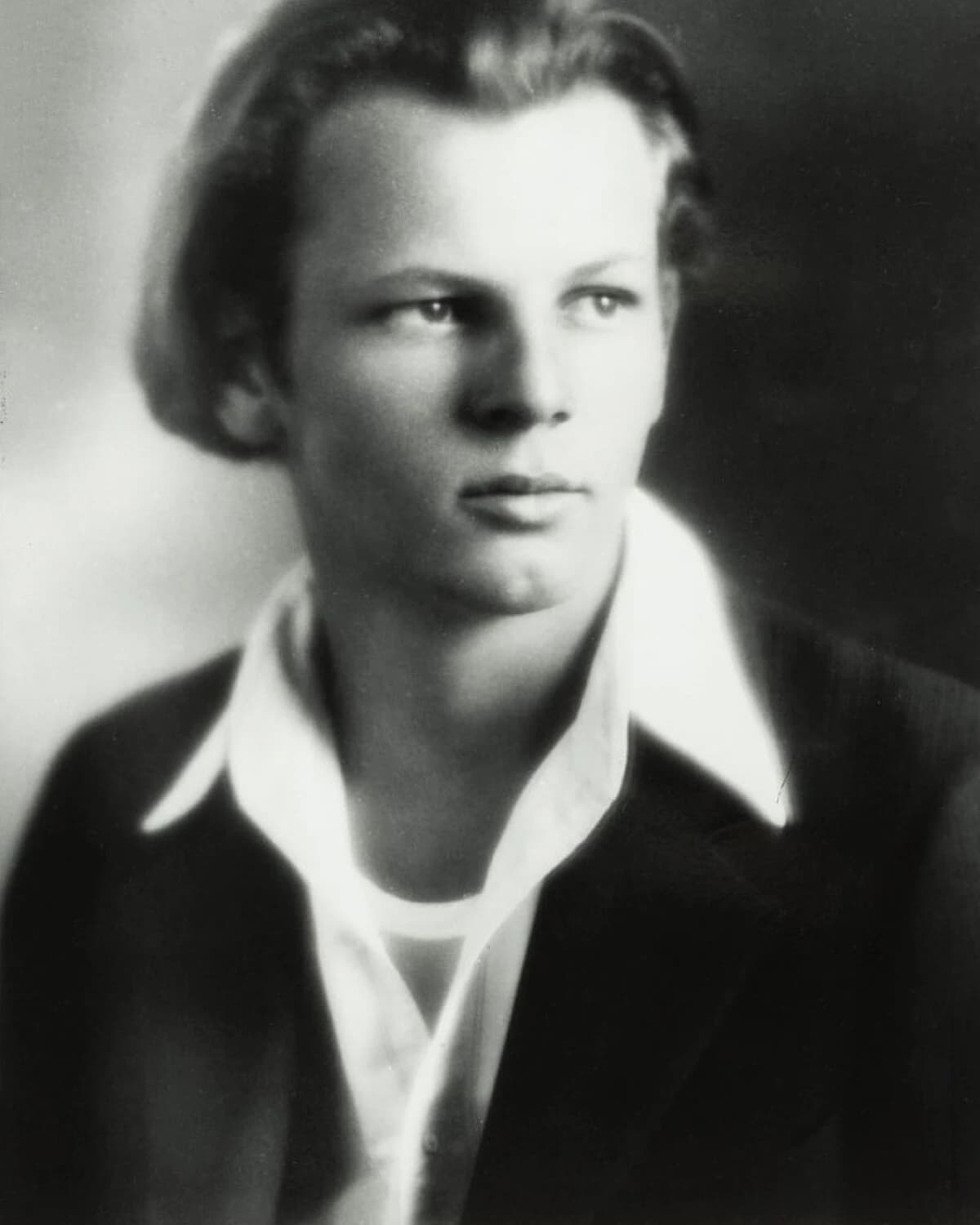
Biography
In 1950 a young photographer, Hans Namuth, came to photograph Pollock at work. Pollock had promised to start a new painting for the occasion, but he met his visitor with apologies: it was already finished. A wet canvas lay on the floor across the whole studio. Pollock stood over it, then suddenly picked up a can and a brush and set off around it, slowly at first, then faster and faster, flinging black, white and rust-coloured paint onto the canvas. As Namuth recalled, he forgot about him and about his wife, did not hear the shutter, and kept going without a break for about half an hour. When he had finished, all he said was: “This is it.”
His wife, standing next to Namuth, was Lee Krasner, and she was an artist too.
Paul Jackson Pollock was born on 28 January 1912 in Cody, Wyoming, the youngest of five brothers, and as early as November his mother took her sons to San Diego; he never went back to Cody. His father, a farmer and later a government land surveyor, changed jobs often, and his childhood was spent in Arizona and in Chico, California. On trips with his father the boy first came across Native American culture. He was expelled from two schools, the last time from Manual Arts High School in Los Angeles. In 1930 he followed his elder brother Charles to New York, and both studied at the Art Students League under Thomas Hart Benton. His teacher’s rural subjects did not rub off on him, but the rhythm of the brushstroke and a stubborn independence stayed. One summer he roamed the West with Benton and a fellow student, Glen Rounds. The Mexican muralists, though, especially José Clemente Orozco, had a stronger effect on him than Benton.
In 1936, in David Alfaro Siqueiros’s experimental workshop in New York, Pollock worked with liquid paint for the first time, and that summer he went to Dartmouth College to see Orozco’s fresco “The Epic of American Civilization”. In 1938–1942 he received commissions under the Federal Art Project and was treated by Jungian psychoanalysts, and Jungian archetypes passed into his paintings of the late 1930s and early 1940s. In 1943 the Museum of Modern Art in New York bought “The She-Wolf”. In July of that year he signed a contract with Peggy Guggenheim and painted “Mural”, 2.4 by 6 metres, for the entrance hall of her new house; on Marcel Duchamp’s advice he painted it on canvas, so that it could be moved. Clement Greenberg, on seeing it, decided that he was looking at the best painter in the country.
He met Lee Krasner in 1942 at an exhibition in which they both took part; she came to see him unannounced. In October 1945 they married, and a month later, with a loan from Peggy Guggenheim, they bought a wooden house with a barn in Springs, in East Hampton, on the south shore of Long Island. The barn became his studio, and it was there, in 1947–1950, that his best-known paintings were made, among them “No. 5, 1948” and “Autumn Rhythm”. The canvas, not stretched on a frame, lay on the floor or was tacked to the wall. Pollock himself wrote that on the floor he felt more at ease: he could walk around it, work from all four sides and literally be in the painting. Instead of brushes he used sticks, trowels, knives, hardened brushes and basting syringes; instead of artists’ paints, synthetic enamel, sometimes with sand and broken glass. He himself compared his method to the sand paintings of the Native Americans of the West, demonstrations of which he had seen in the 1940s; Greenberg added that Pollock had been affected by the work of Janet Sobel, and his friend Fritz Bultman believed it had all started with Wolfgang Paalen’s fumage. Pollock denied that chance played a part: he usually had an idea of how a painting should look. He replaced titles with numbers. Numbers are neutral, Krasner explained; they make people look at a picture as pure painting.
On 8 August 1949 Life magazine ran a piece on him with a question in the headline: was he the greatest living painter in the United States? In 1952 Harold Rosenberg coined the term “action painting”, and many assumed that Pollock had been his model. There was mockery too; in 1959 one British newspaper headlined a piece “This is not art, it’s a joke in bad taste.” Critics on the left later wrote that the American authorities, through the CIA-funded Congress for Cultural Freedom, had turned him into a Cold War weapon against Socialist Realism. I think this dispute says more about the period than about the paintings themselves.
At the height of his fame Pollock gave up the drip technique. After 1951 came the “black pourings” on unprimed canvas, in which figures emerge again; at the exhibition at Betty Parsons not one of them sold. Then colour returned; among these works is “Blue Poles” (1952), bought in 1973 for the National Gallery of Australia by the government of Gough Whitlam. Pollock moved to the more commercial Sidney Janis Gallery, and collectors were waiting for new paintings. His last two, “Scent” and “Search”, were painted in 1955. In 1956 he did not paint at all, and only modelled constructions of wire, gauze and plaster at the home of his friend Tony Smith.
Pollock died on 11 August 1956 not far from his home in Springs; Lee Krasner was in Europe at the time. Four months later the Museum of Modern Art opened a posthumous retrospective. Krasner managed his estate for the rest of her life. They are buried in Green River Cemetery in Springs: a large boulder over his grave, a smaller stone over hers.
Related context
Associations
Works connected through artistic movements, cultural context and period. Priced works available in this market appear first.








Profile notes
Profile and sources
Image
Artist image
Unknown author Unknown author; Wikimedia Commons; Public domain.
