
23.04.1775–19.12.1851
J. M. W. Turner
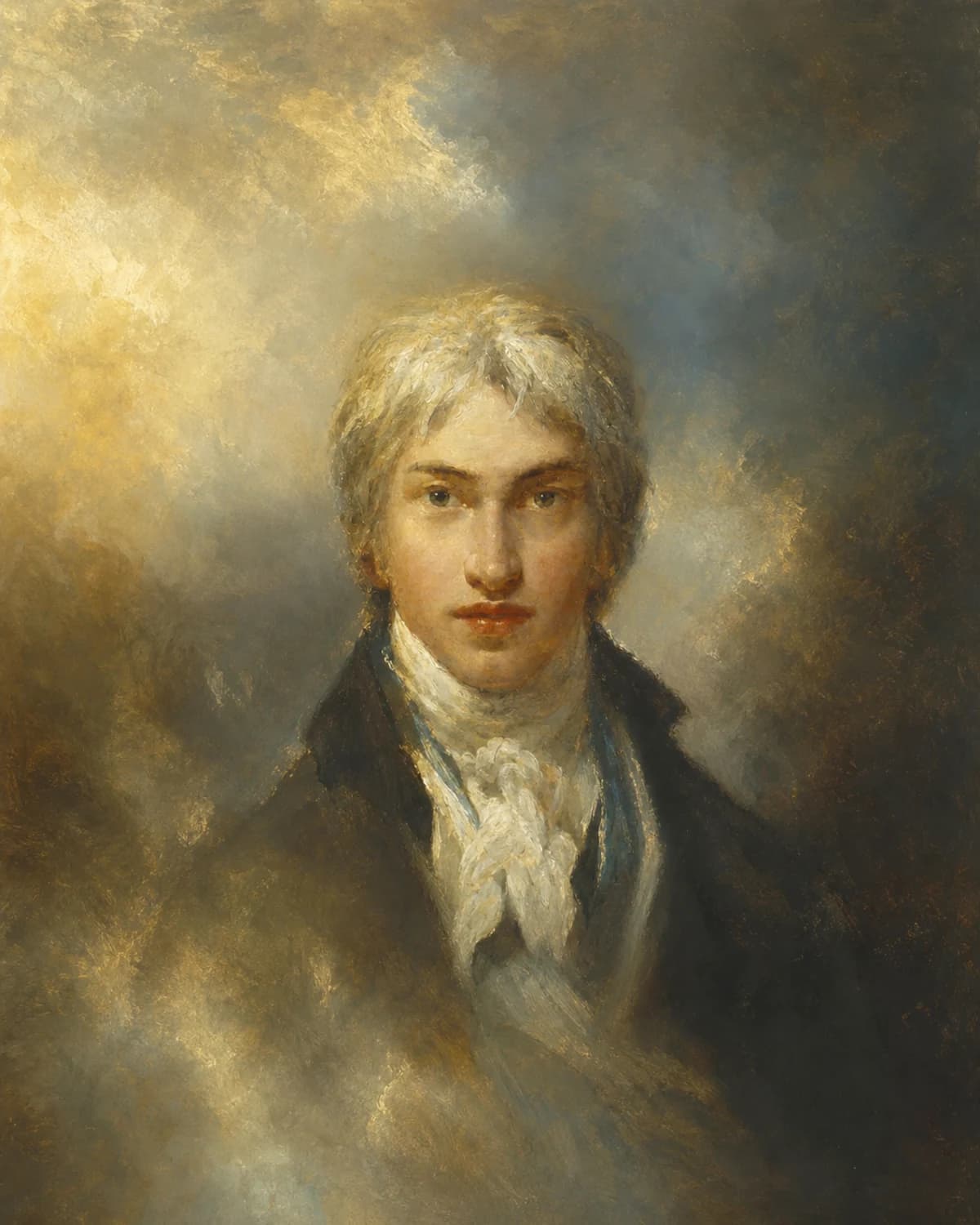
J. M. W. Turner (1775–1851), the son of a London barber, became a Royal Academician at twenty-seven. He painted storms, shipwrecks, Venice and steam trains, and towards the end dissolved objects in light and mist so thoroughly that critics laughed at him. He left more than 550 oil paintings and around two thousand watercolours, and bequeathed the main part of his legacy to the British nation.
Biography
In 1799 the collector John Julius Angerstein invited the young Turner to see his collection. In front of Claude Lorrain’s “Seaport with the Embarkation of the Queen of Sheba” the guest burst into tears, and when his host asked why, he answered that he would never be able to paint anything like it. Sixteen years later he finished “Dido Building Carthage” and decided that he had at last drawn level with Claude. He later bequeathed this picture to the National Gallery on condition that it hang beside “The Queen of Sheba”.
He was born in Maiden Lane, Covent Garden, in London. His birthday, 23 April 1775, was named by the artist himself, and some scholars dispute it. His father kept a barber’s shop and made wigs, his mother came from a family of butchers, and Turner kept his cockney accent all his life.
In 1785, because the family had fallen on hard times, the boy was sent to an uncle in Brentford, then to Margate. His father displayed his drawings in the barber’s shop window and sold them for a few shillings each. As a teenager he worked for architects and coloured views of castles and abbeys; in 1789 he began to study with the topographer Thomas Malton, whom he later called his real master, and in December of that year, aged fourteen, he entered the Royal Academy Schools, where he was admitted by Joshua Reynolds. As early as 1790 the Academy exhibition hung his watercolour of the Archbishop’s Palace at Lambeth. He also earned money as a theatre scene painter, and his later love of harsh light and blazing colour has been linked with that work.
His first real success was “Fishermen at Sea” (1796), a moonlit night seascape. In October 1798 he told a friend that he had sixty commissions for watercolours and was earning more than he could spend. In 1799 he was elected an associate of the Academy. “Dutch Boats in a Gale” (1801) was hung in the best place at the exhibition, opposite the entrance, although the influential collector Sir George Beaumont compared its sea to pea soup. On 10 February 1802 Turner became an Academician; he was twenty-seven.
The peace between Britain and France in 1802 allowed him to visit Paris, see the old masters in the Louvre and travel through the Swiss Alps. In 1804 he opened his own gallery so as to sell pictures without middlemen, and his father gave up the barber’s shop to help his son. Of all rivers he loved the Thames best: he rented houses at Isleworth and Hammersmith, turned a boat into a floating studio, and in 1811 built himself a house, Sandycombe Lodge, at Twickenham. From 1806 to 1819 he issued the “Liber Studiorum”, about seventy mezzotints modelled on Claude’s “Liber Veritatis”, and divided landscape into marine, mountainous, pastoral, historical, architectural and epic pastoral; the plates sold badly. In 1811, by then professor of perspective, he began lecturing at the Academy. He proved a muddled lecturer, but students were grateful for his advice in the classes.
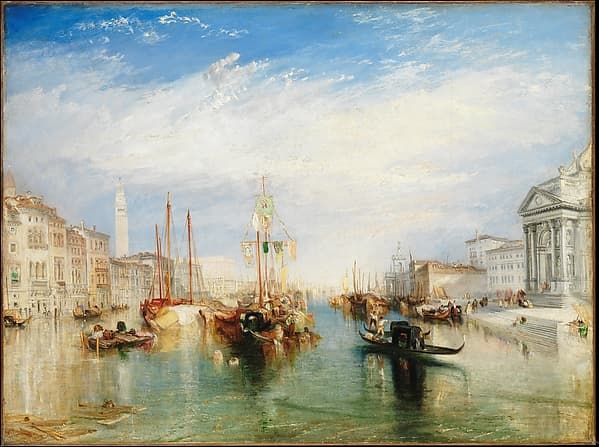
“Snow Storm: Hannibal and His Army Crossing the Alps” (1812) is built around a huge vortex of cloud that engulfs both the Carthaginian army and the mountain tribesmen; the people below can barely be made out. That vortex came back more than once in his later pictures. “The Field of Waterloo” (1818) contains no victory, only a field strewn with bodies. “The Battle of Trafalgar” (1822–1824), commissioned by George IV for St James’s Palace, showed blood and drowning men in the foreground; the king disliked it, and it never hung in the palace. In 1819 Turner made his first long journey to Italy: Turin, Milan, Como, Rome, Naples, Venice. He went back to Venice in 1833 and 1840, and after Italy his painting became noticeably brighter. He used new pigments, sometimes before they had reached the shops, such as trial samples of chrome yellow, and would not give up fugitive carmine even though he had been warned. Many of his colours have faded since.
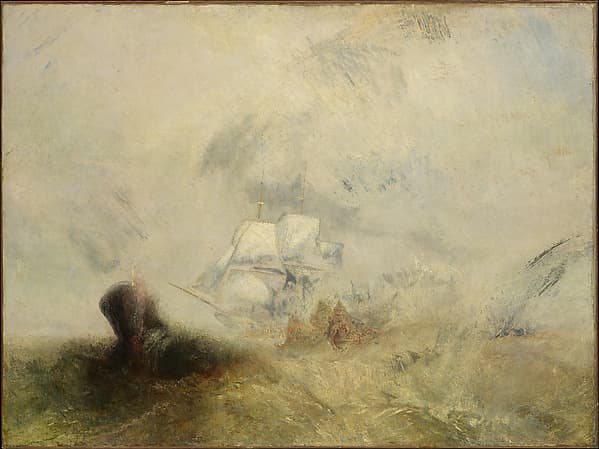
The more freely he painted, the angrier the reviews became. Of “Snow Storm: Steam-Boat off a Harbour’s Mouth” (1842) the Athenaeum wrote that the painter worked in cream, chocolate, yolk of egg and currant jelly, and that there was no telling where the steamboat was and where the harbour. Few people defended him. William Hazlitt had called these landscapes pictures of nothing, and very like, as early as 1816. John Ruskin, in the many volumes of “Modern Painters” (from 1843), placed him above everyone.
In his late canvases Turner often paints the new age beside the old. “The Fighting Temeraire” (1838): a small tug tows an old ship of the line, a veteran of Trafalgar, away to be broken up. In “The Slave Ship” (1840) people are falling into the waves, thrown overboard by slavers for the sake of the insurance. And in “Rain, Steam and Speed” (1844) a Great Western Railway train races across a bridge through a downpour, and one can hardly make out a locomotive in it at all. Turner was sixty-nine. I would hang this picture next to the “Hannibal”: the same vortex, only with a machine in place of an army.
In old age he stopped caring for his appearance, and acquaintances said he looked more like a farmer or a river boatman than a famous painter. He never married. In his last years he spent long periods in Chelsea at the house of a widow, Sophia Caroline Booth, and the neighbours knew him as Mr Booth.
It was in that house that he died on 19 December 1851. He was buried in St Paul’s Cathedral.
To the nation he left about a hundred finished and two hundred unfinished oil paintings, more than nineteen thousand drawings and watercolours and about two hundred sketchbooks. His cousins contested the will for five years. His requirement that a separate gallery be built for these pictures was met only in 1987, when the Clore Gallery opened at the Tate.
Artist works
Works by the artist
Works by J. M. W. Turner available in this edition of NEOARCA.

Related context
Associations
Works connected through artistic movements, cultural context and period. Priced works available in this market appear first.







Profile notes
Profile and sources
Image
Artist image
На основе открытого изображения: J. M. W. Turner; Wikimedia Commons; Public domain.
