
18.01.1869–22.03.1941
Ivan Trush
Ivan Trush (1869–1941) studied in Kraków under Leon Wyczółkowski and Jan Stanisławski, lived in Lviv from 1898 and painted landscapes and portraits of Ivan Franko, Lesya Ukrainka and Vasyl Stefanyk. He founded the first professional art societies in Galicia and published the journal “Artystychnyi visnyk”. More than six thousand works remain after him.
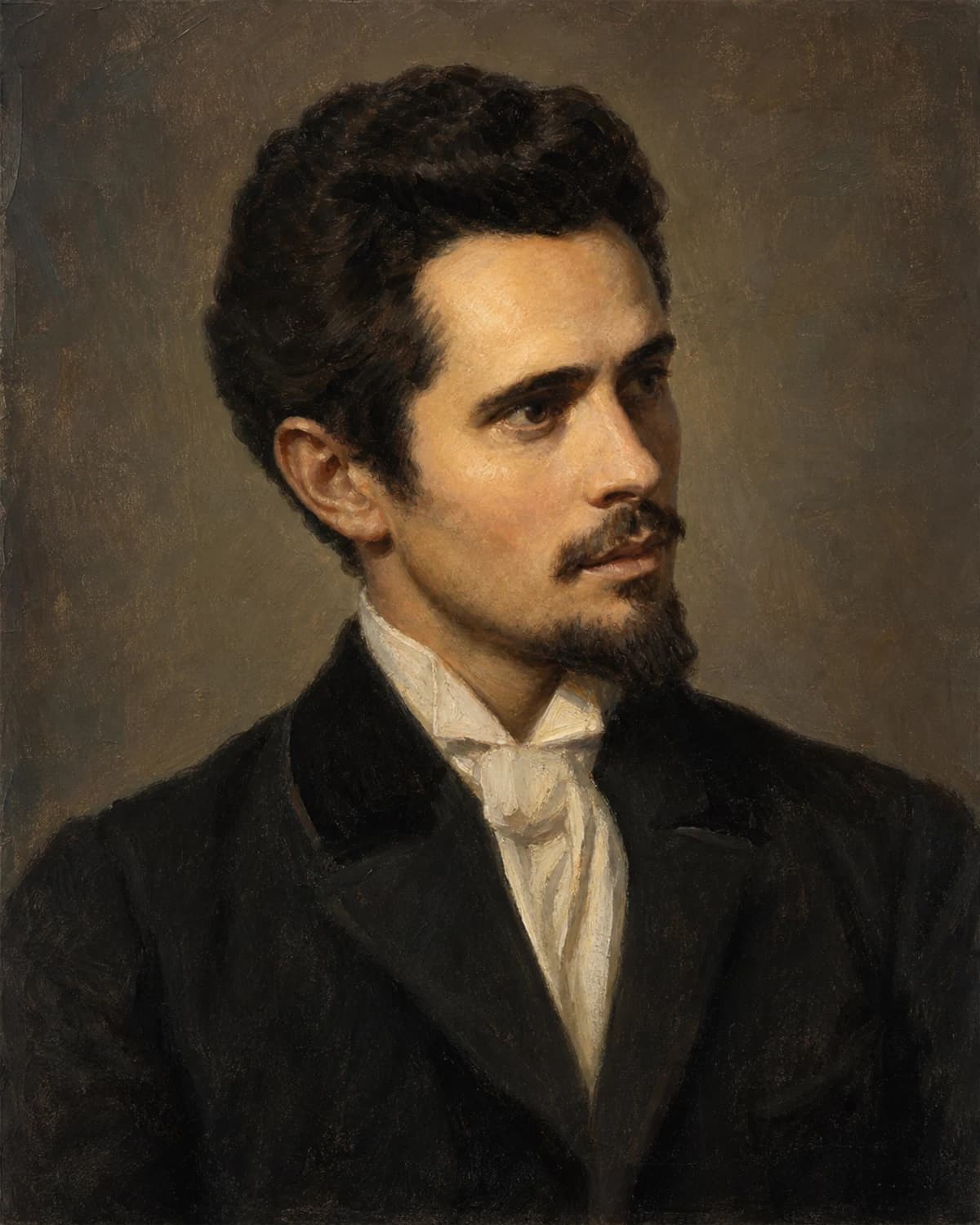
Biography
One of Trush’s best-known motifs is the lone pine: broad, spreading, battered by winds and scorched by the sun. He returned to it in several landscapes with the same title, and art historians see in the tree an image of the painter himself. That reading seems plausible to me, but Trush himself, as far as is known, never said anything of the kind.
He was born on 18 January 1869 in the village of Vysotsko near Brody, in what was then Austria-Hungary. He studied at the Brody gymnasium in 1881–1889. The sources differ on small points: by some accounts he was born on 17 January, and Brody is sometimes given as the place of birth; here the date of 18 January and the village of Vysotsko are accepted.
From 1891 he studied at the School of Fine Arts in Kraków, where his teachers are named as Leon Wyczółkowski and Jan Stanisławski (by another account, also Jan Matejko). In Kraków he became friends with the writer Vasyl Stefanyk. In 1894 he worked in Vienna, and in 1897, having received a scholarship, in Munich under Anton Ažbe.
From 1898 Trush lived in Lviv and quickly entered Ukrainian public life: he grew close to Ivan Franko and began working for the Shevchenko Scientific Society, for which he painted mainly portraits. His first exhibition took place in Lviv in 1899 (by other accounts, 1898). After that he exhibited almost every year with Ukrainian and Polish painters: in Kyiv, Poltava, Kraków, Poznań, Warsaw, London, Vienna and Sofia. On the society’s commission he travelled to Dnieper Ukraine and made acquaintances there among artists and cultural figures. In 1900, at the invitation of Olena Pchilka, he went to the Poltava region, and at the Drahomanov estate in Hadiach he met Ariadna, the daughter of the historian and political writer Mykhailo Drahomanov. They were married in Kyiv on 21 January 1904.
He travelled widely: to the Crimea (1901–1904), Italy (1902 and 1908), Egypt and Palestine (1912). These journeys produced his Crimean, Venetian and Egyptian landscapes and genre scenes such as “Arabs on the Road”.
Trush worked at organising as much as with the brush. In 1898 he founded the Society for the Development of Rus’ Art (in the Galician usage of the time, “Rus’” meant Ukrainian), and in 1905 the Society of Friends of Ukrainian Literature, Science and Art, under which the first “Exhibition of Ukrainian Artists” was held. Kyiv artists took part too: Mykhailo Zhuk, Mykola Burachek and Fotii Krasytsky. In the same year, together with the composer Stanyslav Liudkevych, he published “Artystychnyi visnyk”, the first Ukrainian journal about art. He gave public lectures on art and literature and wrote critical articles for “Budushchnist”, “Literaturno-naukovyi visnyk”, “Moloda Ukraina”, “Dilo” and the German-language journal “Ukrainische Rundschau”; in 1958 these were collected in the book “Trush on Art and Literature”. By some accounts, from 1912 he taught at the Free Academy of Fine Arts in Lviv. Together with the ethnographers, Franko and the first director, Illarion Svientsitsky, he took part in founding the National Museum in Lviv.
As a painter he is called an Impressionist, a lyricist and a colourist. His brushwork is rich; the colour in early works is bright, in later ones more restrained and toned. Among the landscapes are “Sunset in the Forest” (1904), “The Dnieper near Kyiv” (1910), “Haycocks by the Forest” (1919), “In the Embrace of Snow” and “Moonlit Night over the Sea” (both 1925), and the cycle “The Life of Tree Stumps” (1929). There were also views of Kyiv with St Michael’s Cathedral and St Andrew’s Church. In “The Trembita Players” the Hutsuls, a highland people of the Carpathians, stand as monumental figures merging with the mountain landscape; in “Hutsul Woman with a Child” (1912) the figures are set against dense green and the blue of a fading day.
His portraits are psychologically restrained: Franko, Stefanyk, Mykhailo Drahomanov, Mykola Lysenko, Cardinal Sylvester Sembratovych, the painter’s wife. His portrait of Lesya Ukrainka of 1900 is kept to a muted palette: plain clothes, ordinary features, large attentive eyes. Also known is his portrait of Kateryna Hrushevska, called the “Ukrainian infanta” in art-historical writing.
The total number of his works is estimated at six thousand or more. Trush died in Lviv on 22 March 1941 and was buried in the Lychakiv Cemetery. Right after his death, the same year, a large retrospective exhibition was held in Lviv. In the villa designed by Oleksandr Lushpynsky, built in 1910 and the family home until 1941, a memorial museum was opened in 1986. His sons Myron and Roman became known as archers.
Related context
Associations
Works connected through artistic movements, cultural context and period. Priced works available in this market appear first.








Profile notes
Profile and sources
Image
Artist image
На основе открытого изображения: Unknown author Unknown author; Wikimedia Commons; Public domain.
