
13.01.1832–08.03.1898
Ivan Shishkin
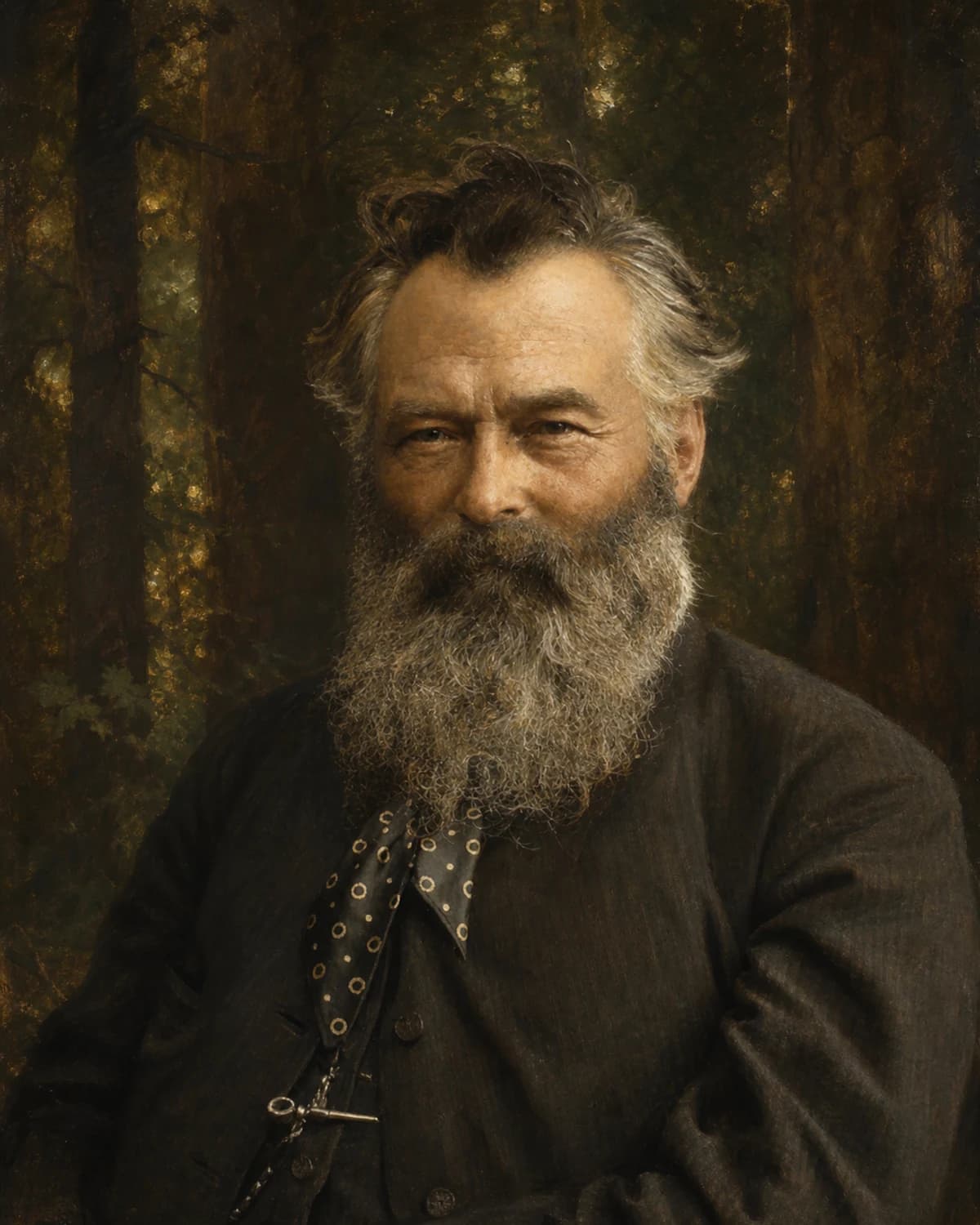
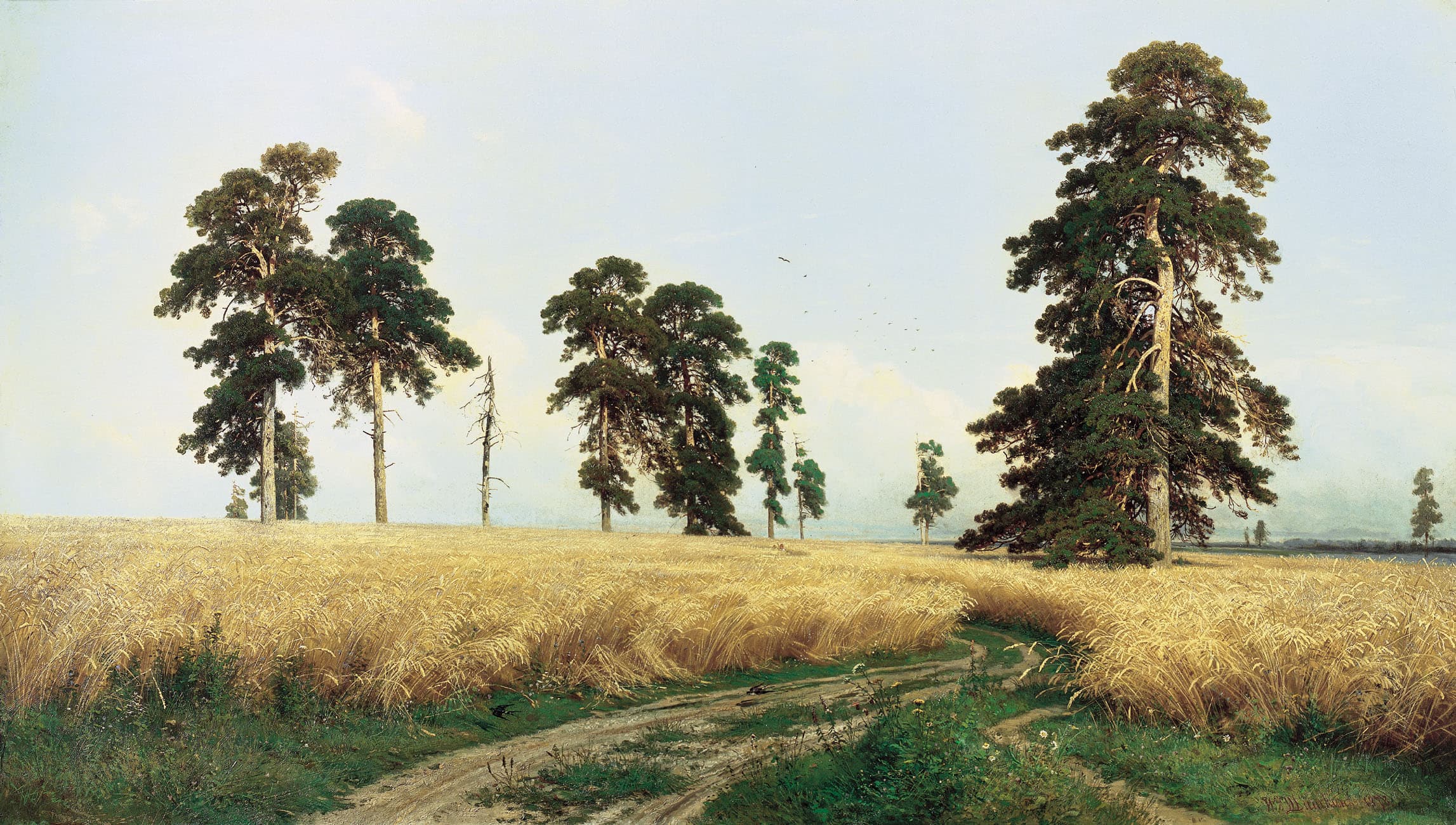
Ivan Shishkin, a merchant's son from Yelabuga, painted forests in such detail that in his pictures you can tell the kinds of trees, the ferns, the deadwood and the soil beneath them. He studied in Moscow, at the St Petersburg Academy and under the animal painter Rudolf Koller in Zurich, was one of the founders of the Peredvizhniki and made about a hundred etchings. The bears in his “Morning in a Pine Forest” were painted by Konstantin Savitsky.
Biography
On the canvas of “Morning in a Pine Forest”, almost a metre and a half by more than two, there were at first no bears at all. Konstantin Savitsky suggested adding them and, at the request of Shishkin, who did not much trust himself as an animal painter, painted the family of bears himself, playing among the fallen pines. The picture was signed by both. When Pavel Tretyakov bought it, he erased Savitsky's signature.
In the early 1890s the Einem factory began making sweets called “Mishka Kosolapy”, the Clumsy Bear, and in 1913 the artist Manuil Andreev put the subject of the painting on the wrapper.
Shishkin was born on 13 (25) January 1832 in Yelabuga, into the family of a grain merchant, Ivan Vasilyevich Shishkin; his grandfather, a palace peasant, had registered as a Yelabuga merchant in 1792. At twelve the boy was sent to the First Kazan Gymnasium, but after five years there he went back home and lived in Yelabuga for four years. In 1852 he entered the Moscow School of Painting and Sculpture, where in 1853 he made his first etching, “Mountain Road”. In 1857 he moved to the Academy of Arts, to the class of the landscape painter Sokrat Vorobiev. With his fellow students Alexander Gine and Pavel Dzhogin he worked in the summers at Dubki near Sestroretsk, and later all three went to Valaam. For his Valaam pictures Shishkin won medal after medal: the large silver for “Pine on Valaam” (1858), the small gold for “Gorge on Valaam” (1859), the large gold for “View on the Island of Valaam. Kukko Locality” (1860). The Academy Council separately awarded the three friends 150 silver roubles for their experiments in lithography.
The large gold medal carried the right to a study trip abroad at the Academy's expense, and in 1861 he went to Munich, to the studios of the Adam brothers, well-known animal painters. In 1863 he moved to Zurich to work with Rudolf Koller and drew animals there from life. There, too, he first tried etching a copper plate with aqua regia. He went to Geneva to look at François Diday and Alexandre Calame, and in 1864–1865 he lived in Düsseldorf. “View in the Environs of Düsseldorf”, painted there on commission for the collector Bykov, earned him the title of academician, and his pen drawings were hung in the Düsseldorf museum next to sheets by Andreas Achenbach and Carl Friedrich Lessing. It strikes me as funny that after studying with Koller he still asked someone else to paint the bears for his best-known picture.
In 1866, homesick for Russia, he came back before his time was up. Two years later the Academy awarded him the title of professor for “Pine Forest” and the picture “Rather than Take the Bridge, Let's Look for a Ford”, but the President of the Academy, Grand Duchess Maria Nikolaevna, gave him the Order of St Stanislaus, third class, instead of the title. He became a professor only in 1873, for “Forest Wilderness”.
On 28 October 1868 Shishkin married Evgenia Vasilyeva, the sister of the landscape painter Fyodor Vasilyev. He painted her in “Lady with a Dog” (1868) and “Before the Mirror. Reading a Letter” (1870). Of their three children only their daughter Lidia survived, and Evgenia Alexandrovna herself died in 1874. His second wife was a pupil of his, the landscape painter Olga Lagoda; in 1881 their daughter Ksenia was born, and in the same year Olga Antonovna died.
In 1870 he was among the founders of the Association of Travelling Art Exhibitions, and in 1871 of the Society of Russian Aquafortists. He never gave up etching after that and spent almost as much time on it as on painting. By D. A. Rovinsky's count, Shishkin made a hundred etchings and sixty-eight lithographs, and besides the needle he used soft ground, aquatint and drypoint. In 1873 he printed the album “Engravings on Copper in Aqua Fortis” himself, then brought out three more, the last of them, “60 Etchings”, in December 1894. Critics wrote that his gift shows more clearly in the single-colour sheets than in oil, where precise drawing sometimes overshadows mood. To my mind it is hard to argue with that if you put one of his etchings next to a large canvas of the 1870s.
In the 1880s his painting became freer: “Stream in a Forest (On the Hillside)” (1880), “Nature Reserve. Pine Forest” (1881), “In a Pine Forest” (1887), “Rain in an Oak Forest” (1891). He painted the Baltic coast, Siverskaya, Merreküll, the forest near Yelabuga; he had a dacha in the village of Vyra near St Petersburg. In 1892 he was invited to head the landscape studio at the Academy, but he did not stay long in the post.
Shishkin died in St Petersburg on 8 (20) March 1898, sitting at his easel in front of a new picture. He was buried in the Smolensky Cemetery; in 1950 his remains and tombstone were moved to the Tikhvin Cemetery of the Alexander Nevsky Lavra.
Artist works
Works by the artist
Works by Ivan Shishkin available in this edition of NEOARCA.
Related context
Associations
Works connected through artistic movements, cultural context and period. Priced works available in this market appear first.








Profile notes
Profile and sources
Image
Artist image
На основе открытого изображения: Maxim Petrovich Dmitriev; Wikimedia Commons; Public domain.
