
07.05.1874–1945
Ivan Popov
Ivan Popov (1874–1945) grew up in the family of a Yakut priest, studied drawing in St Petersburg under Aleksandr Makovsky and opened the first icon-painting and art workshop in Yakutsk. Between about 1910 and 1914 he travelled on ethnographic expeditions across Yakutia and Buryatia, photographing and collecting for museums in the capital and in Germany. In January 1945 he was named People’s Artist of the Yakut Autonomous Soviet Socialist Republic.
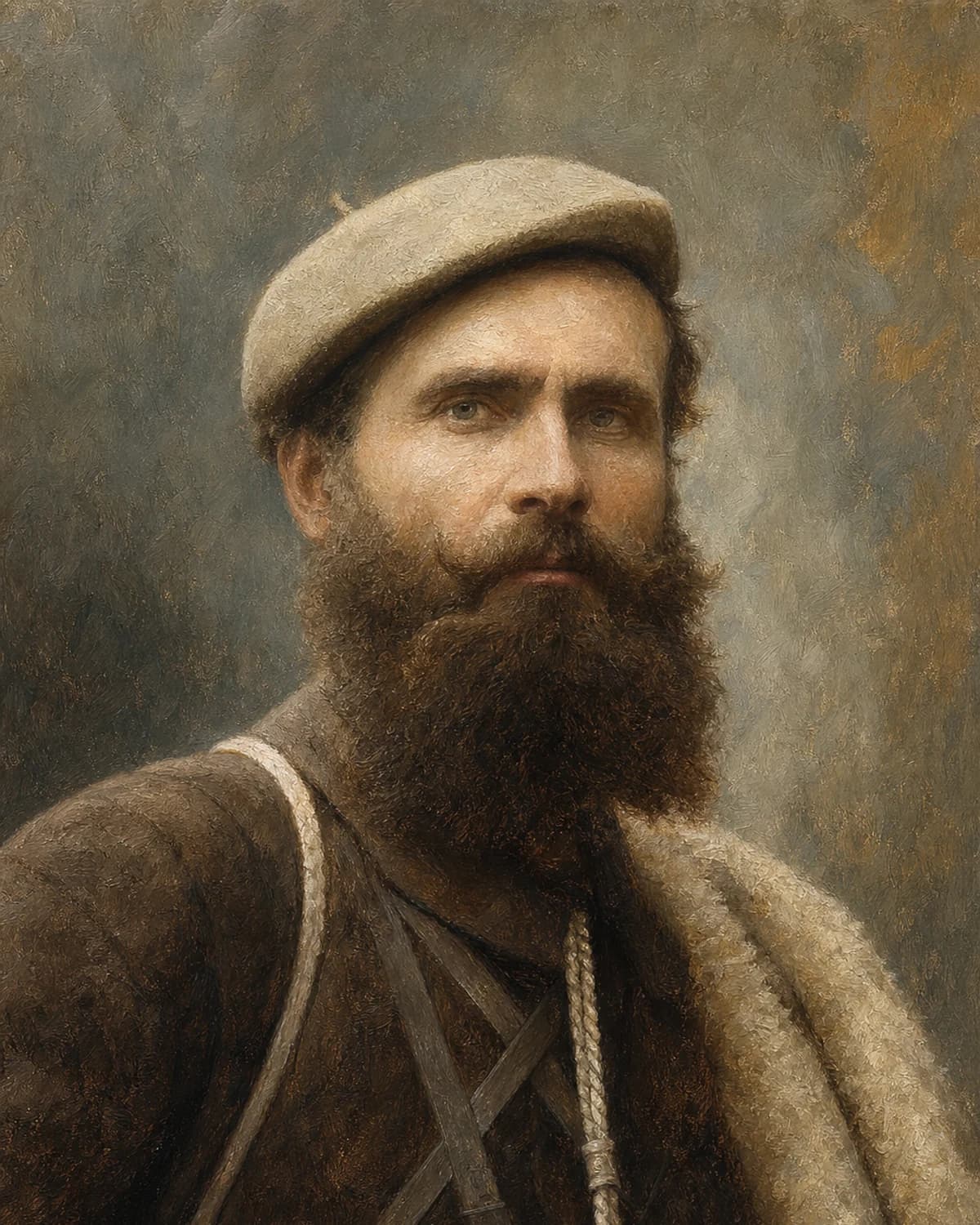
Biography
In 1914 Ivan Popov sent five crates containing 1,226 objects of Yakut everyday life to ethnographic museums in Berlin, Hamburg, Leipzig and Frankfurt. Shortly before, he had still been photographing landscapes and people in traditional dress with a small German camera, and in 1914 he stopped photographing. Why, I do not know: I have found no documents that would explain it.
He was born on 7 May 1874 (25 April, Old Style) in the selo of Ytyk-Kyuyol in the Tattinsky ulus of Yakutsk Oblast, into the family of a priest, Vasily Stepanovich Popov, and Kapitolina Dimitrianovna. His grandfather, Dimitrian Dmitrievich Popov, was a well-known educator in the region and encouraged the boy’s urge to draw. He recorded local words, and these notes helped the exiled linguist Eduard Pekarsky to compile the first Yakut-Russian dictionary. Ivan’s brother, Panteleimon Vasilievich Popov, also left a mark on local studies.
There was no one in Yakutia at the time to teach painting, and he began as a self-taught artist. His first schooling was at the Yakutsk Theological Seminary. From 1891 he served as a psalmist (a church reader and cantor) in various churches. In 1900 he taught drawing at the same seminary while remaining psalmist at the prison church. In 1902 he was assigned to the Kholguma church, but soon the diocesan authorities sent him for a year to Moscow and St Petersburg to study icon painting.
In the capital he stayed for a long time. He studied in the studio of Aleksandr Vasilievich Makovsky in 1903–1905, 1909–1910 and 1912–1915, returning there with breaks, between trips home. Back in Yakutsk, he opened the town’s first icon-painting and art workshop. In 1911–1912 he painted the iconostasis of the Tattinsky Church of St Nicholas.
From 1905 Popov collected ethnographic material for St Petersburg museums. What interested him most was the excavation of ancient graves: he described Yakut burials with great care. To the Archaeological Commission he sent many photographs, drawings and plans of old churches and monuments of the region. From about 1910 to 1914 he worked on expeditions across Yakutia and Buryatia for the ethnographic department of the Alexander III Museum (now the Russian Museum of Ethnography) and for the Kunstkamera, the St Petersburg museum of anthropology and ethnography. He photographed landscapes, daily life and people, sketched household objects, and collected silver, furs, pottery, toys and parts of shamanic costume. Postcards with views of Yakutia made from his photographs were printed by the Moscow firm Scherer, Nabholz & Co. He also recorded oral tradition and folklore.
In the mid-1930s Ivan Vasilievich, like his brother, joined the research society Sakha Keskile (“The Future of the Yakuts”). Little detail survives about the last decades of his life. He worked as a meteorologist during the war.
In January 1945 he was named People’s Artist of the Yakut Autonomous Soviet Socialist Republic, an honorary Soviet title. He died on 8 October 1945, of exhaustion.
Solo exhibitions were held in Yakutsk after his death, in 1953, 1974, 1994 and 1999. His work was shown in Moscow at exhibitions of Yakut art (1957, 1963, 2002), at a travelling exhibition through the cities of the Russian Soviet Federative Socialist Republic in 1963–1964, and at an exhibition of artists from the autonomous republics in 1971. It is held in the National Art Museum of the Sakha Republic (Yakutia), in museums in St Petersburg, Hamburg and Dresden, and in private collections. In 2022 the film “Don’t Bury Me Without Ivan”, based on motifs from his life, was released. His son Ivan also became an artist.
Related context
Associations
Works connected through artistic movements, cultural context and period. Priced works available in this market appear first.








Profile notes
Profile and sources
Image
Artist image
На основе открытого изображения: Unknown author Unknown author; Wikimedia Commons; Public domain.
