
12.05.1936–present
Ivan Marchuk
Ivan Marchuk (born 1936) paints in a technique he himself named pliontanism, from the Ukrainian “pliontaty”, to weave: the image is built up from a great many thin strokes that look like interlaced threads. For almost a quarter of a century he worked in Kyiv without recognition from the Union of Artists; in 1989–2001 he lived in Australia, Canada and the United States, and in 1997 he received the Shevchenko National Prize of Ukraine.
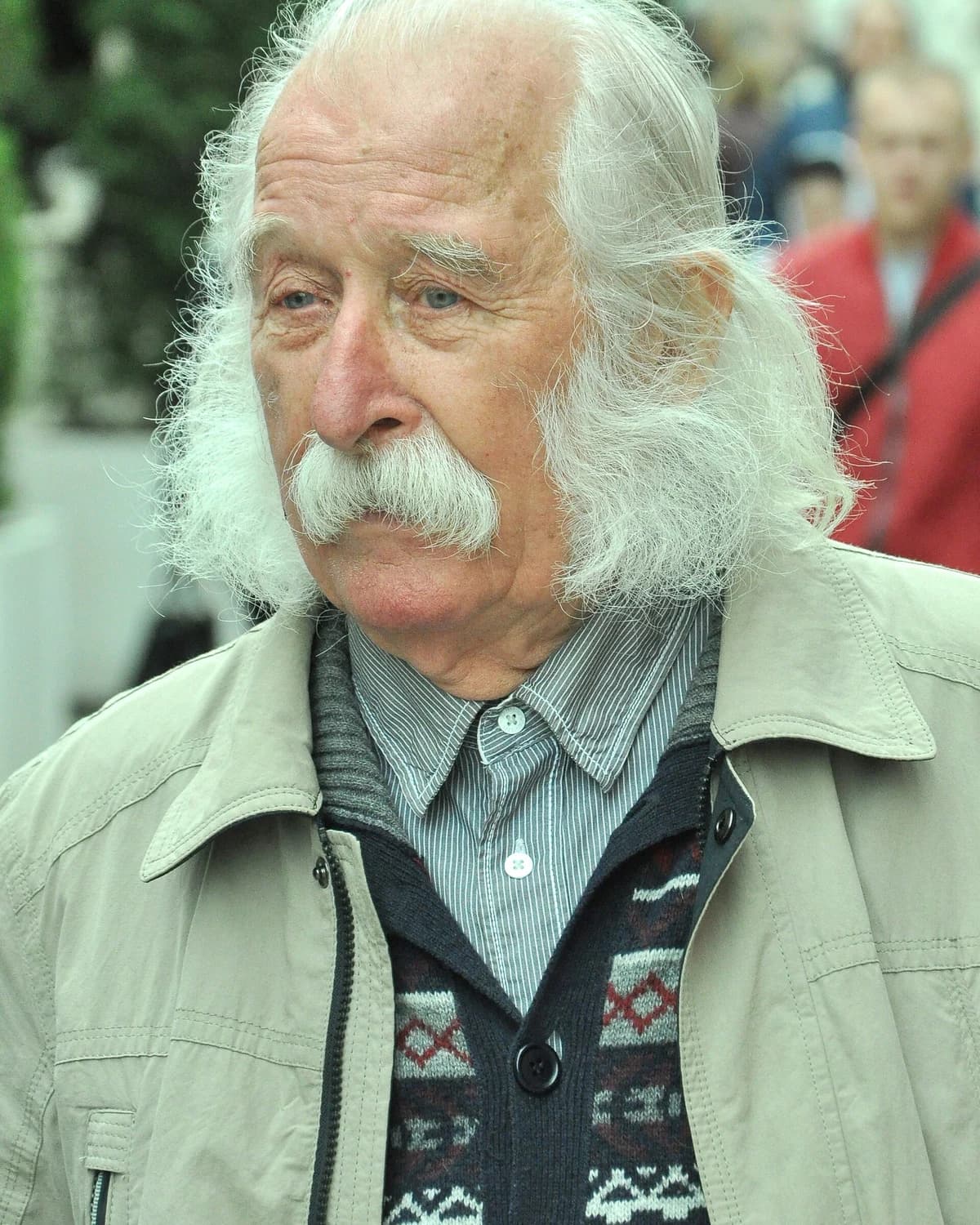
Biography
The Ukrainian verb “pliontaty” means to weave or plait. From it Ivan Marchuk derived the name of his technique, pliontanism: a picture is made up of a great many thin strokes that intertwine like threads. He coined the word himself. When his painting is classed as hyperrealism, the artist disagrees.
This way of painting took shape around 1965, when Marchuk was twenty-nine, and it did not fit into socialist realism at all.
Marchuk was born on 12 May 1936 in the village of Moskalivka, which then belonged to Kremenets County in the Volhynian Voivodeship of Poland and is now in the Ternopil region of Ukraine. His father was a weaver known throughout the district, and the boy helped him at work. He drew from childhood, and when paints and paper ran short he made do with the juice of flowers, grass and fruit. His parents saw him as a surgeon or a biologist but did not argue. After seven years of school, in 1951–1956, he studied in the decorative painting department of the Ivan Trush Lviv School of Applied Arts, where Karlo Zvirynskyi was among the teachers. From 1959, for almost ten years, Marchuk attended the underground school that Zvirynskyi had set up: at its meetings the members were introduced to unofficial art, world literature and music, religion and the suppressed pages of Ukrainian history. After military service he graduated from the ceramics department of the Lviv Institute of Applied and Decorative Arts (1965), where he studied under Roman Selskyi and Danylo Dovboshynskyi.
In 1965 he moved to Kyiv. For three years he worked at the Institute of Superhard Materials of the Academy of Sciences, was poorly paid and earned extra with drawings for the magazines “Ukraina”, “Vitchyzna” and “Kyiv”. In 1968 he sold his first work; it was bought by Yuriy Shcherbak. From 1968 to 1984 he was employed at the Kyiv Combine of Monumental and Decorative Art: he dealt quickly with production orders and gave the rest of his time to his own work, trying out ink and tempera. This is how his first cycle, “Voice of My Soul”, came about, and the others later grew out of it. The Union of Artists would not admit him as a member; without membership he could neither exhibit nor sell. In the 1970s the KGB harassed him with particular persistence: both his dark palette and his Ukrainian subjects were regarded as suspect. He is often compared with the American Mark Tobey, who worked in a similar manner in the 1950s; Marchuk knew nothing of Tobey at the time, and the resemblance, to my mind, points to a similar aim, with no influence at all.
In 1979 his paintings were included in the first exhibition of Ukrainian nonconformist artists, which young émigrés showed in Paris, Munich, New York and London. There they caught the eye of Roland Penrose, Picasso’s biographer. The same year he had a solo exhibition in Moscow, on Malaya Gruzinskaya Street, and in 1980 his first exhibition in Kyiv, with the support of the writers Pavlo Zahrebelnyi and Dmytro Pavlychko. From 1984 Marchuk worked as a freelance artist.
In 1988 he was admitted to the Union of Artists, and that same year he visited Czechoslovakia. In 1989, with the help of a friend, the Australian artist Peter Kravchenko, he obtained a visa for Australia, where he was exhibited by the Ukrainian Artists Society of Australia and by galleries in Sydney; later he lived in Canada and the United States. In 1990 he came home on a visit, and his first official exhibition opened in Kyiv at the State Museum of Ukrainian Fine Arts (now the National Art Museum of Ukraine).
Recognition at home followed: in 1996 the title of Honoured Artist of Ukraine, in 1997 the Shevchenko National Prize for the cycles “Shevchenkiana” and “Voice of My Soul”, in 2002 the title of People’s Artist. In 2001 he returned to Kyiv and worked in a studio in the city centre. In 2006 the International Academy of Contemporary Art in Rome admitted him to its “Golden Guild”, and in 2007 the British newspaper The Daily Telegraph put him on its list of “100 living geniuses”. The artist divides his work into twelve cycles, among them “Blossoming”, “Landscape”, “Colour Preludes”, “White Planet”, “Dreams Overflow Their Banks” and “Gaze into Infinity”. In all he has made about five thousand works, and he has had more than a hundred and fifty solo exhibitions. He is an honorary citizen of Kyiv (2005), Ternopil (2008) and Kaniv (2018), holds the Order of Freedom (2016) and the Order of Prince Yaroslav the Wise, fifth class (2026), and in 2021 received the distinction “National Legend of Ukraine”. For his eightieth birthday in 2016 a postage stamp was issued with his painting “Tell Me the Truth”.
In 2022, after the start of the full-scale war, Marchuk left for Vienna, where in three years he painted about two hundred works. In February 2025 his exhibition “Epic Reality” opened at the Palazzo della Cancelleria in Rome, and in May the exhibition “Tell Me the Truth” in Vienna, with more than 450 paintings; a five-volume album-catalogue, “Voice of My Soul”, was published to accompany it. The same year the Ivan Marchuk Charitable Foundation was set up to preserve the artist’s legacy and create a museum for him. A museum in Kyiv had already been promised by Viktor Yushchenko in the mid-2000s, but at that time it was never built.
Profile notes
Profile and sources
Image
Artist image
Микола Василечко; Wikimedia Commons; CC BY-SA 4.0.
