
27.05.1837–24.03.1887
Ivan Kramskoi
Ivan Kramskoi (1837–1887) began as a retoucher of photographs in Ostrogozhsk and Kharkov, and in 1863, on behalf of fourteen graduates of the Academy of Arts, refused to paint a competition piece on a set subject. He founded the Artel of Artists, became the chief ideologist of the Peredvizhniki and painted “Christ in the Desert”, “Unknown Woman” and portraits of Tolstoy, Shishkin and Tretyakov.
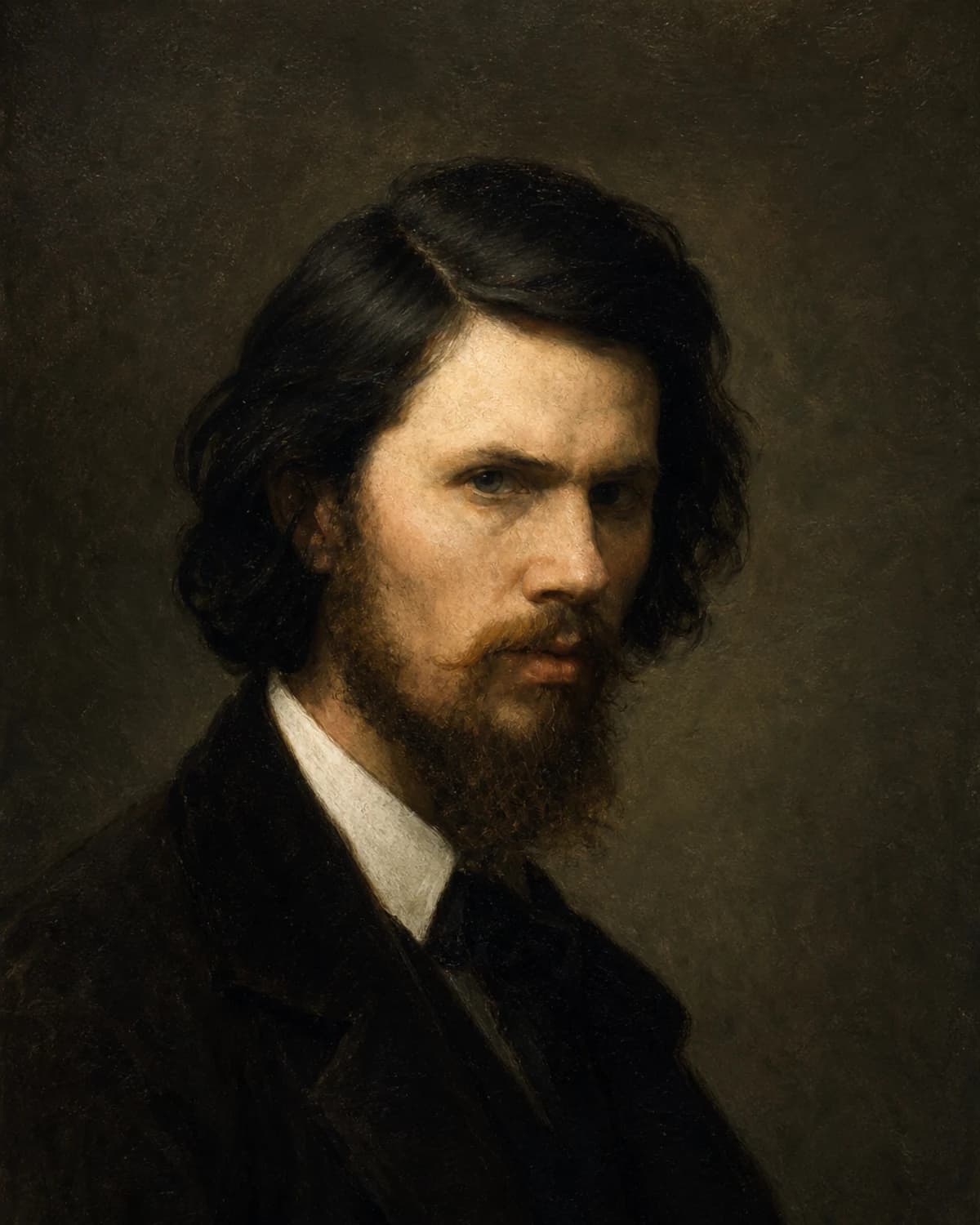
Biography
On 9 November 1863 Ivan Kramskoi addressed the council of the Academy of Arts on behalf of fourteen graduates competing for the large gold medal. They had been set a competition subject from the Scandinavian sagas, “The Feast in Valhalla”, and had asked to be allowed to choose their own subjects. The request was refused, and now the students, as Kramskoi put it, “most humbly request the council to release them from taking part in the competition”. That meant giving up the medal and the scholarship trip abroad.
When the council turned down their request for a free subject, Konstantin Thon, the rector for architecture, remarked: “Had this happened in former times, you would all have been sent to the army!”
Kramskoi was twenty-six at the time. He was born on 27 May (8 June) 1837 in Ostrogozhsk, Voronezh province, into a petty-bourgeois family; his father was a clerk at the town council, and Ivan was the youngest son. At fifteen the boy was apprenticed to an icon painter; after the district school he worked as a copying clerk at the same council, and from 1853 he took up retouching photographs. A fellow townsman, Mikhail Tulinov, taught him to finish photographic portraits with watercolour and retouching; then came work for the Kharkov photographer Yakov Danilevsky. In 1856 Kramskoi moved to St Petersburg and did retouching at the studios of Andrei Denier and Ivan Alexandrovsky, both well known at the time. It seems to me that those years spent over other people’s faces, when every feature had to be made out and strengthened, explain a good deal about his later portraits. In 1857 he entered the Academy as a pupil of Alexei Markov, professor of history painting, and in 1863 received the small gold medal for “Moses Bringing Forth Water from the Rock”.
The artists who had left the Academy set up the Artel of Artists in St Petersburg, which lasted until 1871. In October 1863 Kramskoi married Sofia Nikolayevna Prokhorova. From that year until 1868 he taught at the Drawing School of the Society for the Encouragement of Artists. In 1865 Markov, his former teacher, asked him to help paint the dome of the Cathedral of Christ the Saviour in Moscow; the professor was ill, and in the end the main painting of the dome was done by Kramskoi, Bogdan Venig and Nikolai Koshelev. In 1869 the rebel was made an academician.
The next step was the Association of Travelling Art Exhibitions, founded in 1870. Kramskoi was one of its chief organisers and, if you like, its voice: in letters and articles he argued that the artist bears a public responsibility and that art must be realist, moral and national. He also wrote as a critic, and these sharp, insistent judgements on art had a marked influence on Russian realism in the last third of the nineteenth century.
Portraits paid his way. Leo Tolstoy and Ivan Shishkin (both 1873), Pavel Tretyakov (1876) and Mikhail Saltykov-Shchedrin (1879) appeared, all now in the Tretyakov Gallery, while the Russian Museum holds a second portrait of Shishkin and the portrait of the physician Sergei Botkin (both 1880). In 1871, ten years after the death of Taras Shevchenko, Kramskoi painted his portrait, which became very popular. He painted peasants as well. His clients grew in number, members of the imperial family among them, and by the end of his life the artist was comfortably off. Contemporaries thought him an eccentric: he handed clients their pictures in expensive frames and took no money for the frame.
“Christ in the Desert” (1872) remains one of his best-known pictures: Christ seated on stones, his fingers clasped, the empty, cold expanse around him. Here Kramskoi continued the line of Alexander Ivanov, turning a Gospel subject into a discussion of moral choice. Later he found a form somewhere between portrait and genre painting: “Nekrasov in the Period of ‘Last Songs’” (1877–1878), “Unknown Woman” (1883), “Inconsolable Grief” (1884). All three are in the Tretyakov Gallery.
His pupils included Ilya Repin and Yelena Polenova. In 1881 Kramskoi bought land near Siverskaya station, on the right bank of the Oredezh, and built a dacha with a studio there.
He died on 24 March (5 April) 1887 in St Petersburg, at work on a portrait of Dr Karl Rauchfuss. He was buried in the Smolensky Orthodox Cemetery, and in 1939 his remains were moved to the Tikhvin Cemetery of the Alexander Nevsky Lavra.
Related context
Associations
Works connected through artistic movements, cultural context and period. Priced works available in this market appear first.








Profile notes
Profile and sources
Image
Artist image
На основе открытого изображения: Ivan Kramskoi; Wikimedia Commons; Public domain.
