
05.11.1873–29.12.1954
Ivan Goryushkin-Sorokopudov
Ivan Goryushkin-Sorokopudov (1873–1954) grew up an orphan in a barge hauler’s family, waited on Volga steamboats as a teenager, and later studied in Ilya Repin’s studio at the Academy of Arts. From 1908 until shortly before his death he taught at the Penza art school, and in 1942–1947 he headed the Penza picture gallery. He painted scenes of old Russia, portraits and landscapes.
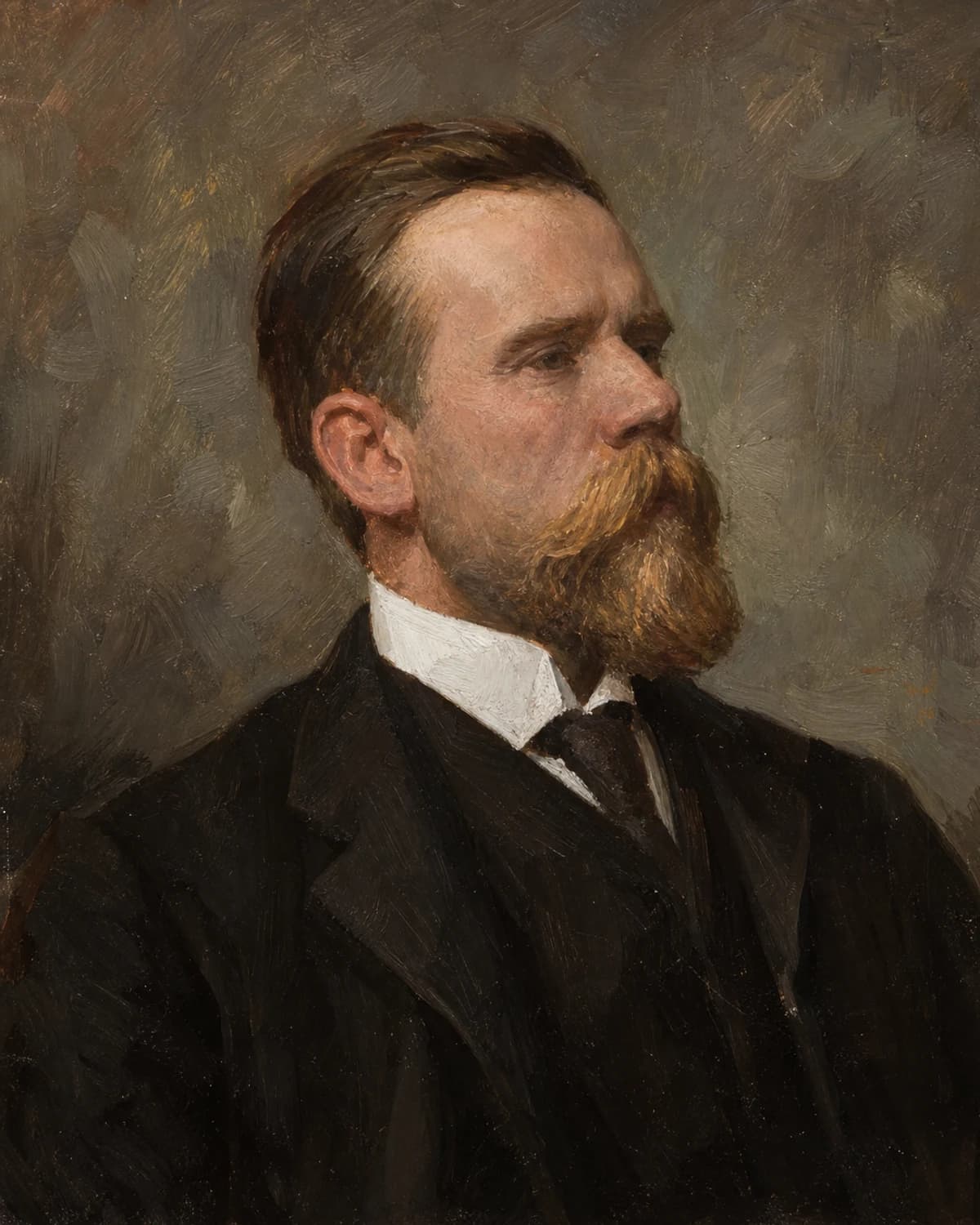
Biography
A boy at the buffet on a Volga steamboat: that was where the future pupil of Repin began. His father, Sila Goryushkin, was a soldier and a burlak (a barge hauler on the Volga), and the boy was orphaned early. By some accounts, he was six when his father drowned. He was brought up by distant relatives, the Sorokopudovs, townspeople of Saratov, hence the double surname.
He was born on 5 November 1873 (24 October, Old Style) in the village of Nashchi in Tambov Governorate. By some accounts his birthday is 27 November; in the text I keep 5 November.
He began drawing in his youth, while working on the steamboats. On the advice of Pavel Pyasetsky, a traveller in Mongolia, China and Eastern Siberia, he went to Astrakhan to study with Pavel Vlasov, around 1890–1892 (the years differ between sources; 1893–1894 is also given). Boris Kustodiev, Alexander Vakhrameev and Illarion Elatontsev studied alongside him. Then came St Petersburg: in 1892–1895 he attended the drawing school of the Imperial Society for the Encouragement of the Arts, and from 1897 to 1902 he studied at the Academy of Arts under Pavel Kovalevsky and Vasily Mathé, and from 1899 also in Ilya Repin’s studio. His fellow students included Ivan Bilibin, Kustodiev, Konstantin Somov, Isaak Brodsky and Fedot Sychkov. In 1902 the Academy awarded him its first prize for the painting “Beyond the Walls of the Quiet Convent”. His diploma work was “At a Concert in Pavlovsk” (1902).
From 1897 he exhibited: at the Academy of Arts, at the Society for the Encouragement of the Arts, at the Society of Russian Watercolourists. He worked a great deal for magazines, among them Niva and Capital and Country Estate. For books he drew illustrations to Pavel Melnikov-Pechersky’s “In the Forests” (1909) and to Alexei Konstantinovich Tolstoy’s “Prince Serebrenni” (1908–1910). In 1906, together with Vakhrameev, Nikolai Petrov, Dmitry Kardovsky and others, he took part in producing the magazine Gamayun, which the censors banned.
His early subjects are almost all from Russia before Peter the Great: “The Prince at Mass”, “A Woman of the Time of the Most Quiet Tsar”, “Easter Eve in Olden Times”, “Giving Alms on Holy Night in Old Russia”, “The Lament of Yaroslavna”. The large later canvases “A Scene from the Seventeenth Century”, “From Age to Age”, “Market Day in an Old Town” and “Trial by God” belong to the same line. Alongside them come portraits: of his wife, of his wife’s mother Claudia, of the actress Alexandra Sobolshchikova-Samarina, of Princess Mansyreva, a self-portrait, and “Girl in the Sun”.
He painted the revolution of 1905–1907 too: “Barricades. 1905”, “The Sacking of a Landowner’s Estate”, “Shlisselburg Prison”. A later version of the last, “The Prisoners Were Brought In”, is dated 1932.
From 1903 to 1908 Goryushkin-Sorokopudov taught at the drawing school of the Society for the Encouragement of the Arts; in 1908 he left the capital and moved to the neighbourhood of Penza, where he became a teacher at the art school. He spent most of his life there: in 1908–1930 and 1932–1954, with a break when the Soviet authorities removed him from teaching. The sources do not give the reasons for his removal. I find the title of his late memoir of his work in Petrograd in the 1920s curious: “For Realism, Put on Trial”. It was printed in the magazine Khudozhnik (The Artist) in 1963. In 1911, by some accounts, he visited France, Italy and the Netherlands.
During the First World War he painted “The Heroism of a Nurse” (1914–1916) and “The Prisoners Have Been Brought!” (1916). After the revolution he helped to organise branches of AKhRR and OMAKhRR in Penza, associations of artists, and exhibited in their shows. In the 1930s he painted several works about Lenin, among them “Lenin on the Rostrum” and “The Funeral of Vladimir Lenin”, a group portrait of Moscow artists, a portrait of Fedot Sychkov (1934), and the landscapes “Winter” (1936) and “Ivanovka” (1939). He painted Penza and its surroundings a great deal, as well as architectural views of Rostov the Great.
In 1942–1945 he was director of the Penza art school, and in 1942–1947 he headed the Penza picture gallery. In 1943 he received the title of Honoured Art Worker of the RSFSR and the Order of the Red Banner of Labour. Among his pupils are named Gabriel Gyurjyan, Viktor Pozdnov, Ivan Galaganov and Nina Gan.
He died on 29 December 1954 in the village of Ivanovka in Penza Oblast. He is buried in Penza at the Mitrofanovskoye cemetery, beside Konstantin Savitsky. Since 1966 the grave has been protected as a cultural heritage site of regional significance. The Penza picture gallery holds more than two hundred of his works, and a memorial museum to the artist has operated there since 1986.
Related context
Associations
Works connected through artistic movements, cultural context and period. Priced works available in this market appear first.








Profile notes
Profile and sources
Image
Artist image
На основе открытого изображения: Aleksandr Vakhrameev; Wikimedia Commons; Public domain.
