
21.10.1874–1939
Ivan Fedorovich Choultsé
Ivan Choultsé (1874–1939) trained as an engineer and took up painting seriously only after thirty, under Konstantin Kryzhitsky. He painted snow, water and moonlight, almost never people. He made his name in St Petersburg in the 1910s and, after emigrating, exhibited in Paris, London and New York, where he was called a “magician of light”. He died in Nice.
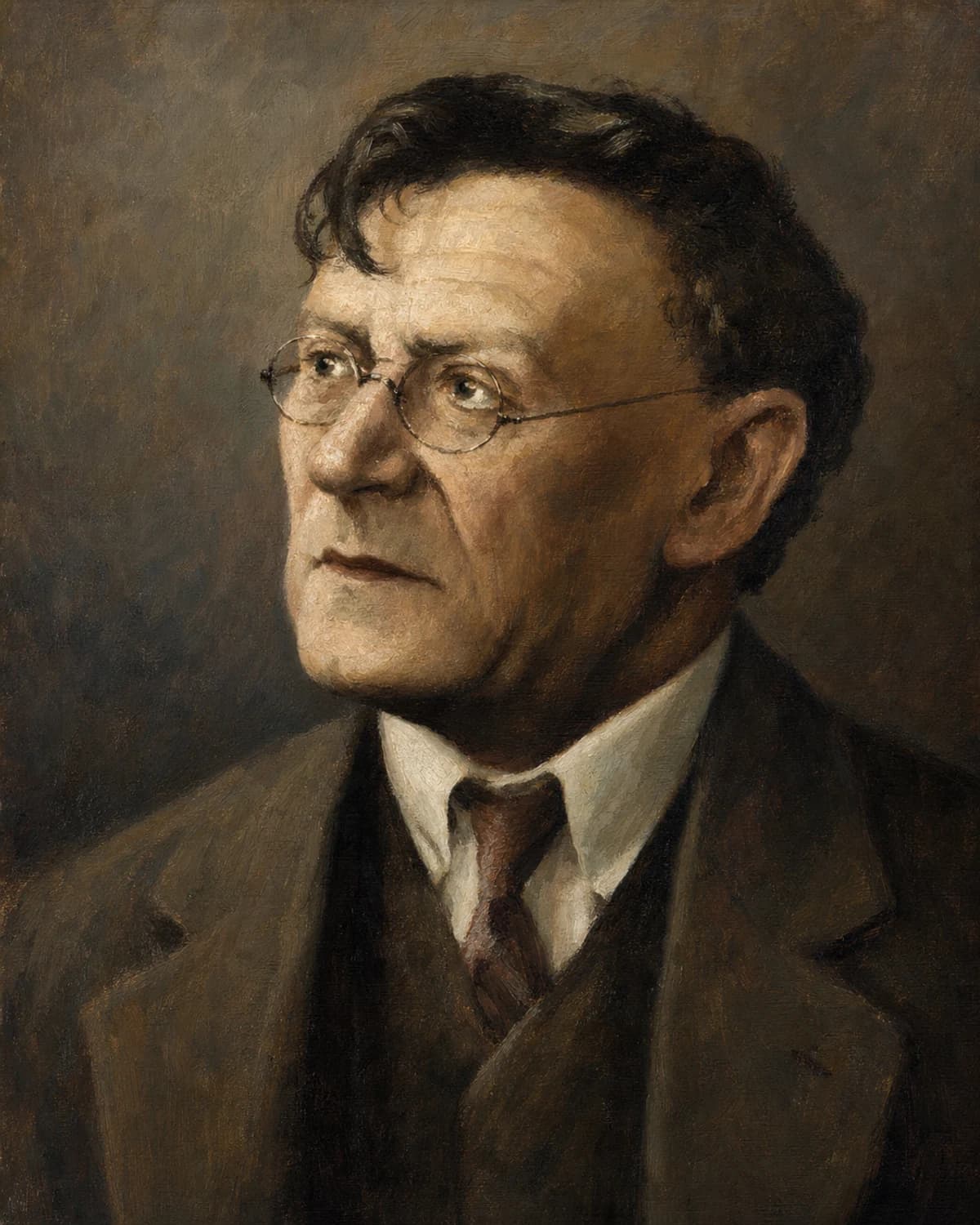
Biography
On 1 December 1928 an exhibition of landscapes by Ivan Choultsé, an émigré from St Petersburg, opened at Édouard Jonas’s gallery on East 56th Street in New York. The advertising slogan promised: “It must be seen to be believed.” The Toronto art dealer Blair Laing later recalled these snow scenes this way: the light in them seems to come from behind the canvas and glow from within.
The painter was fifty-four at the time. He had taken up the brush in earnest only after thirty.
Choultsé was born on 21 October 1874 in St Petersburg, into a German family that had lived in Russia so long it had become thoroughly Russian. He trained as an engineer and at first was more interested in electricity than in art. When he was already past thirty, he showed his first studies to Konstantin Kryzhitsky, a landscape painter and member of the Academy of Arts, who invited him to study with him. Besides Kryzhitsky, he was strongly influenced by Arkhip Kuindzhi and the Swiss painter Alexandre Calame. The apprenticeship did not last long: Kuindzhi died in 1910, and Kryzhitsky was gone in 1911.
In the late 1900s Choultsé went to Spitsbergen and brought back many Arctic landscapes: Danes Island and Bear Island, St Magdalene Bay. Accounts of the date of the trip differ, as do accounts of whether his teacher went with him.
After Kryzhitsky’s death one of his pupils, Grand Duchess Olga Alexandrovna, founded a society in his memory. Its exhibitions were held in her palace on Sergievskaya Street, and Choultsé took part in them more than once. By 1916 all of St Petersburg knew him. Members of the Romanov family bought his pictures, among them the Tsar’s brother, Grand Duke Michael Alexandrovich. Nicholas II himself, as the artist recalled in emigration, had no interest whatever in landscapes and still lifes: they told no story. Carl Fabergé acquired several works, as recorded in the 1918 inventory of his property. But what did most for Choultsé’s fame, to my mind, was postcards: his landscapes on these “open letters” travelled across the whole country, far beyond the exhibition halls.
From 1917 to 1919 he travelled in Europe, painting the Swiss Alps, the south of France and the north of Italy. In 1921 in Petrograd he joined the Society of Individualist Artists, whose members included Isaak Brodsky, Ivan Veltz, Julius Klever and Alexander Makovsky, and took part in the society’s first two exhibitions. This was his last attempt to find an audience in the new Russia. Soon afterwards he left for France for good.
In Paris Choultsé settled at 121 Boulevard Pereire. The city was crowded with artists, native and foreign, and it was hard to break through. His first solo exhibition, of fifty works, opened on 23 November 1922 in the rue La Boétie. The Léon Gérard gallery showed his “November Evening” at the 136th Salon in 1923 and “Last Rays” at the next one, the 137th. Until 1925 Gérard gave him a solo exhibition every year. At the end of 1927 the artist became a French citizen.
That same year, on 16 March 1927, an exhibition of his work opened in London at the Arthur Tooth & Sons gallery in New Bond Street, and The Studio magazine described it as a sensation in the old, classical genre of landscape. Following this, Édouard Jonas, who had showrooms in both Paris and New York, offered to represent Choultsé in America on an exclusive basis. Almost a year after the New York debut, from 15 November 1929 to 1 January 1930, Jonas showed sixty-eight of his paintings. They sold readily, and the works were dispersed across American cities and also to Canada, Argentina and Mexico. In 1935, when the retrospective “One Hundred and Fifty Years of Russian Painting” was on at the Hammer Galleries in New York, a critic for The New York Times once again called him a “magician of light”. In France he acquired imitators, who sometimes copied his compositions wholesale.
The world of his canvases is empty: no people, not even animals. Earth, sky, the moon, trees and, above all, snow and water. Winter landscapes are the most frequent, and often the place is Switzerland rather than Russia. Because of his attention to light and its effects, Choultsé’s painting is classed as luminism, which places him beside Kuindzhi and Kryzhitsky. According to Laing, critics of the day scorned these pictures as photographic and denied that they were art at all, while later the same manner came to be valued as “magic realism”.
In the mid-1930s Choultsé moved to Nice. The last reliable record of him dates from 7 March 1936: on that day the marine writer and painter Alexander Gefter saw him at a gathering of Russian émigrés at the Château Breton. After that the documents fall silent. In America, meanwhile, his work went on being shown: in New York in April 1936, in Oklahoma City in May and June 1938, and in New York again in 1940 and 1943.
Russian museums hold few of his paintings; among them are the collections of the Russian State Museum of the Arctic and Antarctic in St Petersburg and the Dagestan Museum of Fine Arts. In North America there are more: the Hillwood Museum in Washington, the Washington State University Museum of Art, the Indianapolis Museum of Art and the Montreal Museum of Fine Arts. Much remains in private hands. Since 2016, with the participation of the artist’s foundation in Zurich, exhibitions of his work have been held in Samara, Moscow, Nizhny Novgorod and Plyos.
On his grave in the Russian Orthodox cemetery of Caucade in Nice there is only the year of his death: 1939.
Related context
Associations
Works connected through artistic movements, cultural context and period. Priced works available in this market appear first.








Profile notes
Profile and sources
Image
Artist image
На основе открытого изображения: Miftakhova; Wikimedia Commons; CC BY-SA 4.0.
