
17.08.1855–25.12.1932
Ivan Bogdanov
The son of a Moscow tailor, Ivan Bogdanov (1855–1932) spent eleven years at the Moscow School of Painting, Sculpture and Architecture under Illarion Pryanishnikov and Vladimir Makovsky, and from 1895 belonged to the Wanderers. Pavel Tretyakov bought two of his paintings, “Settling Accounts” and “The Newcomer”. He lived among the Moscow urban poor and painted them, keeping his realist manner after the revolution and beyond.
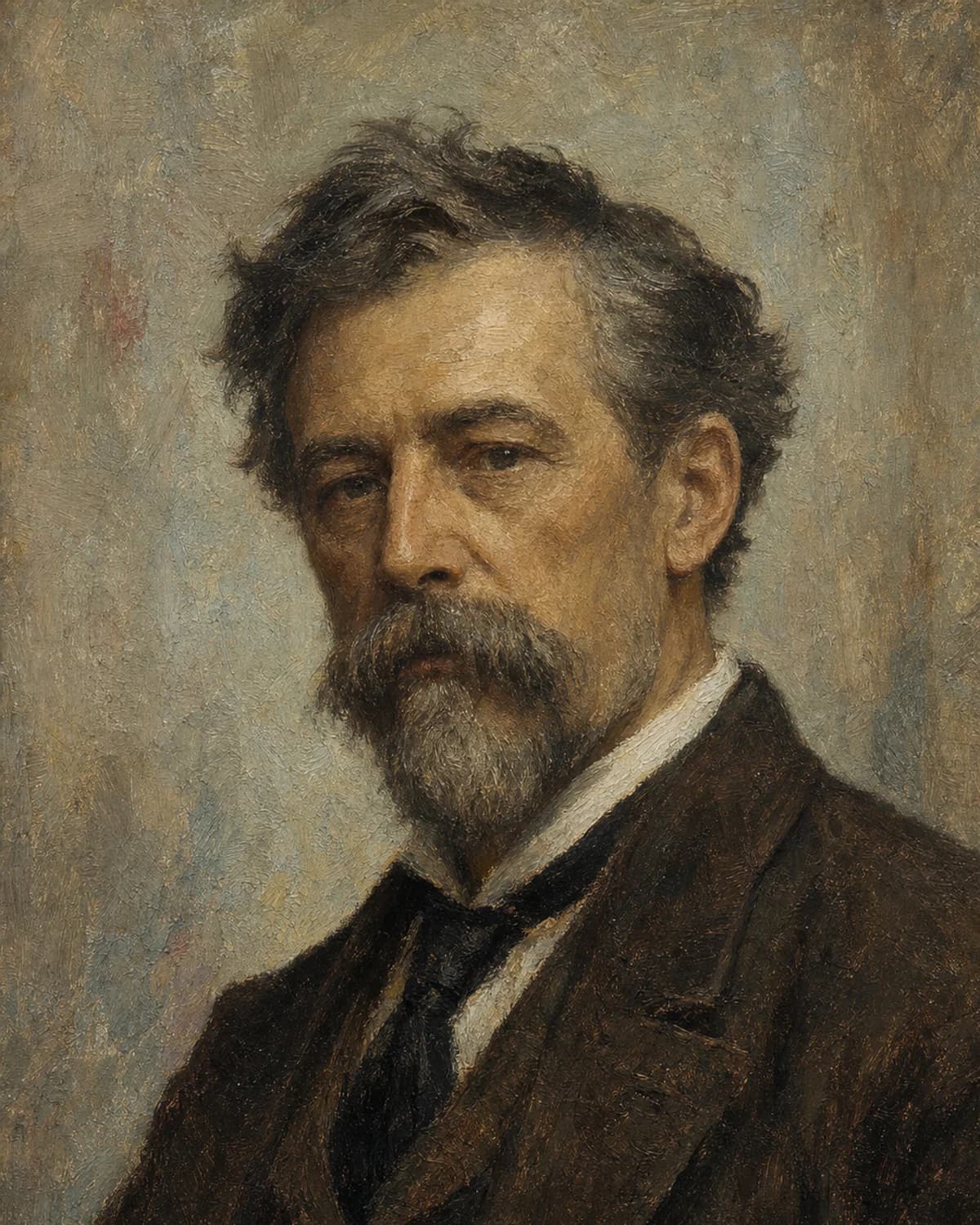
Biography
Two of Bogdanov’s paintings, “Settling Accounts” and “The Newcomer” (also called “Apprenticed”), were bought for his gallery by Pavel Tretyakov, the Moscow collector. For a painter who came from a family of craftsmen and had no patrons, this was perhaps the most weighty recognition he received.
Ivan Petrovich Bogdanov was born in Moscow on 29 August 1855 (17 August, Old Style). His father was a tailor.
In 1878 he entered the Moscow School of Painting, Sculpture and Architecture and stayed there until 1889, an unusually long time. His teachers were Illarion Pryanishnikov and Vladimir Makovsky, and Makovsky’s influence, according to his biographers, was especially strong. Both were Wanderers (the name given to members of the Society for Travelling Art Exhibitions, an association of realist painters that held exhibitions in cities across the country), and it was in this school that Bogdanov absorbed subjects from the lives of ordinary people. Already toward the end of his studies Makovsky took him on as an assistant: together they painted the murals in the Church of Christ the Saviour at Borki, near Kharkiv. From 1891 Bogdanov showed at the Wanderers’ exhibitions as a contributor, and in 1895 he was admitted as a member of the Society. Tretyakov’s purchases belong to this period. How his relations with the collector developed, and how much he was paid for these canvases, I could not establish; no documents about commissions or sales have come to light. He spent most of his life among the urban poor, near Maryina Roshcha, on Pereyaslavskaya Street, which ended at the railway tracks. He raised his son alone. This environment shows in his subjects too: a settling of accounts with an employer, a boy sent off to be apprenticed, that is, scenes from the lives of people he saw from his window and on the staircase of his own house.
The revolutions of the early twentieth century and the Civil War forced many Russian artists either to leave or to change their subjects and manner sharply. Bogdanov stayed in Russia and did not change his way of painting: he kept the traditional realist style, and in the 1920s produced genre paintings with a social theme, continuing the Wanderers’ motifs. A typical example from this time is the painting “By the Campfire”. It seems to me that the changes in his life showed more in his choice of subjects than in his painting technique, but it is hard to judge this from a few surviving descriptions.
In 1929 Bogdanov joined the Association of Artists of Realistic Art, a Moscow group of realist painters. He died in Moscow on 25 December 1932.
Related context
Associations
Works connected through artistic movements, cultural context and period. Priced works available in this market appear first.








Profile notes
Profile and sources
Image
Artist image
На основе открытого изображения: Ivan Bogdanov; Wikimedia Commons; Public domain.
