
18.11.1872–08.06.1944
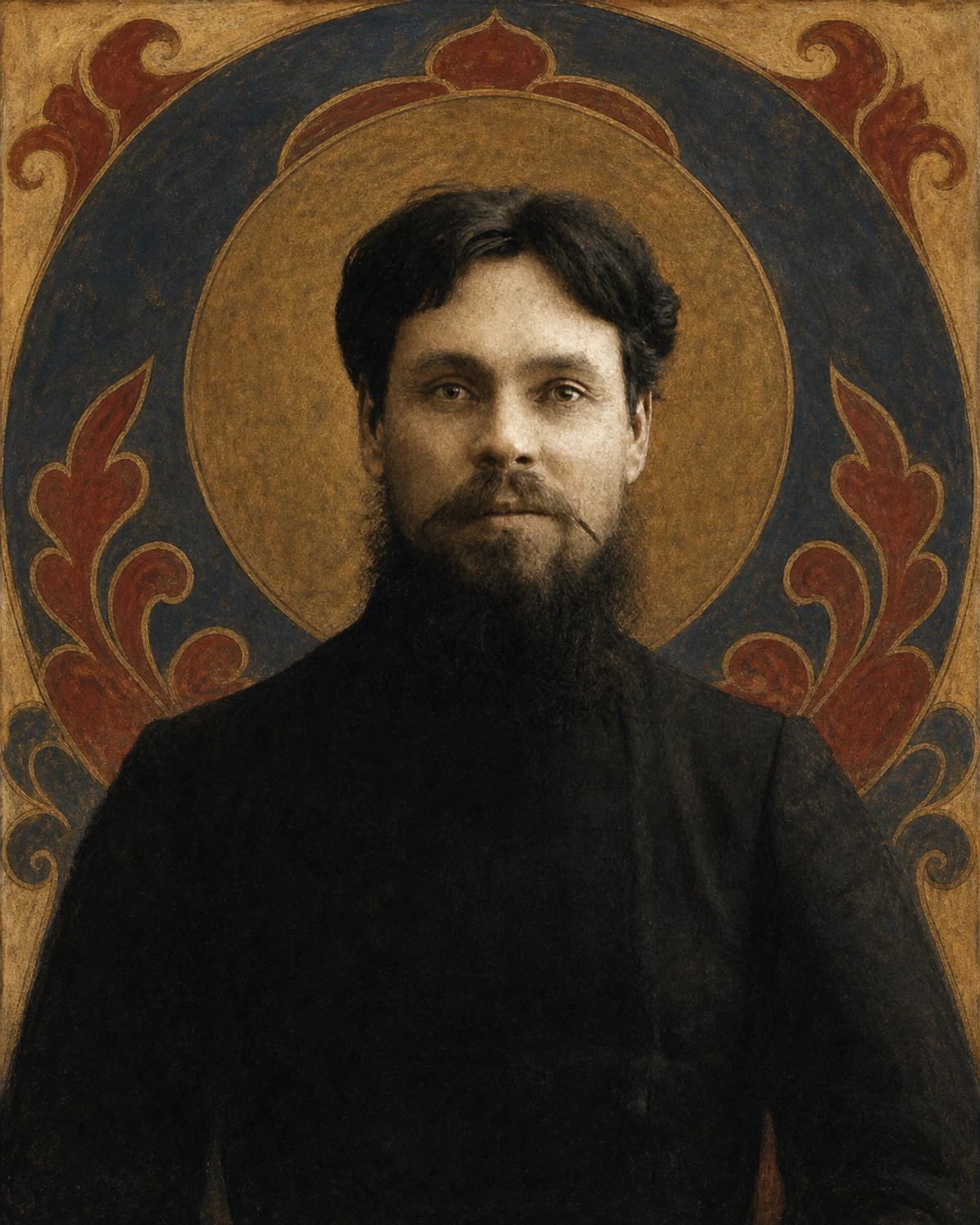
Ivan Blinov
Ivan Blinov, from the village of Kudashikha near Gorodets, copied and illuminated about two hundred manuscripts in his lifetime, from “The Tale of Peter and Fevronia of Murom” to several copies of “The Tale of Igor’s Campaign”. His clients were Old Believer collectors and the imperial court. After 1917 he ran the museum in Gorodets, and then went back to his home village.
Biography
In 1916 Blinov was summoned to Tsarskoye Selo, and for three weeks he lived in the house of Prince Mikhail Putyatin, head of the palace administration. The job was urgent: drawings for the statutes of the Order of St Olga, an order for women, intended for Nicholas II, Alexandra Feodorovna and the Dowager Empress Maria Feodorovna. His reward was 500 roubles, a gold medal “For Diligence” on the ribbon of the Order of St Andrew, and a written letter of thanks from the empress.
By then the peasant’s son from Balakhninsky Uyezd was forty-three.
He was born on 18 November 1872 (5 November, Old Style) in the village of Kudashikha in Nizhny Novgorod Governorate, into a Beglopopovtsy family (one of the Old Believer branches, the Old Believers being those who rejected the seventeenth-century church reforms); his parents were Gavriil Andreyevich and Lyubov Klementyevna Blinov. His grandfather and his maternal uncle were icon painters and also decorated spinning-wheel boards. He spent his childhood in his grandfather’s house in the village of Koskovo on the Uzola river, where he learned to read and write. As a teenager he became absorbed in copying books: at first these were notebooks of canons, made on commission for a bookseller in Gorodets. In 1887 came a Kanonnik (a book of canons) of 219 leaves, and a year later an illustrated Commentary on the Apocalypse.
Around the turn of the 1880s and 1890s he began working for the merchant collectors of Gorodets, Pyotr Ovchinnikov and Grigory Pryanishnikov, and from 1895 for Nikolai Nikiforov, a merchant of Gorbatov. His clients kept rich book collections, and Blinov studied them and got to know other copyists, miniaturists and icon painters. Among his works of 1894–1901, several illustrated copies of “The Tale of Peter and Fevronia of Murom” stand out, together with the “Canon to the Honourable Cross”, shown at the palaeographic exhibition of 1899, and a Kanonnik with ten canons for the twelve great feasts of the church year. By the end of the 1890s his manuscripts were being bought by several collectors, among them the scholar Yevgeny Barsov, the theatre collector Alexei Bakhrushin and a collector named Bolshakov. From the middle of the 1890s he also restored manuscripts: he filled in lost passages and added ornaments and “pictures” to books that had none. In 1906 he was invited to a regional historical and archaeological congress in Vladimir.
In 1905 the Nizhny Novgorod city council commissioned from him an illustrated copy of Josephus’s “The Jewish War”; he worked in the libraries of Kazan University and the Kazan Theological Academy. In the late 1900s his Old Believer connections took him to Moscow: the Historical Museum, the Rumyantsev Museum, the Tretyakov Gallery, the Synodal Library, the library of the Trinity Lavra of St Sergius. In St Petersburg he looked at the collection of the Imperial Public Library. His models were manuscripts from the Kremlin workshops of the sixteenth and early seventeenth centuries, above all the Illustrated Chronicle of Ivan the Terrible.
From 1909 to 1916, with breaks, Blinov worked as senior proofreader of Slavonic type at the Old Believer press in Moscow owned by Leonty Malekhonov, at a salary of 25 roubles a week. He took private commissions as well. At the turn of the 1900s and 1910s he met Dmitry Stelletsky: Blinov wrote out the text of “The Tale of Igor’s Campaign” and Stelletsky made the illustrations (this copy has not survived). In 1912, together with Alexander Savinov, he worked at the Natalyevka estate near Kharkiv, owned by the sugar manufacturer and patron Pavel Kharitonenko, and made the inscriptions in the Church of the Saviour, built to a design by Alexey Shchusev. In 1912–1914 he made three more copies of the “Tale”; one was bought by a Moscow merchant named Yegorov, another by Prince Shirinsky-Shikhmatov, a member of the State Council. He also worked with Viktor Vasnetsov, Mikhail Nesterov and Boris Zvorykin.
From 1916 Blinov worked at the printing firm of Levenson, and was then conscripted into Tsarskoye Selo Field Medical Train No. 143. In service he met two painters, Charlemagne and Naumov, and the poet Sergei Yesenin.
The revolution found him at the height of his powers, but his gift, as one biography puts it, was alien to the new authorities. He went on working all the same, and 1918 was, it seems, the most productive year of his career. The following year was the hardest financially. In 1919 he painted “Simon, son of Jonas, lovest thou me?”, after the Gospel of John; the subject, by his own account, came to him during prayer at a church service. In March of that year Blinov joined the Scholarly Board of the Russian Historical Museum, and in 1920 he became director and research fellow of the Gorodets Museum of Local History, one of whose founders he was. In 1925, for family reasons, he returned to Kudashikha.
In the second half of the 1920s and in the 1930s he changed occupations: collective farm, lecturer and decorator at a village club, editor-in-chief of the Gorodets newspaper “Kolkhozny udarnik”, teacher at a colony. The authorities regarded him with suspicion. He still kept returning to manuscripts: he compiled and decorated with miniatures a “History of the Town of Gorodets” (1937) and copied small books of canons for his children and grandchildren. This brought no income and strengthened his reputation as “unreliable”. Not long before his death a friend, the historian and archaeographer Georgievsky, asked him to make a new book, “The Tale of Igor’s Campaign”; Blinov began it and did not live to finish it.
He died in Kudashikha on 8 June 1944. The cemetery where he was buried was destroyed in 1985, and his grave was restored in 1988 at the insistence of relatives and townspeople. His manuscripts are held in the Russian State Library, the State Historical Museum, the Gorodets Museum of Local History and the National Library of Russia; some are in private collections, including abroad. In 2005 a memorial plaque was placed on the building of the Gorodets Museum of Local History.
Related context
Associations
Works connected through artistic movements, cultural context and period. Priced works available in this market appear first.








Profile notes
Profile and sources
Image
Artist image
На основе открытого изображения: Unknown author Unknown author; Wikimedia Commons; Public domain.
