
1729–1802
Ivan Argunov
A serf of the Counts Sheremetev, Ivan Argunov (1729–1802) painted Catherine II, his masters and their relatives, and in 1784 created the “Portrait of an Unknown Peasant Woman in Russian Dress”, the first image in Russian portraiture of a woman of the “base estate”. Anton Losenko and Kirill Golovachevsky were among his pupils, and in his last years he managed the Sheremetevs’ Moscow house.
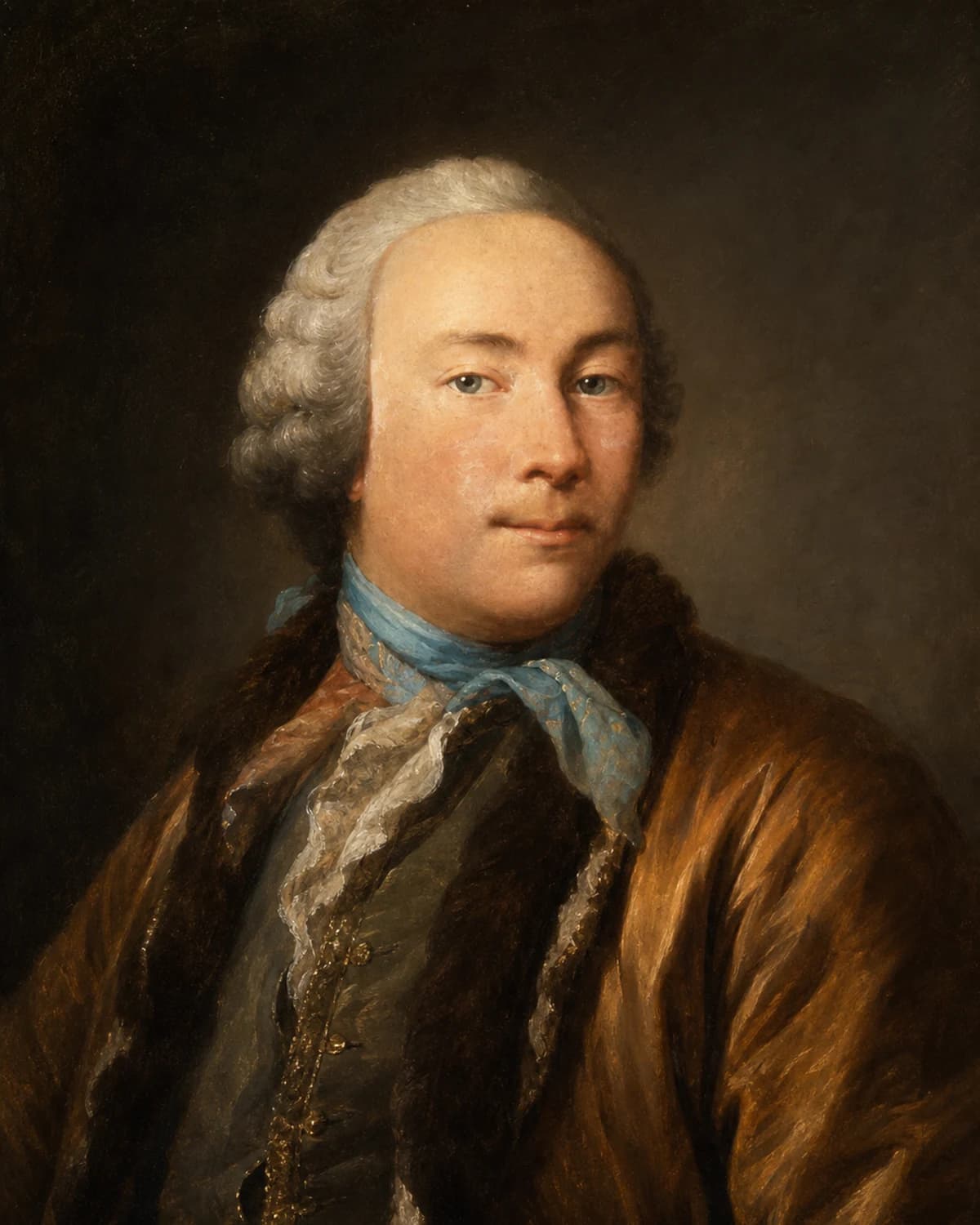
Biography
A little Kalmyk girl, Annushka, holds up an engraving opened towards the viewer. The engraving shows her mistress, Countess Varvara Alekseevna Sheremeteva, who had died shortly before. The portrait was painted by Ivan Argunov, who had himself once passed to the Sheremetevs as part of this same Varvara Alekseevna’s dowry.
Artist and sitter belonged to the same family.
Ivan Petrovich Argunov was born in 1729 into a family of serfs of Prince A. M. Cherkassky. Later, as part of Varvara Alekseevna’s dowry, the Argunovs passed to her husband, Count Pyotr Borisovich Sheremetev. The boy was brought up by his uncle, Semyon Mikhailovich Argunov, first a steward to the Cherkasskys, then majordomo to the Sheremetevs, who for many years ran their house on Millionnaya Street in Saint Petersburg. It was in that house that Ivan grew up.
He learned portrait painting from his cousin Fyodor Leontyevich Argunov and from foreign masters; in 1746–1749 his teacher was the German painter Georg Christoph Grooth, who served at the court of Empress Elizabeth. Under Grooth’s direction Argunov painted icons for the church of the Catherine Palace at Tsarskoe Selo (1753), and he also made icons for the New Jerusalem Monastery (1749). To the same years belongs his only known history painting, “The Dying Cleopatra” (1750), in the manner of academic Rococo. His first known portraits, a ceremonial portrait of Prince Ivan Ivanovich Lobanov-Rostovsky and its pendant of Princess Ekaterina Alexandrovna (1754), combine the old tradition of the parsuna with the new Baroque.
His prime came in the 1760s and 1770s, when he painted ceremonial, semi-ceremonial and intimate portraits. In 1762 he received an important commission, a portrait of Catherine II: the empress, in a markedly theatrical pose, looks down at the viewer, surrounded by part of a column, lavish drapery, gilded furniture and regalia. He does not flatter Count P. B. Sheremetev, leaving him his squint and his puffy face, but renders the texture of fabrics and the shadows very finely. His finest works are rightly held to be the intimate paired portraits of K. A. Khripunov and his wife: both seem to have just looked up from reading and gaze at the viewer, she attentively and kindly, he searchingly. He painted the Sheremetevs and their kin, the Lazarevs and the Counts Tolstoy, and he painted children and adolescents. Argunov was one of the creators of the posthumous portrait, and he depicted many Sheremetevs after their deaths. It seems to me that the portrait of Annushka grew out of the same genre: a posthumous portrait of the mistress set inside a portrait of the girl.
He began teaching early. From 1753, before the Academy of Arts opened in 1757, he gave painting lessons. By order of Empress Elizabeth, court choristers who had lost their voices were sent to him “to be taught art”: Anton Losenko, the future director of the Academy, Kirill Golovachevsky, the future inspector of its Educational School, and Ivan Sablukov, a future academician; Fyodor Rokotov is also named among his pupils. He also taught serfs of Count Nikolai Petrovich Sheremetev from the village of Beloye in Kashin district, and his own sons: Pavel became an architect, Nikolai and Yakov painters.
From 1770 Argunov was majordomo of the Sheremetev house on Millionnaya Street, then managed the counts’ Moscow house and sat on their serf board, which ran their estates and affairs. He painted less and less. Yet it was in these years, in 1784, that the “Portrait of an Unknown Peasant Woman in Russian Dress” appeared, the first image in Russian portraiture of a woman of the “base estate”: a festive sarafan, a kokoshnik above a fair brow, a proud bearing, a gaze full of dignity. Who sat for it is unknown. Suggestions have ranged from the Sheremetevs’ serf actress and singer Kovalyova-Zhemchugova to a nameless wet nurse from among the Sheremetev serfs.
From the second half of the 1780s he virtually gave up painting and dealt only with the Sheremetevs’ affairs; he took part in the building of the palace theatre at Ostankino. Ivan Argunov died in Moscow on 12 (24) March 1802 and was buried on 15 March in the Pokrovsky Monastery.
Related context
Associations
Works connected through artistic movements, cultural context and period. Priced works available in this market appear first.








Profile notes
Profile and sources
Image
Artist image
На основе открытого изображения: Ivan Argunov; Wikimedia Commons; Public domain.
