
22.05.1755–15.05.1814
Ivan Akimov
Ivan Akimov (1755–1814) wrote a petition to the Academy of Arts at ten, asking to be admitted, and ended up as its director. He painted history pictures on subjects from antiquity and early Russian history, studied in Italy for five years, ran the imperial Shpalerny Manufactory, the state weaving works, and taught drawing to the children of Emperor Paul I. His contemporaries valued him above all as a teacher.
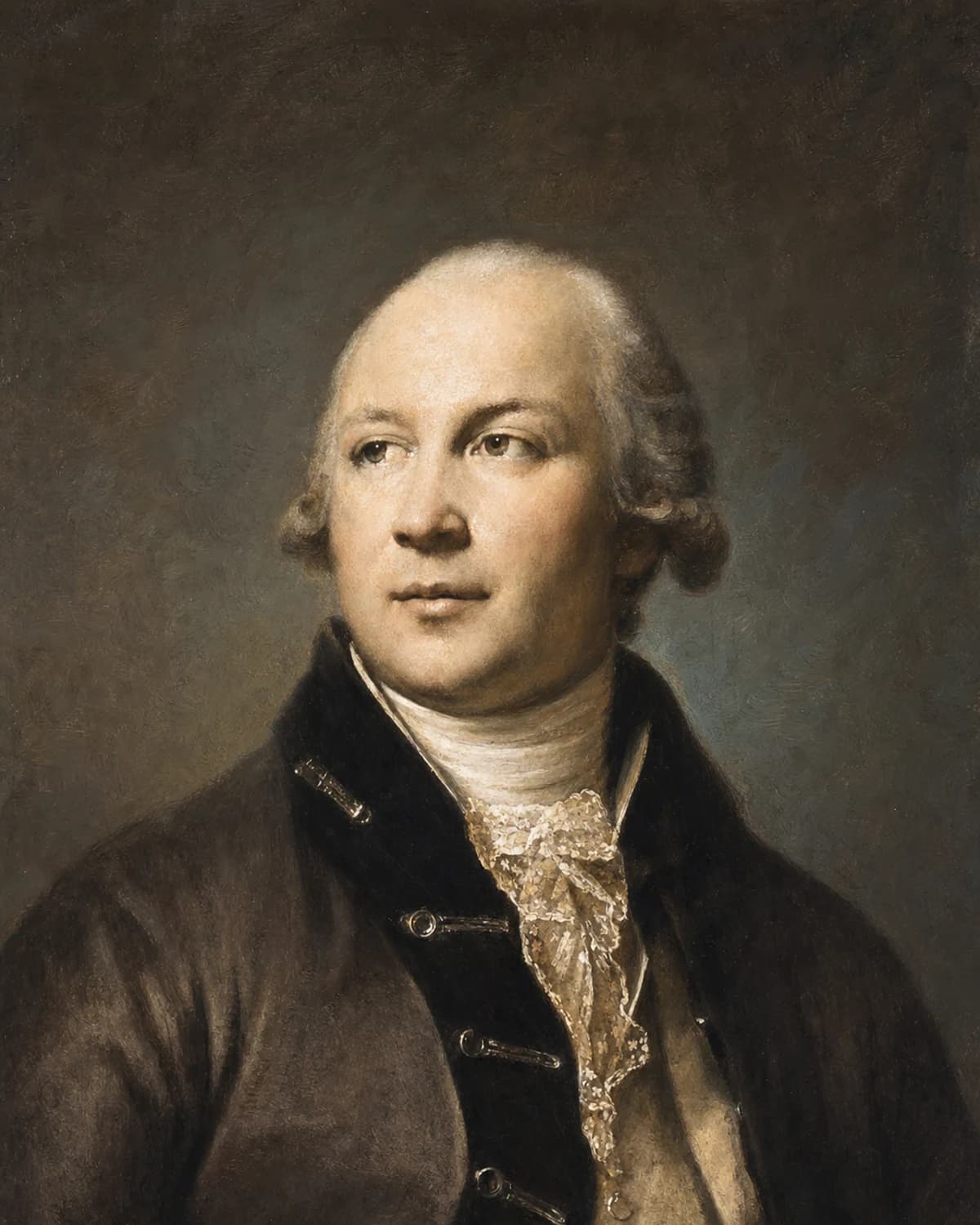
Biography
In 1764 or 1765 a ten-year-old boy, the son of a typesetter at the Senate printing house, wrote to the Academy of Arts asking to be admitted. His father had died by then, and his mother could not look after the child on her own, so Ivan Akimov asked to be taken in as a pupil. The request was granted.
He was born in Saint Petersburg on 2 June 1755 (22 May, Old Style). Sources differ, giving 1754 and 1755; I have taken 1755. He studied under Anton Losenko, and in 1769 won two silver medals for drawings from life. The programmes for the gold medal were historical: first “The Baptism of Grand Prince Vladimir”, then a subject with the Greek philosopher Cyril showing the prince a curtain bearing a picture of the Last Judgement. In 1772 he received the minor gold medal for a picture about Izyaslav Mstislavich, whom his own warriors failed to recognise on the battlefield, and in 1773 the major gold medal for “Grand Prince Svyatoslav Kissing His Mother and Children on His Return from the Danube to Kiev”. This award carried the right to travel abroad; the painting is now in the Tretyakov Gallery.
The journey lasted from 1773 to 1778. He travelled through Paris, Avignon, Lyon and Genoa and settled in Bologna, where he studied at the Pontifical Clementine Academy under Gaetano Gandolfi. He was dissatisfied: in his letters he complained that there were no good schools there, that the drawing was poor, and that he needed both a good school and hard work, because colour came to him with difficulty. After a year he moved to Rome without permission. According to some accounts, he found there an association of artists with private pupils rather than an academy, and was able to enter Pompeo Batoni’s classes only on the recommendation of a Russian nobleman living in Italy. Later the Academy ordered him back to Bologna, where he finished “Prometheus Making a Statue at the Command of Minerva”; for this work he was appointed an academician-designate in 1778. Then came Florence, Venice and Rome again, where he painted “Narcissus”, “Dido and Aeneas” and “A Faun Playing with a Kid”.
From January 1779 he taught in the life classes of the Academy as assistant to Professor Gavriil Kozlov. In 1782 he was elected an academician for “The Self-Immolation of Hercules”, and in 1785 became an associate professor. In 1791 he joined the Academy’s council and almost at once took charge of the Imperial Shpalerny Manufactory, the state weaving works. At the same time he taught drawing to the children of Paul I, among them the future Emperor Nicholas I.
In 1794, on the proposal of the Academy’s president, Alexander Musin-Pushkin, Akimov became assistant rector, and in September of the same year senior professor; on 12 January 1796 he was elected director of the Academy. The post was abolished in 1799, when the office of vice-president was created, and in January 1800 he gave it up. Sources date the end of his directorship differently, 1799 or 1800.
Critics did not think much of his own paintings. The present-day graphic artist and theorist Vladimir Vlasov writes that they are dull in colour and resemble dimly tinted drawings; Grigory Ugryumov, a pupil and contemporary, was ranked above him. Yet among his pupils are named Andrey Ivanov, Vasily Shebuyev and Alexei Yegorov, and Alexander Stupin even lived in Akimov’s family. To my mind, this is the best measure of what he was: the influence of his brush was smaller than the influence of his classroom.
He also worked outside easel painting. For the Trinity Church in the Alexander Nevsky Lavra he painted the main icons, for the Mikhailovsky Castle he painted mirrors on commission from Paul I and made an icon of the Holy Trinity for the castle church. He made sketches for the Kazan Cathedral, vignettes for Sumarokov’s “Description of the Crimea”, and designs for medals of 1807 and 1808. After 1801, when the wars with Napoleon began, he turned to contemporary subjects such as the feat of the standard-bearer Starikov and Peter I in the camp on the Prut. These pieces were not highly regarded, but they are hard to judge now: little has survived.
He left a few texts as well. In 1804 his article “Brief Historical Information About Some Russian Artists” appeared in the journal “Severny Vestnik”, one of the first attempts to write a history of Russian art; he also wrote for the theatre.
Ivan Akimov died on 27 May 1814 (15 May, Old Style) in Saint Petersburg and was buried beneath the Smolensky Church. He left the Academy 15,000 roubles in paper money to support two scholarship holders in his name.
Related context
Associations
Works connected through artistic movements, cultural context and period. Priced works available in this market appear first.








Profile notes
Profile and sources
Image
Artist image
На основе открытого изображения: various litographers; Wikimedia Commons; Public domain.
