
17.07.1817–19.04.1900
Ivan Aivazovsky
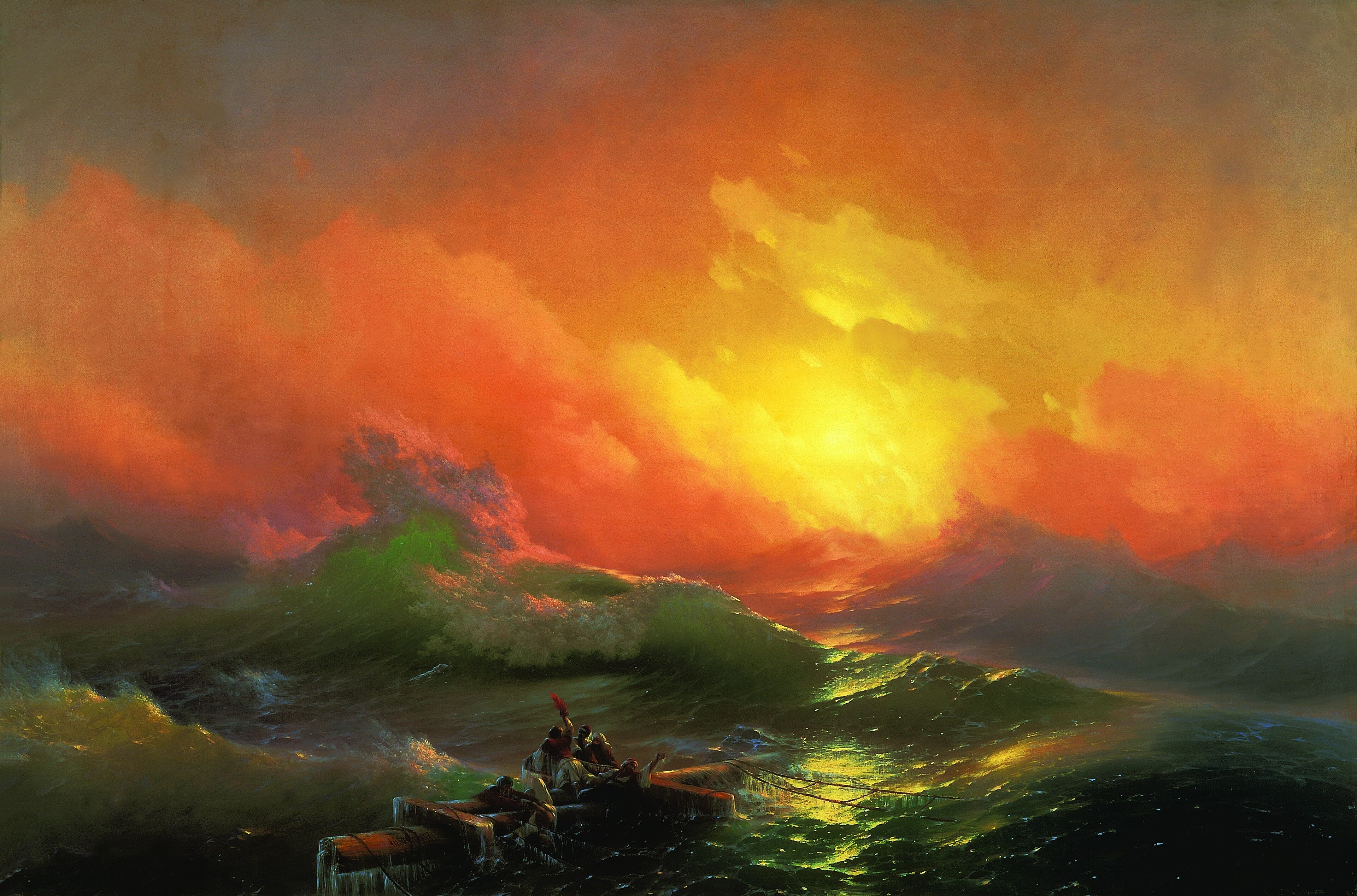
Ivan Aivazovsky painted some six thousand pictures, and the sea is in almost all of them: storms, calms, moonlit nights, naval battles from Chesma to Sinop. From 1844 he was painter to the Main Naval Staff, yet he lived and worked in his native Feodosia, where he opened an art gallery, brought in a water supply and secured the building of a port. “The Ninth Wave” (1850) is in the Russian Museum.
Biography
At the Academy of Arts autumn exhibition of 1836 there hung five pictures by a student named Gaivazovsky: Kronstadt, the steamer “Hercules” in foul weather, boys with a fishing rod. The critics spoke well of them. His mentor, the French marine painter Philippe Tanneur, had forbidden his assistant to work on his own, and he complained to Nicholas I, after which the pictures were taken off the wall on the tsar's orders. The young artist was forgiven six months later.
In September 1837 he received the large gold medal for “Calm”.
He was born on 17 (29) July 1817 in Feodosia; the Armenian priest entered him in the parish register as “Hovhannes, son of Gevorg Ayvazyan”. His father, a merchant, had come to the Crimea from Galicia by way of the Danubian Principalities and spelled the surname in the Polish manner, Gaivazovsky. During the plague of 1812 he was ruined, and the family lived in poverty. The boy taught himself the violin, spent several years serving and playing in a local coffee house, and at the age of eight drew a sailing ship in charcoal on the wall of a house. He was noticed by the Feodosia architect Yakov Koch, who gave him his first lessons and told the town governor, Alexander Kaznacheev, about him. With Kaznacheev's help Aivazovsky got into the gymnasium in Simferopol, and from there, recommended by his drawing teacher, into the St Petersburg Academy of Arts at state expense. He arrived in the capital on 28 August 1833 and began in Maxim Vorobiev's landscape class.
He was released from the Academy two years early and sent to the Crimea for two summers. There he painted more than the sea: off the coast of Circassia he watched from the shore as troops landed in the Shakhe valley, and later painted “Landing of a Detachment in the Subashi Valley”. Nicholas I bought the picture. His acquaintance with Lev Sergeyevich Pushkin, adjutant to General Raevsky, gave him the idea of painting scenes from Alexander Pushkin's Black Sea months. On 23 September 1839 Aivazovsky received his Academy certificate, a sword, his first rank and personal nobility.
In July 1840 he set off for Italy with his classmate Vasily Sternberg. In Venice he met Gogol, and on the island of San Lazzaro he saw his elder brother Gabriel, a monk of the Armenian monastery, after a long separation. It was then that his way of working took shape: a short time in front of nature, quick sketches, and the picture itself painted in the studio from memory, with room for improvisation. I think this explains a good deal about his painting. Aivazovsky's sea is almost always remembered rather than observed. Pope Gregory XVI bought his “Chaos” and awarded him a gold medal, and J. M. W. Turner praised him as well. In 1842 he travelled through Switzerland to Holland, England, Paris, Portugal and Spain. In the Bay of Biscay his ship was caught in a storm and nearly went down, and the Paris newspapers managed to report the painter's death. In the autumn of 1844 he returned to Russia.
In October of that year he was appointed painter to the Main Naval Staff, with the right to wear naval uniform. A year later he was an academician, and in 1847 a professor of the Academy of Arts. In 1845 he sailed with Fyodor Litke's expedition to the coast of Asia Minor and saw Constantinople for the first time; he would paint it many times. In the same year he began building a house on the Feodosia waterfront. He did not stop travelling and was in St Petersburg several times a year, but he wrote to Tretyakov: “My address is always Feodosia.” In the spring of 1846 six warships under the command of Vladimir Kornilov came to Feodosia to congratulate the artist on ten years of work.
“The Ninth Wave” was painted in 1850. Alongside it ran another, official line: the battles of Navarino, Chesma and Sinop, two pictures of the brig “Mercury” under Lieutenant-Commander Kazarsky. During the Crimean War Aivazovsky held an exhibition of battle paintings in Sevastopol and for a long time refused to leave the besieged city, until Kornilov gave him an official order to go. For the series “The Riches of Russia”, made for the Paris exhibition of 1857, he became the first Russian artist to receive the Legion of Honour. In 1864 he was granted hereditary nobility.
Feodosia occupied him no less than painting. He directed the excavation of more than ninety burial mounds (some of the finds went to the Hermitage), built a new home for the town's museum of antiquities on Mount Mithridates, and pressed for a railway to Dzhankoy (it opened in 1892) and for a commercial port. In 1887 he gave the town the water of his Subash spring, fifty thousand buckets a day, and in the park by the waterfront a fountain was built to his design, from which anyone could draw water free of charge. He opened a picture gallery in his own house in 1880 and left it to the town in his will. He became Feodosia's first honorary citizen.
He kept travelling in old age. In November 1869 he passed through the newly opened Suez Canal aboard the steamer “General Kotzebue”, and in 1892, at seventy-five, he went to the United States with his wife and painted Niagara. On 1 January 1896 he was given the rank of Actual Privy Councillor, the only Russian artist to receive it. Chekhov, who stayed with him at his Shah-Mamai estate in the summer of 1888, wrote of him in a letter: “a complex nature, and worthy of attention”.
On the last day of his life Aivazovsky began a picture, “The Explosion of a Turkish Ship”, and did not finish it. He died in Feodosia on 19 April (2 May) 1900. As his will directed, he was buried in the courtyard of the Armenian church of Surb Sarkis, where he had once been baptised. His widow, Anna Burnazyan, placed a white marble sarcophagus on the grave bearing a line from Movses Khorenatsi in Classical Armenian: “Born a mortal, he left behind an immortal memory.”
Artist works
Works by the artist
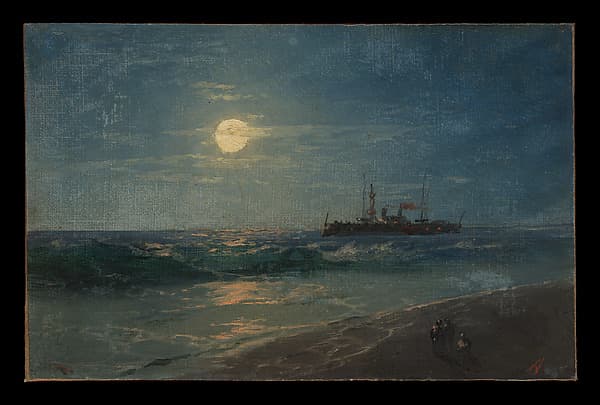
Works by Ivan Aivazovsky available in this edition of NEOARCA.
Related context
Associations
Works connected through artistic movements, cultural context and period. Priced works available in this market appear first.








Profile notes
Profile and sources
Image
Artist image
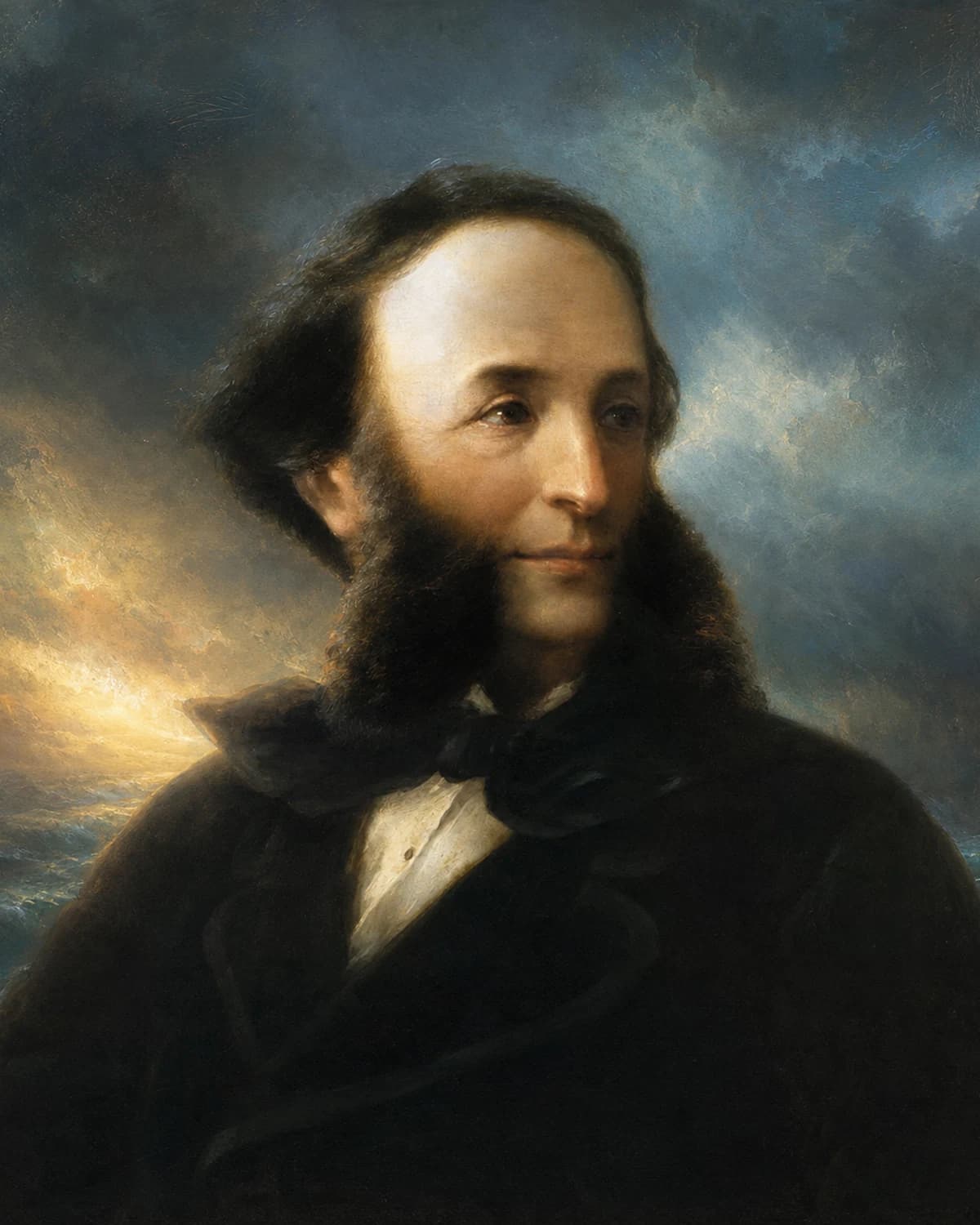
На основе открытого изображения: Ivan Aivazovsky; Wikimedia Commons; Public domain.
