
18.08.1860–22.07.1900
Isaac Levitan
Isaac Levitan, a pupil of Savrasov and a friend of Chekhov, turned the unassuming landscape of central Russia into a picture of a state of mind: “Vladimirka”, “Above Eternal Peace”, “March”, “Golden Autumn”. Twice, as a Jew, he was expelled from Moscow. His main subjects came from summer seasons on the Volga at Plyos and in Tver Governorate; in 1898 he became an academician and took charge of the landscape studio at the school where he had studied.
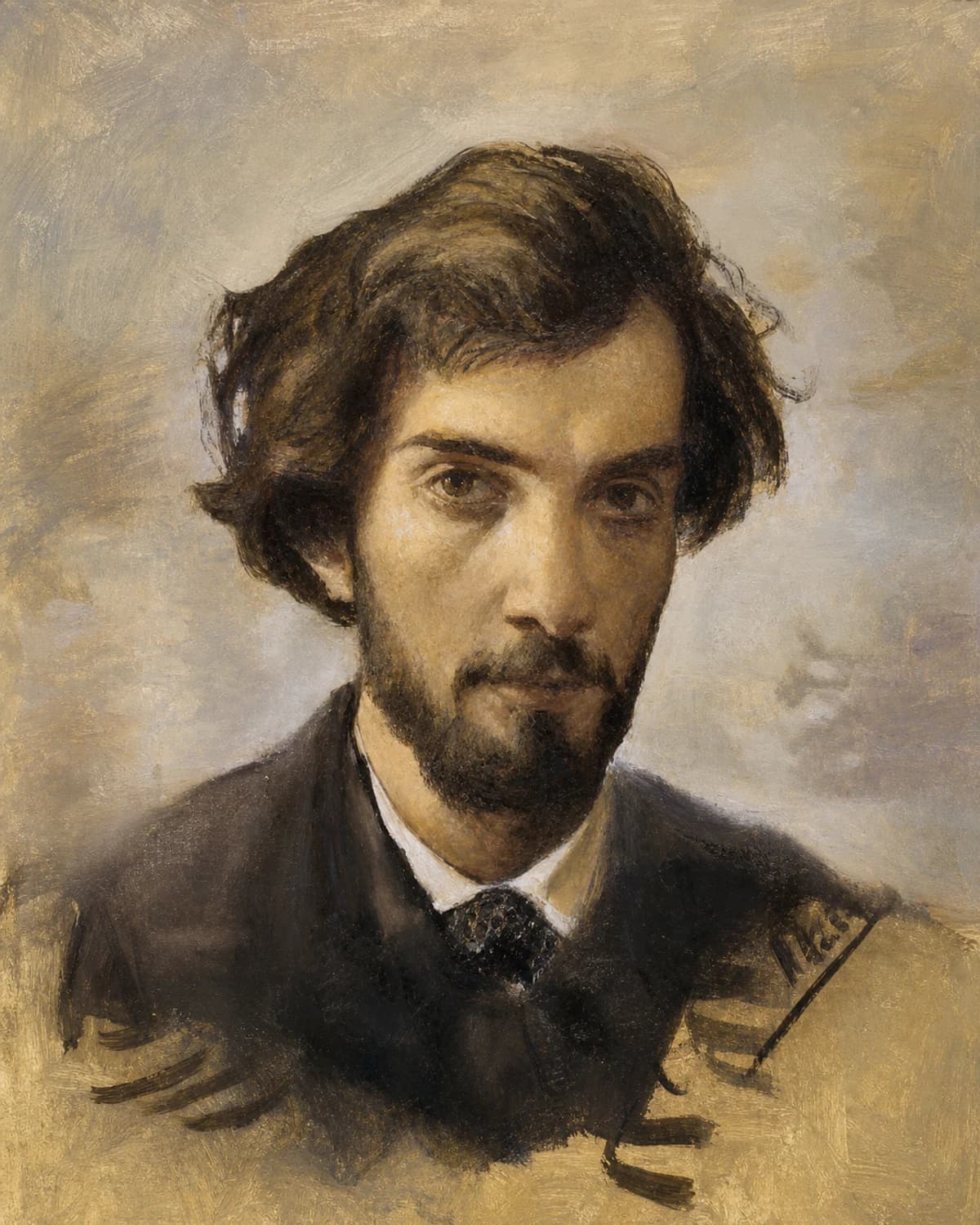
Biography
In the spring of 1885 the twenty-four-year-old Levitan finished his studies at the Moscow School of Painting, Sculpture and Architecture and received a diploma as a teacher of penmanship. He was not given the title of artist. A couple of years earlier Savrasov had written “silver medal” on the back of one of his canvases, but the council rejected the picture. Why is hard to say: some blamed Savrasov, who had fallen out of favour by then, while others, Konstantin Korovin among them, said it was a matter of the pupil's origins.
Even the date of his birth is in question. Officially it is 18 (30) August 1860, and the place is given as the settlement of Kibarty in Augustów Governorate or, according to the birth record, Keidany in Kovno Governorate. Archival finds of recent years allow that the future artist was born on 3 (15) October 1860 and was a nephew brought up as a son. His father, Elyash Levitan, from a family of Keidany rabbis, taught himself French and German, taught them in Kovno and later worked as an interpreter for a French company building a railway bridge. In the early 1870s the family moved to Moscow.
In the autumn of 1873 thirteen-year-old Isaac entered the school, where his elder brother Avel (later Adolf) had already been studying for two years. His teachers were Perov, Savrasov and Polenov. In 1875 his mother died, and two years later his father, and the brothers were left in dire poverty; the school released them from fees “in view of extreme poverty” and as students who had “shown great success in art”. In March 1877 two of his works were noticed by the press, and the sixteen-year-old student received a small silver medal and 220 roubles to continue his studies. Mikhail Nesterov recalled that everything came easily to Levitan, yet he worked doggedly. In 1879, after Solovyov's attempt on the life of Alexander II, Jews began to be expelled from Moscow, and Levitan, with his brother and sister, ended up at a dacha in Saltykovka. That same year he painted “Autumn Day. Sokolniki”, a long avenue in the park; the figure of a woman in a black dress was added by Nikolai Chekhov, who decided the avenue needed someone walking along it. Tretyakov bought the picture.
In the summers of 1880–1884 he painted at Ostankino, and in 1884 at Savvinskaya Sloboda near Zvenigorod (“The Last Snow”, “The Footbridge”); together with Korovin he made sets for Mamontov's Private Opera. In April 1885 he settled in the village of Maksimovka, next to Babkino, where the Chekhovs were staying, and a friendship began with Anton Chekhov that lasted his whole life, with quarrels and reconciliations. The very first summer's picture, “The Istra River”, he gave to Chekhov.
At first the Volga disappointed him. In 1887 the weather was cold, and he wrote to Chekhov about “sickly little bushes and, like lichen, the bluffs”. In the spring of 1888 he set out again, with the painters Alexei Stepanov and Sofia Kuvshinnikova, along the Oka to Nizhny Novgorod and on up the Volga, and came upon little Plyos by chance. Three summers in a row were spent there, 1888–1890, and some two hundred works, among them “Evening. Golden Plyos” and “After the Rain. Plyos”. From Plyos he travelled to Kostroma, Kineshma and Yuryevets; near Yuryevets, by the Krivoozersky Monastery, the idea arose for “Quiet Abode” (1890), which made a strong impression on Chekhov. In the winter of 1889/90 Levitan went to France and Italy for the first time and at the Exposition Universelle in Paris looked at contemporary painting, above all, it seems, the Barbizon painters and the Impressionists. Nesterov wrote down the conclusion he drew: the path he had chosen before was the right one. To my mind it shows in the pictures: Levitan took light from the Impressionists, but not their aims.
In March 1891 he was admitted to the Association of Travelling Art Exhibitions, and Sergei Morozov gave him a comfortable studio in Tryokhsvyatitelsky Lane.
In the autumn of 1892, as a “person of the Judaic faith”, Levitan once again had to leave Moscow and spent several months in Tver and Vladimir governorates until his friends obtained permission for him to return “by way of exception”. That same year he painted “Vladimirka”, the empty road along which convicts were driven to Siberia, and “Evening Bells”. Around then he also fell out with Chekhov for a time: in the story “The Grasshopper” readers recognised Levitan himself and his pupil Kuvshinnikova. They made it up in January 1895.
His best-known pictures were painted in Tver Governorate, by Lakes Ostrovno and Udomlya. “Above Eternal Peace” (1894) combined two views: of Lake Ostrovno and of Udomlya from Krasilnikova Hill. At the neighbouring estate of Gorka a two-storey house was built for him as a studio, jokingly called “the synagogue”. In March 1895 he painted “March” from there in a few sessions, and in the autumn, on the little river Syezha half a kilometre from the estate, “Golden Autumn”. Tretyakov bought both.
In 1896 Levitan worked for several weeks in Finland, painting the fortress of Olavinlinna, rocks and Punkaharju, and afterwards “Spring. High Water”. In 1898 he received the title of academician and began to run the landscape studio at his old school. One of his students recalled that under his corrections the studies came alive. He dreamed of a “House of Landscapes”, a shared studio for all Russian landscape painters. In the winter of 1899 the doctors sent him to Yalta, and after he came back he hardly left the house in Tryokhsvyatitelsky Lane. From June 1900 his pictures hung in the Russian section of the Exposition Universelle in Paris.
Levitan died on 22 July (4 August) 1900. He left in the studio about forty unfinished paintings and some three hundred studies; the last of them, “The Lake”, was also unfinished. The letters addressed to him were destroyed by his brother at his request. He was buried on 25 July in the old Jewish cemetery next to the Dorogomilovo Cemetery, and on 22 April 1941 his remains were moved to the Novodevichy Cemetery, where his grave ended up beside those of Chekhov and Nesterov.
Related context
Associations
Works connected through artistic movements, cultural context and period. Priced works available in this market appear first.








Profile notes
Profile and sources
Image
Artist image
На основе открытого изображения: Isaac Levitan; Wikimedia Commons; Public domain.
