
16.04.1924–17.04.1989
Inji Aflatoun
Inji Aflatoun (1924–1989) began in Cairo among the Surrealists of the Art and Freedom Group, then painted people at work in Luxor, Nubia and the oases, and kept painting in prison, where she spent 1959–1963 as a political prisoner. In the 1940s and 1950s she was one of the prominent figures of Egypt’s left-wing women’s movement; in the 1970s she arrived at luminous pictures with areas of bare canvas.
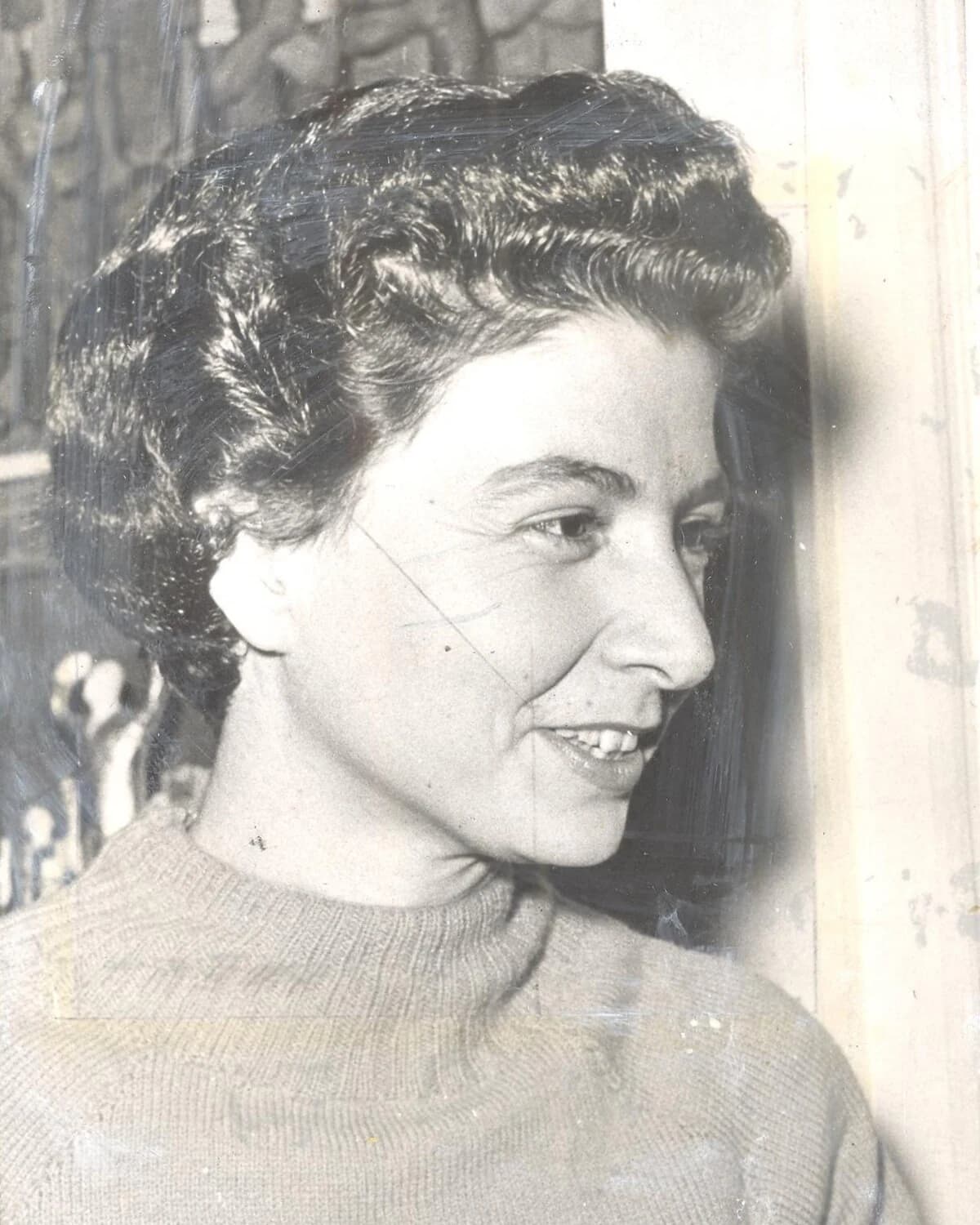
Biography
From the window of the prison cell a tree could be seen, and the inmates nicknamed it Inji’s tree. Inji Aflatoun painted it many times. For the first two years of her imprisonment she painted portraits of her fellow prisoners; then she realised she could no longer depict that hopelessness and turned to trees and boats, and to see the boats better she was allowed to go to the laundry room.
She had been arrested in 1959. She was among the first twenty-six Egyptian women imprisoned for their political beliefs.
Inji Aflatoun was born on 16 April 1924 in Cairo, in the district of Shobra, into a traditional Muslim family that she later described as “semi-feudal and bourgeois”. Her father, Hassan, was a landowner and an entomologist. The surname Aflatoun, Arabic for “Plato”, had been a family nickname. Her mother, Salha, married at fourteen, divorced soon after Inji was born and brought up Inji and her elder sister Gulpérie on her own. She had trained in France as a dress designer, worked on the women’s committee of the Egyptian Red Crescent Society, and in 1936, with the backing of the banker Talaat Harb, opened the first fashion house in Egypt. It is generally thought that in her mother’s life the daughter saw early on how unequal women and men were in her country.
At the Catholic school of the Sacré-Coeur Inji felt confined: there was, she recalled, not even equality before God. At fourteen she was moved to the Lycée Français in Cairo, where she discovered Marxism and asked ever more insistently why some were so rich and others so poor. She had loved drawing since childhood and her parents encouraged it, but she found the school’s art teachers dull. Her work was shown to the painter Mahmoud Said, who advised her mother to find her a private tutor. The tutor was Kamel el-Telmissany, one of the founders of the Surrealist Art and Freedom Group, which had issued the manifesto “Long Live Degenerate Art!” in response to Nazi propaganda. He introduced his pupil to Surrealism and Cubism and told her about the lives of Egyptian peasants. Aflatoun’s early pictures are full of disquieting landscapes and dream images; viewers, she said, were puzzled as to why a girl from a rich family was so tormented. She took part in two of the group’s exhibitions, and then she was drawn towards realism and towards painting as social statement.
From 1946 to 1948 she did not paint at all: what came out on the canvas no longer matched what she felt.
She had been involved in politics since her youth. In 1942 she joined the Communist youth organisation Iskra. After graduating in philosophy from Fuad I University, in 1945 she founded, together with Latifa al-Zayyat, the League of University and Institutes’ Young Women, and that same year she represented it in Paris at the first congress of the Women’s International Democratic Federation. Her pamphlet “Eighty Million Women with Us” (1948) was confiscated as soon as it came out; it was distributed again after Aflatoun sued the Ministry of the Interior. It was followed by the pamphlet “We Egyptian Women” (1949). Both tie the inequality of class and of women to colonial oppression. In 1951 she took part in founding a women’s committee against the British presence in Egypt.
What brought her back to painting were trips to Luxor, Nubia and the Egyptian oases, where she could, in her words, go into people’s houses and sketch men and women at work. For a year she studied with the Egyptian-born Swiss artist Margo Veillon, and she attended the workshop of Hammad Abdullah. Her canvases of those years show groups and portraits of working people, with harsh shadows cast by the bright Egyptian sun. She held solo exhibitions in Cairo and Alexandria and showed work at the Venice Biennale of 1952 and at the São Paulo Biennial, where in 1956 she became friends with the Mexican muralist David Alfaro Siqueiros.
In 1959, during the mass arrests of Communists under Nasser, Aflatoun went into hiding in disguise, but she was found. Shortly before her arrest she had won first prize in a landscape competition held by the Ministry of Culture, and this helped persuade the prison director, Hassan al-Kurdi, an amateur of painting, to let her paint. She argued that the pictures could be sold for the benefit of the prison. They sold poorly, and those who bought them were mostly the prisoners themselves. Some of the works were carried out by guards who wrapped the canvases around their bodies. She was released on 26 July 1963.
By then the Communist Party had been dissolved, and Aflatoun gave herself almost entirely to painting. She later called Nasser, who had put her in prison, a good patriot. The interest in light that had come through the bars of her cell stayed with her after her release. She exhibited in Rome and Paris (1967), in Dresden, East Berlin, Warsaw and Moscow (1970), in Sofia (1974), Prague (1975) and New Delhi (1979). Her brushwork became lively and her colour intense, and some viewers were reminded of Van Gogh and Bonnard. The 1970s brought the “White Light” series: loosely built forms, quivering filaments of colour and plenty of bare canvas around the figures. White, the artist said, lets a painting breathe. To my mind, these white fields should be seen alongside the prison works; then it is clear where they came from.
Inji Aflatoun died in Cairo on 17 April 1989, the day after her sixty-fifth birthday.
Collections of her work are held at the Amir Taz Palace in Cairo and at the Barjeel Art Foundation in Sharjah. In 1994 she was shown by the National Museum of Women in the Arts in Washington, and in 2015–2016 by Mathaf: Arab Museum of Modern Art. At the 2015 Venice Biennale, curated by Okwui Enwezor, the “White Light” series hung beside the prison paintings.
Profile notes
Profile and sources
Image
Artist image
Unavailable; Wikimedia Commons; Public domain.
