
24.07.1844–29.09.1930
Ilya Repin
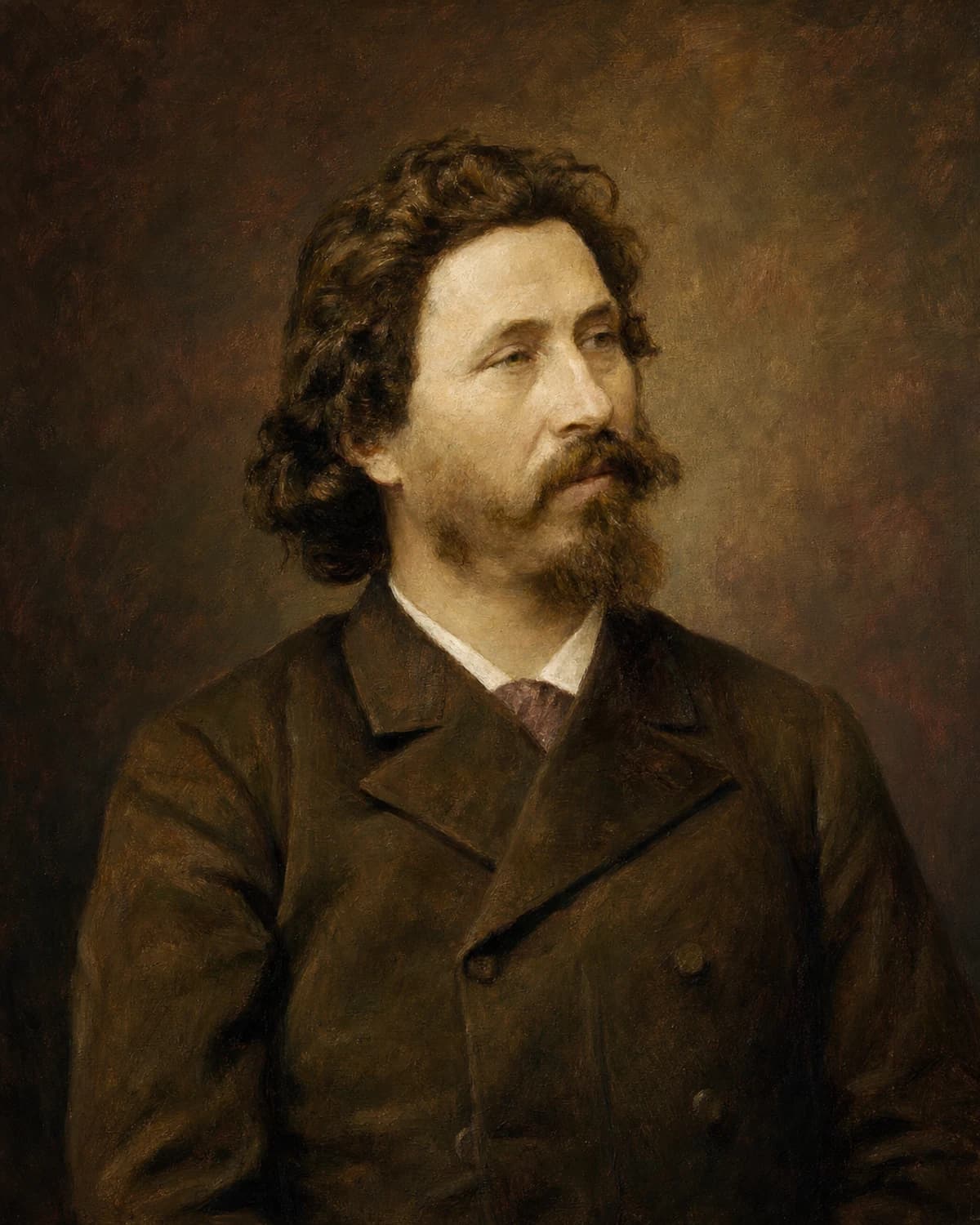
Ilya Repin (1844–1930) started out in an icon-painting workshop in Chuguyev and ended up as a professor and rector of the Academy of Arts. A member of the Peredvizhniki, he painted “Barge Haulers on the Volga”, “Religious Procession in Kursk Province”, “Reply of the Zaporozhian Cossacks” and portraits of Mussorgsky and Tolstoy. From the early 1900s he lived at Penaty in Kuokkala, and after 1917, without moving anywhere, found himself in independent Finland.
Biography
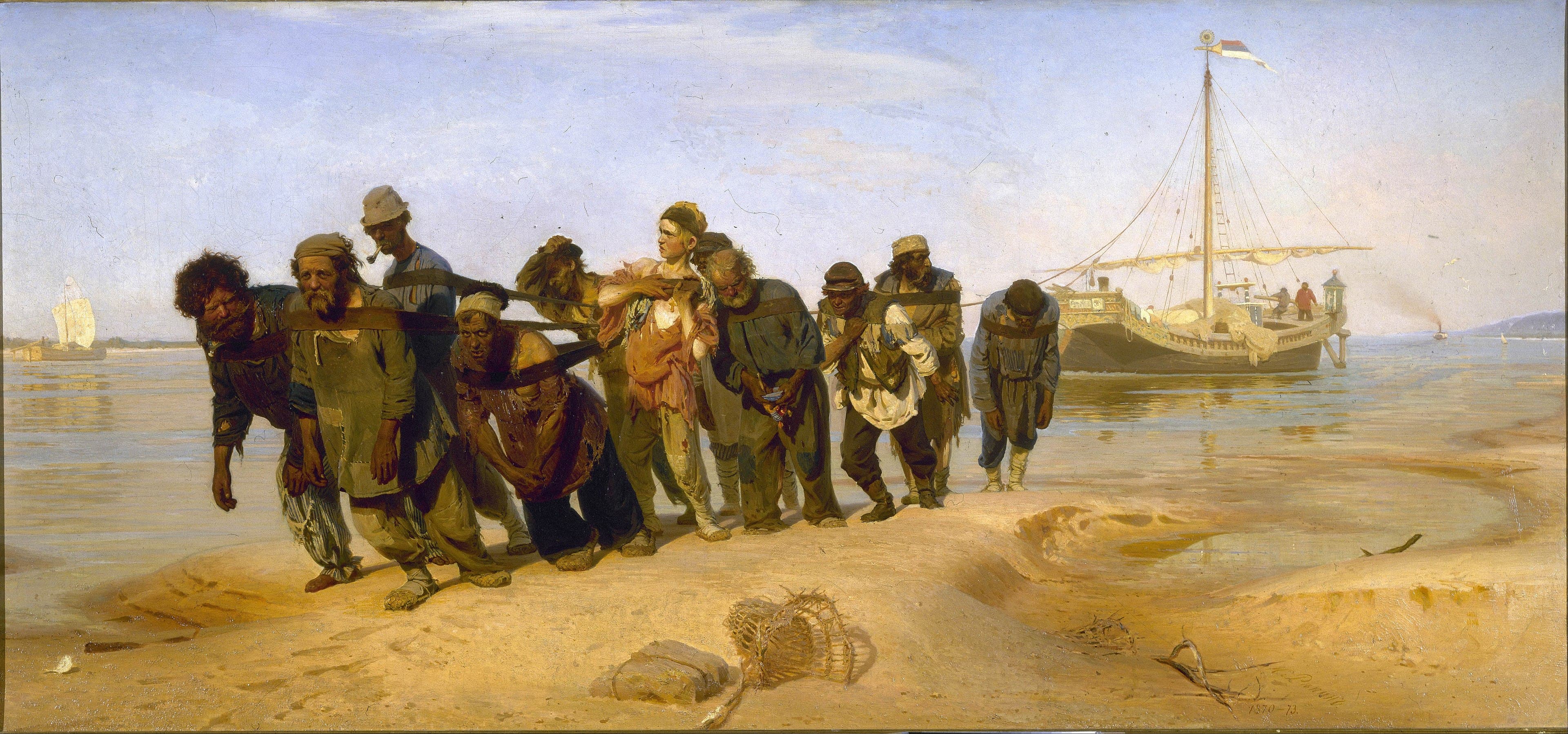
In 1868 Ilya Repin, a student at the Academy of Arts, was painting studies on the Neva when he saw barge haulers. Smartly dressed summer residents were strolling along the bank, and past them men in harness were hauling rafts. Repin later recalled how the contrast struck him. Five years later it had become a painting that every Russian schoolchild knows.
For that, though, he needed the Volga. In the summer of 1870 he went there with the landscape painter Fyodor Vasilyev and with Yevgeny Makarov: they sailed from Tver to Saratov and stayed near Stavropol in Samara province. “Barge Haulers on the Volga” (1870–1873) turned into a portrait of a gang in which every man has his own character. At the front is the calm, philosopher-like leader; in the middle, a boy trying to straighten up in his harness. In 1873 the painting was shown at the World’s Fair in Vienna; today it is in the Russian Museum.
Now back to the beginning.
Repin was born on 24 July (5 August) 1844 in Chuguyev, Kharkov province, into the family of a military settler. He first studied at a school for military topographers, and when it was abolished he went to the icon-painting workshop of Ivan Bunakov. At sixteen he left home for a travelling artel of icon painters that moved from town to town with its commissions. Little is written about those years, which is a pity: the speed, the habit of large surfaces, the attitude to painting as work done to order all come from there.
He arrived in St Petersburg in 1863. He rented a room in a garret, lived half-starved, attended the evening Drawing School of the Society for the Encouragement of Artists, where he met Ivan Kramskoi, and in 1864 entered the Academy. He graduated in 1871 with the major gold medal for “The Raising of Jairus’ Daughter”.
His Academy-funded years abroad, 1873–1876, were spent mostly in Paris. “Paris Café”, “Sadko”. He saw the Impressionists but never took up their language: his palette grew lighter, his brushwork freer, and that was all.
In February 1878 he was admitted to the Association of Travelling Art Exhibitions, and without the usual probation as an exhibitor: an exception was made for him. He was living in Moscow at the time. Then come ten years in which almost everything we call “Repin” was painted: “Tsarevna Sophia” (1879), “Religious Procession in Kursk Province” (1880–1883), “Arrest of a Propagandist”, “Refusal of Confession”, “They Did Not Expect Him” (1884–1888). The whole province fits into the “Procession”, from pious merchants’ wives to a cripple being driven off with a stick. “They Did Not Expect Him” works the other way round. One room, an exile walking back into the house, and nobody knows what to say. The mother is rising from her armchair, the children look on warily, the maid has frozen in the doorway.
“Ivan the Terrible and His Son Ivan on 16 November 1581” (1883–1885) was bought by Pavel Tretyakov. The painting was soon banned from public display; many people spoke up for it, among them the painter Alexei Bogolyubov, and the ban was lifted. In 1913 and 2018 the canvas was damaged by museum visitors, and both times it was restored.
He worked on “Reply of the Zaporozhian Cossacks” for twelve years: he made the first sketch in 1878 at Abramtsevo and showed the finished painting at his solo exhibition of 1891. He travelled around Ukraine collecting faces, costumes and weapons. The painting was bought by Alexander III and is in the Russian Museum. Everyone in it is laughing, and it seems that Repin took the whole thing on for the sake of that roar.
Portraits are a subject of their own and, to my mind, his strongest. Mussorgsky was painted in March 1881 in hospital, a few days before the composer’s death: a hospital dressing gown, dishevelled hair, inflamed eyes. Repin painted Leo Tolstoy over many years, from “Tolstoy Ploughing” to domestic studies at Yasnaya Polyana. There were also Pirogov, Stasov, Tretyakov and dozens of others.
From the mid-1890s Repin taught at the reformed Academy and ran a studio there, and in 1898–1899 he was its rector. His pupils included Boris Kustodiev, Filipp Malyavin, Anna Ostroumova-Lebedeva and Igor Grabar. Valentin Serov he had taught as a boy; Repin recalled how the boy, with incredible patience, copied the views from his windows, little gardens with birch trees, small houses. His last large commission, “Ceremonial Sitting of the State Council on 7 May 1901” (1901–1903), he carried out together with Kustodiev and Ivan Kulikov.
Repin spent the last thirty years of his life at Penaty, his estate in Kuokkala, a dacha suburb of St Petersburg. After the revolution Kuokkala ended up in independent Finland, and without going anywhere he became an émigré. Thirteen years of that kind of emigration. He worked less by then, turned to biblical subjects and wrote memoirs that later went into the book “Far and Near”. When his right hand stopped obeying him and his friends, worried about his health, began hiding his brushes, he started painting with his left. The palette, which his fingers could no longer hold, he hung from straps around his neck.
Repin died on 29 September 1930 in Kuokkala and was buried in the park at Penaty. The village was renamed Repino only in 1948.
Artist works
Works by the artist
Works by Ilya Repin available in this edition of NEOARCA.
Related context
Associations
Works connected through artistic movements, cultural context and period. Priced works available in this market appear first.








Profile notes
Profile and sources
Image
Artist image
На основе открытого изображения: Неизвестен; Wikimedia Commons; Public Domain.
