
20.07.1858–08.07.1929
Ilya Ostroukhov
Ilya Ostroukhov (1858–1929) became a landscape painter in his twenties; Pavel Tretyakov bought his “Golden Autumn”, “First Greenery” and “Siverko”. Later, for more than ten years, he was the de facto head of the Tretyakov Gallery’s council, and in his house in Trubnikovsky Lane he gathered icons, paintings and studies by Russian artists that became a museum bearing his name after 1918.
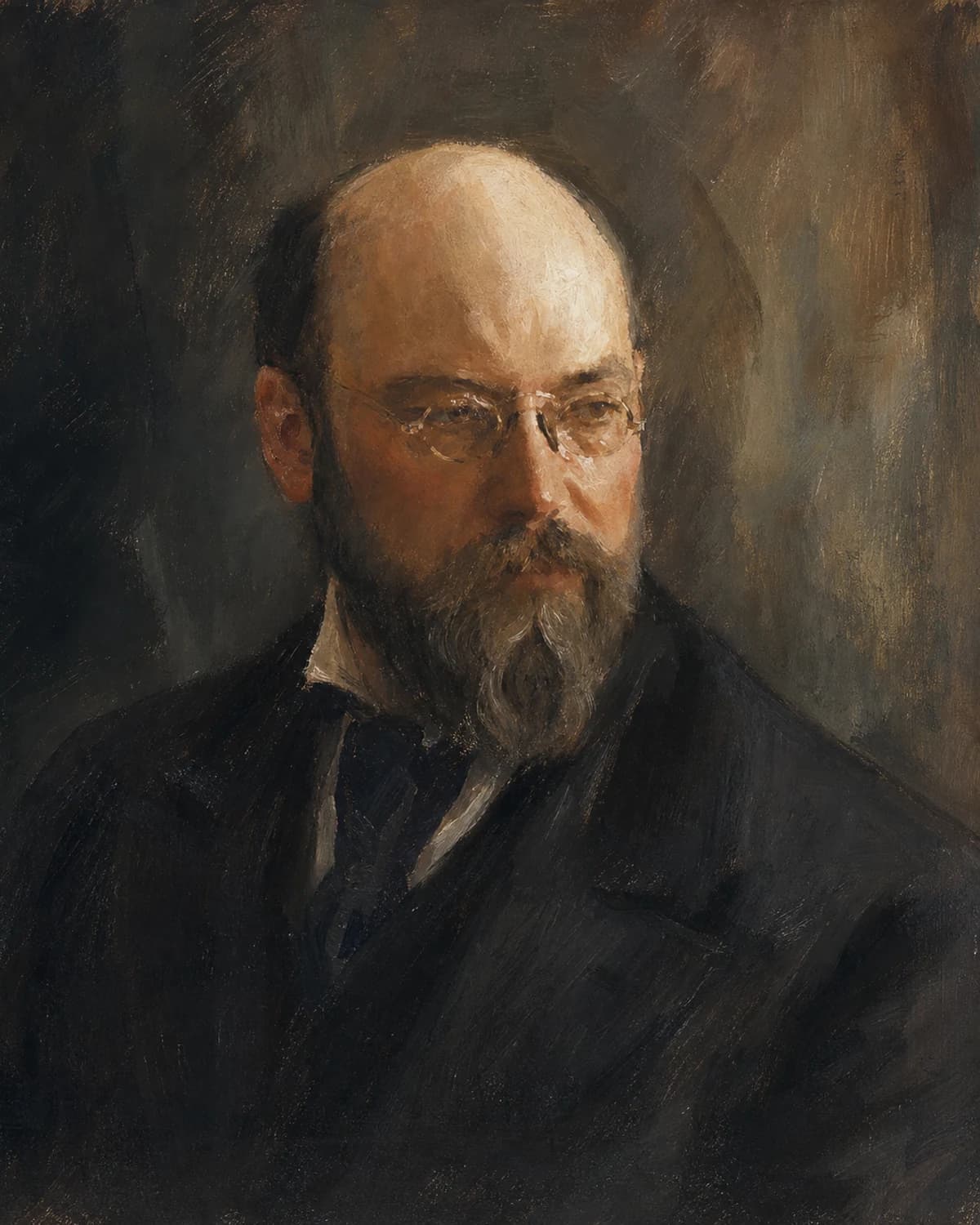
Biography
Ilya Ostroukhov liked to say that no stack of documents from art historians would ever convince him: “if I see that this is not a Rembrandt, then it is not a Rembrandt.” All Moscow came to his studio for his opinion, he gave his verdict at first glance, and what he disliked he dismissed briefly: “rubbish and trash.” According to the art historian Abram Efros, that is how he described a small painting shown to him by the collector Dmitry Shchukin. Shchukin sold it, the Dutch connoisseur Abraham Bredius bought it, and it turned out to be Johannes Vermeer’s “Allegory of Faith”, which now hangs in the Metropolitan Museum in New York. Ostroukhov never admitted his mistake and insisted that art historians had “the eye of a pig”.
The anecdote may be embellished, but I think it captures his character exactly.
He was born on 20 July (1 August) 1858 in Moscow, into the merchant family of Semyon Vasilyevich Ostroukhov, a hereditary honorary citizen. In 1870 he entered the Moscow Practical Academy of Commercial Sciences and there became absorbed in zoology: he corresponded with Alfred Brehm, collected insects and in 1877 published a little book, “Angling”. As early as 1874 he had brought his sketches “Birds of Central Russia” to the publisher A. I. Mamontov and made friends with his sons. He decided to become a painter after seeing Vasily Polenov’s landscapes at a Peredvizhniki exhibition: “A Moscow Courtyard”, “Grandmother’s Garden”, “Overgrown Pond”. Only his age worried him.
In April 1880 he began taking lessons from Alexander Kiselyov, the tutor of the Mamontov children, and in the winter of 1881 from Repin as well. At Christmas, together with Viktor Vasnetsov, he designed the poster and Berendey’s palace for a home performance of “The Snow Maiden” at Savva Mamontov’s. In the summer of 1882 he went to Abramtsevo for the first time, where the Church of the Saviour Not Made by Hands was then being built, and painted a study of it. That autumn, on Repin’s advice, he went to St Petersburg, failed to get into the Academy of Arts and spent a year there as an auditing student. What mattered most were two seasons, 1882/83 and 1883/84, in Pavel Chistyakov’s private studio. With his closest friend, Valentin Serov, he designed a home performance of “The Black Turban” in 1884, and for Mamontov’s private opera he painted a set design, “The Tavern”, for “Carmen”; after the premiere on 22 December 1885 Polenov reported in a letter that the set had been much liked. In the autumn of 1886 he joined Vladimir Makovsky’s class at the Moscow School of Painting, Sculpture and Architecture.
He made his debut in 1884 with the landscape “The Little River” at an exhibition of the Moscow Society of Art Lovers. In February 1886 the Fourteenth Peredvizhniki exhibition showed his “First Snow” and “Early Spring”; he went on reworking the latter for two years. In 1887 “Golden Autumn” appeared at the Fifteenth, and Pavel Tretyakov bought both pictures; in 1889 they were joined by “First Greenery”. In the summer of 1887 Ostroukhov travelled to Italy with Serov and the Mamontov brothers and brought back studies of Venice. After the Nineteenth exhibition in 1891, where “Siverko” (1890) was shown, he was admitted to the Association of Travelling Art Exhibitions. Igor Grabar saw in this painting a seriousness that keeps it from ageing.
In July 1889 Ostroukhov married Nadezhda Petrovna Botkina, daughter of the tea merchant Pyotr Botkin, and received a house in Trubnikovsky Lane as her dowry. There, from the 1890s, his collection took shape. The first piece in it was “The Boat”, a study Polenov had given him back in 1882; then came seventeen works by Repin, twelve by Serov, eleven by Polenov, and works by Surikov, Vrubel, Levitan, Fyodor Vasilyev, Fedotov, Kiprensky and Bryullov. He valued studies above finished paintings, and there were more of them. The Western section was small, but it included Degas, Renoir, Matisse and Manet’s “Portrait of Antonin Proust”. His icons formed one of the finest collections in Russia, and his library of more than twelve thousand volumes, with a 1515 “Divine Comedy”, was given a separate stone annexe in 1914.
After Tretyakov’s death in December 1898 the Moscow City Duma elected a council for the gallery, and Ostroukhov joined it together with Serov, I. E. Tsvetkov and Tretyakov’s daughter Alexandra Botkina. In practice he led the council in 1899–1903 and 1905–1913. In June 1903 he was removed for spending too much on acquisitions. On 28 January 1905 the Duma voted him down, but on 10 March it nevertheless elected him chairman of the council and trustee. After a visitor slashed Repin’s “Ivan the Terrible and His Son Ivan” on 16 January 1913, his opponents started a campaign against him, and he soon resigned.
In 1900 he organised the Russian section at the Exposition Universelle in Paris and received the Legion of Honour; in 1903 he was among the founders of the Union of Russian Artists; in 1906 he became a full member of the Academy of Arts. He had all but given up painting and returned to it in 1916, after spending two and a half weeks in Crimea. In January 1918 his last landscapes painted from nature were shown: “Crimean Noon”, “Morning in Gurzuf” and “Plum-Peach in Blossom”. Later, because of a bad leg, he painted in the studio from old studies; this is how “The Leaves Do Not Tremble…” and “Birch Autumn” came about in 1921.
In 1918 the collection was nationalised and Ostroukhov was appointed its curator for life; from 1920 it was called the I. S. Ostroukhov Museum of Icon Painting and Painting. In March 1929 he was deprived of his voting rights as a former house owner and co-owner of a tea business. Ilya Ostroukhov died in Moscow on 8 July 1929 and was buried in the Danilovskoye Cemetery. A month later the museum was dissolved, its holdings were dispersed among other collections, and most of the icons are now in the Tretyakov Gallery.
Since 1979 his house in Trubnikovsky Lane has belonged to the State Literary Museum.
Related context
Associations
Works connected through artistic movements, cultural context and period. Priced works available in this market appear first.








Profile notes
Profile and sources
Image
Artist image
На основе открытого изображения: Valentin Serov; Wikimedia Commons; Public domain.
