
17.07.1881–20.03.1944
Ilya Mashkov
Ilya Mashkov (1881–1944) started out as a teenager painting shop signs in Borisoglebsk, and in 1910 became one of the founders of the Jack of Diamonds. His still lifes of fruit, bread and food combine the lessons of Cézanne and Matisse with the lubok, the shop sign and the painted tray. For a quarter of a century he taught painting, first privately, then at Vkhutemas, and in the 1920s and 1930s he painted in the spirit of Soviet realism.
Biography
In Borisoglebsk, with the merchant M. E. Yuryev, to whom his parents had sent him to earn his keep, the teenage Ilya Mashkov painted shop signs. Before that he had already worked in the grocery trade in the Cossack village of Filonovskaya. It was in Borisoglebsk, too, that he began learning to draw from a gymnasium teacher, N. A. Evseev.
The shop sign would later come back into his painting.
He was born on 17 (29) July 1881 in the Cossack village of Mikhailovskaya, in the Khopyor district of the Don Host Province. His parents, as he put it, were state peasants who had come to the Don from Pronsk district in Ryazan Governorate, and they lived by petty trade; Ilya was the eldest of nine children. In 1889–1892 he attended parish schools, and from 1892 to 1899 he worked for tradesmen.
In 1900 Mashkov entered the Moscow School of Painting, Sculpture and Architecture. He studied under Leonid Pasternak, Serov, Konstantin Korovin, Apollinary Vasnetsov, Arkhipov and Kasatkin; in 1904 he broke off his studies for three years and returned in 1907. At the school he was known as an eccentric and loved strong colour, hyperbole and gigantic size above all. Drawing lessons brought in money: from 1904 until September 1917 his private studio was attended by Falk, Tatlin, Osmerkin, Vera Mukhina, Kliun and many others. In 1906 he built himself a studio in the Polytechnic Society building in Maly Kharitonyevsky Lane and worked there for the rest of his life. In 1907 he met Pyotr Konchalovsky, and in the spring and summer of 1908 he travelled through France, England, Germany, Austria-Hungary, Switzerland, Spain and Italy. In 1910 he was expelled from the school.
The year of his expulsion became a year of loud exhibitions. Mashkov showed twelve works at the Izdebsky Salon, which travelled to Odessa, Kiev, St Petersburg and Riga, and exhibited at the Salon d’Automne in Paris; Ivan Morozov bought the still life “Blue Plums”. In December 1910 the first Jack of Diamonds exhibition opened in the Levisson house in Moscow. For it Mashkov painted the huge “Self-Portrait and Portrait of Pyotr Konchalovsky”, and “Still Life with Fruit” (1910) hung there too, a picture in which Cézanne and Matisse meet the lubok, tray painting and the shop sign. In 1911, together with Konchalovsky and Alexander Kuprin, he founded the Jack of Diamonds society and became its secretary; until 1916 he took part in all its exhibitions.
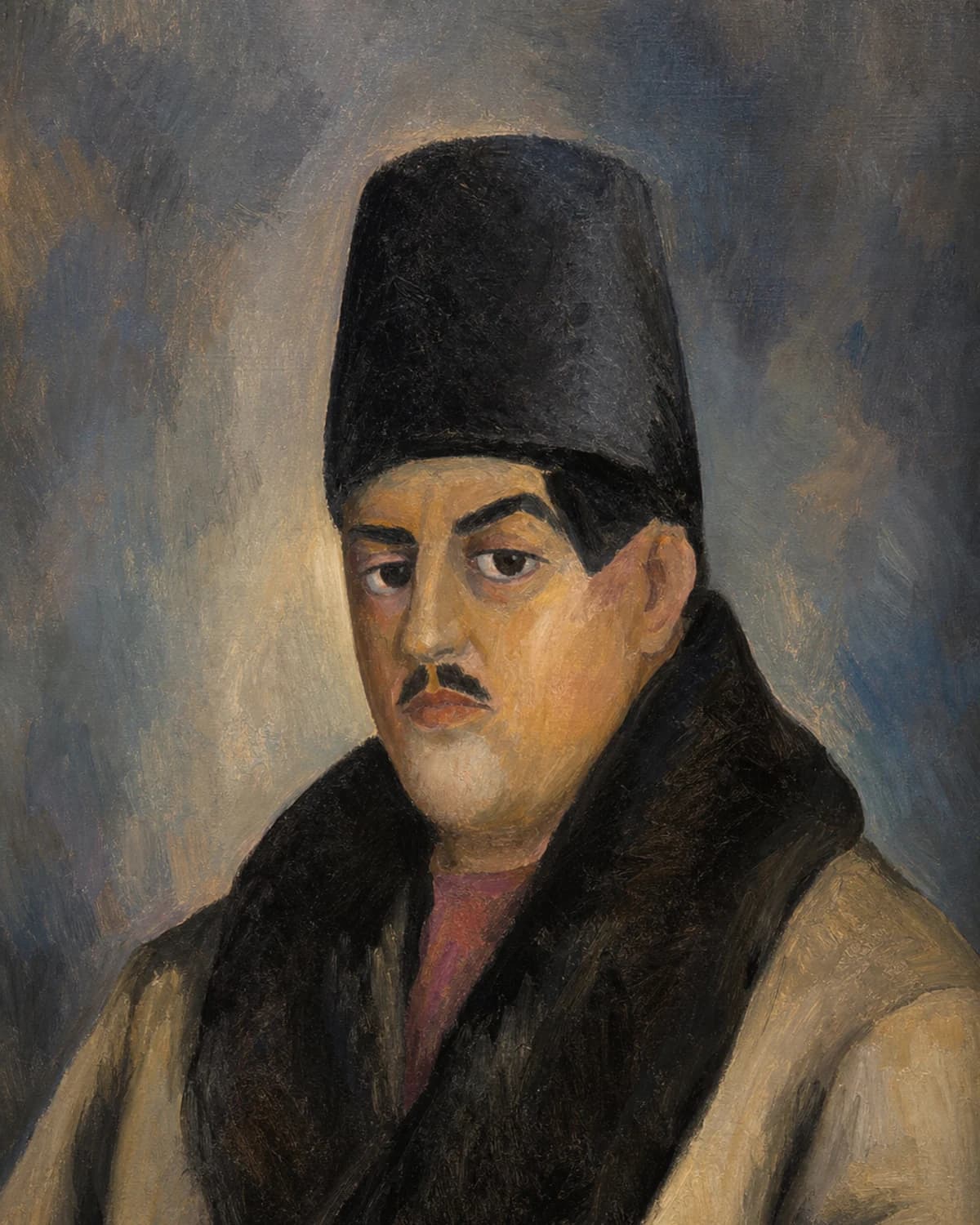
His favourite genre remained the still life. Mashkov inflates objects, compacts forms, sets colours against each other and exaggerates texture, and the fruit on his tables is arranged by the laws of simple symmetry, as on a sign or a tray. The portraits of those years, “Portrait of E. I. Kirkaldi” (1910) and “Self-Portrait” (1911), are deliberately theatrical and provocative. It seems to me that the Borisoglebsk shop signs gave him more than the school’s classrooms: he painted bread and pumpkins as if they had to be sold from the street.
In 1913 his works were shown at the Stedelijk Museum in Amsterdam. In 1914 he drew “war” lubki to verses by Mayakovsky, and in 1915 two of his still lifes were bought for the Tretyakov collection. In 1916 Mashkov joined the World of Art, and in April he showed more than seventy works at the “Exhibition of Contemporary Russian Painting”; it was the largest exhibition of his lifetime.
After the revolution he worked on organising an artists’ trade union, sat from September 1918 to June 1919 on the collegium of the fine arts department of Narkompros, and from September 1918 until 1929 taught in the painting faculty of Vkhutemas–Vkhutein; he also painted panels for revolutionary festivals. In 1921 he became head of the Moscow branch of the World of Art. Among his works of the early 1920s are “Still Life with a Fan” (1922), the Crimean series of 1923 with “Beach at Simeiz” and “Women’s Beach”, and the still lifes of 1924 “Moscow Food: Meat, Game” and “Moscow Food: Breads”. In 1924 his paintings were seen in America and at the Venice Biennale.
From the mid-1920s Mashkov belonged to AKhRR, the Association of Artists of Revolutionary Russia; until September 1929 he ran its Central Studio, and he stayed in the association until it was dissolved in 1932. He painted Soviet leisure, leading workers (among them Pasha Angelina), Red partisans and collective-farm landscapes. In 1929 he was granted a personal pension for life, and he gave up teaching. In 1930–1934 he lived in his native Mikhailovskaya, intending to turn the village into a model socialist town; from there came “Collective Farm Woman with Pumpkins” (1930), which was later reproduced many times on magazine covers. Back in Moscow, he painted “Greetings to the 17th Congress of the VKP(b)” with portraits of Marx, Lenin and Stalin among flowers. The baked goods for “Soviet Breads” (1936) were made specially to his order. In 1936–1937 he decorated the banquet hall of the Hotel Moskva with a series of panels, and his “Portrait of the Red Partisan A. E. Torshin” (1933) won a gold medal at the International Exhibition in Paris in 1937.
From the spring of 1938 Mashkov spent long periods in Abramtsevo, and his late works are called “Abramtsevo” pictures; among them is “Still Life. Pineapples and Bananas” (1938). During the war he painted portraits of soldiers and of staff at Moscow hospitals. He died on 20 March 1944 at his dacha in Abramtsevo and was buried in the Novodevichy Cemetery. The Volgograd Museum of Fine Arts bears his name.
Related context
Associations
Works connected through artistic movements, cultural context and period. Priced works available in this market appear first.








Profile notes
Profile and sources
Image
Artist image
На основе открытого изображения: Ilya Mashkov; Wikimedia Commons; Public domain.
