
30.09.1933–27.05.2023
Ilya Kabakov
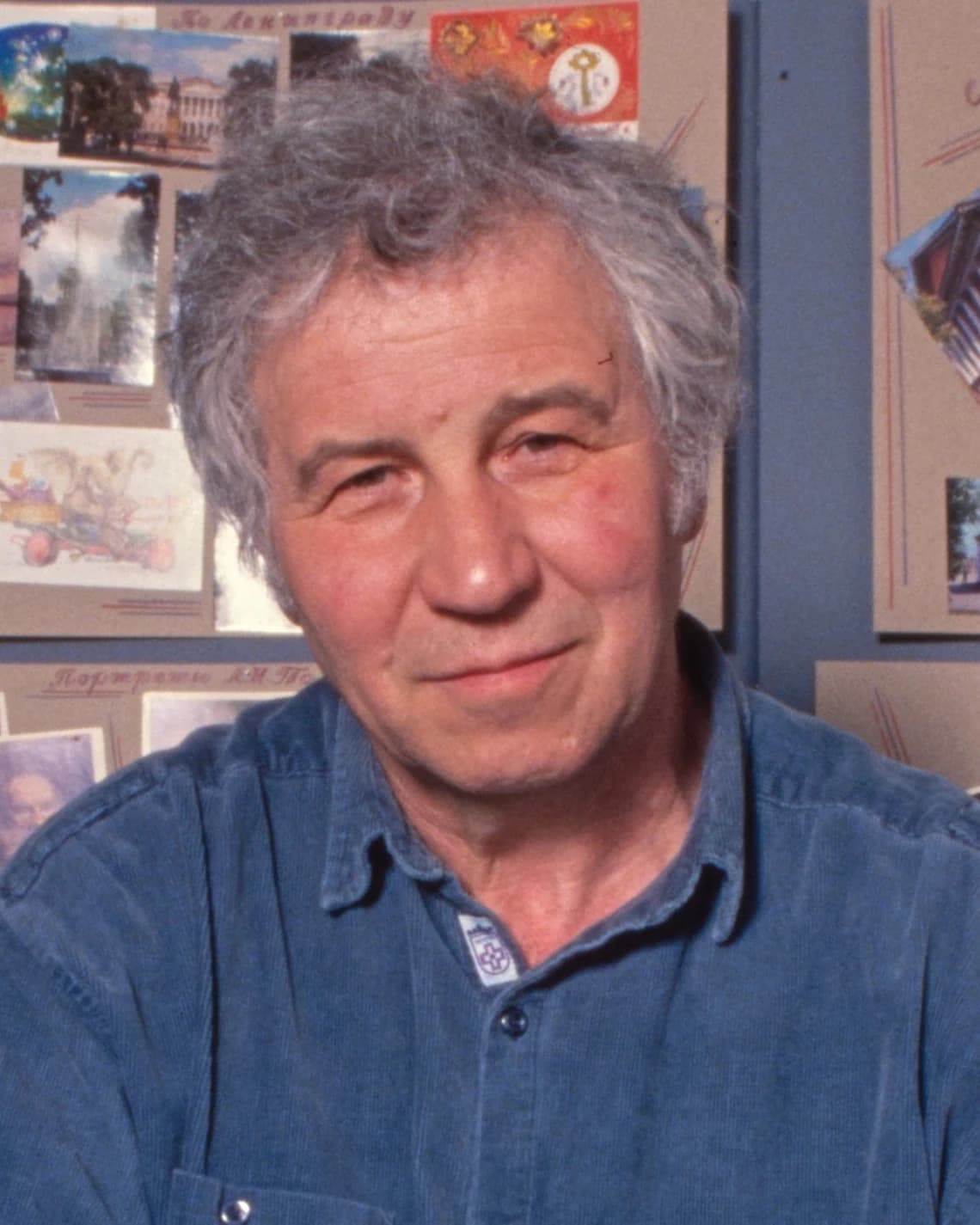
For thirty years in Moscow Ilya Kabakov (1933–2023) illustrated children’s books, some 75 titles, while “for himself” he drew albums and built installations about communal life in his attic. One of the leading figures of Moscow Conceptualism, he introduced the notion of the “total installation”. From the late 1980s he lived abroad and worked with his wife Emilia; their works are in the Hermitage, the Tretyakov Gallery, the Museum of Modern Art in New York and the Centre Pompidou.
Biography
New York, Ronald Feldman Gallery, 1988. The visitor looks into a cramped, shabby room: the walls are covered with propaganda pictures, and there is a large hole broken through the ceiling. The occupant, if the title is to be believed, flew into space straight from his room. There were plenty of reviews, and after this show the New York public remembered Kabakov’s name.
He had conceived the piece in Moscow in 1982 and put it together by the mid-1980s in his attic.
Ilya Kabakov was born on 30 September 1933 in Dnepropetrovsk, the son of Iosif Bentsionovich Kabakov, a metalworker, and Berta Yudelevna Solodukhina, an accountant. In 1941 his father went to the front, and mother and son were evacuated first to the North Caucasus, then to Samarkand. The art school attached to the Repin Institute of Painting, Sculpture and Architecture in Leningrad had also been moved there, and in 1943 the boy was admitted to it. In 1945 he was transferred to the Moscow Secondary Art School, from which he graduated in 1951. Then came the graphics department of the Surikov Institute, the book studio of Professor Boris Dekhterev, and a diploma in 1957.
While still a student, from 1956, he began illustrating books for Detgiz (later Detskaya Literatura) and drawing for the children’s magazines Malysh, Murzilka and Vesyolye Kartinki; over his Soviet years the total came to about 75 children’s books. In 1959 he was admitted to the Union of Artists, as a full member in 1962, and this gave him an income and standing. As a rule he gave three to six months a year to book work and spent the rest of the time on his own. From the second half of the 1950s he painted “for himself”. At the end of 1967, together with Ülo Sooster, he set up a studio in the attic of the former Rossiya apartment building on Sretensky Boulevard; it later became famous. In 1968, with Oleg Vassiliev, Erik Bulatov and other unofficial artists, he exhibited at the Blue Bird café. His works reached an exhibition in L’Aquila in Italy as early as 1965, and from the early 1970s they were included in Western shows of Soviet unofficial art in Cologne, London and Venice. On 16 January 1970 the Paris gallerist Dina Vierny met him in Moscow; she bought his works and in 1973 showed them in an exhibition of Moscow nonconformists at her gallery.
He refused to regard himself as a dissident. In the late 1980s, answering questions for an English-language collection on Soviet dissident artists, he said that he had fought with no one and nothing and that the term did not apply to him. I think this should be taken literally.
Between 1970 and 1976 Kabakov drew 55 albums for the series “Ten Characters”. In the mid-1970s came a triptych made of three white boards, and from 1978 the ironic “ZhEK series”. In the 1980s he almost abandoned graphic work for installations made of ordinary rubbish that played on life in communal apartments. He called such large spatial works “total installations”.
In 1987 he received his first foreign grant, from the art society in Graz, and built the installation “Before Supper” in the foyer of the opera house there. In 1988 came the Feldman show and a grant from the French Ministry of Culture, and in 1989 a fellowship from the German Academic Exchange Service and a move to Berlin. From then on he worked outside the country, lived near New York, on Long Island, and did everything together with Emilia Kabakov. Between 1983 and 2000 he produced 155 installations. There were exhibitions at the Centre Pompidou, the Museum of Modern Art in New York, the Kunsthalle in Cologne, at Documenta in Kassel (1992) and at the Venice Biennale, where in 1993 Kabakov, together with Joseph Kosuth, received a special prize.
He returned to Russia through exhibitions in the 2000s. In the autumn of 2003 the Moscow House of Photography showed documentation of his life and work; early in 2004 the Tretyakov Gallery staged the exhibition “Ten Characters”; and in June of the same year an exhibition by Ilya and Emilia Kabakov, “Incident at the Museum and Other Installations”, opened in the General Staff Building of the Hermitage. They gave two installations to the Hermitage, and according to Mikhail Piotrovsky these marked the beginning of the museum’s collection of the most recent art. In 2006 “The Man Who Flew into Space from His Room” travelled to the Guggenheim Museum for the exhibition “Russia!”, where it stood alongside icons by Rublev and Dionisy. In the autumn of 2008 the largest retrospective of the Kabakovs was held in Moscow, at three venues at once: the Pushkin Museum of Fine Arts, Vinzavod and Garage. In the same year the couple received Japan’s Praemium Imperiale in the sculpture category, and Kabakov the Order of Friendship. In 2017 Tate Modern in London showed their exhibition “Not Everyone Will Be Taken into the Future”, and the Hirshhorn Museum in Washington “The Utopian Projects”.
In August 2018 the Kabakovs gave their studio to the Tretyakov Gallery. Ilya Kabakov died on Long Island on 27 May 2023, at the age of 89.
Profile notes
Profile and sources
Image
Artist image
Gotfryd, Bernard, photographer; Wikimedia Commons; Public domain.
