
04.08.1915–27.07.1984
Igor Savitsky
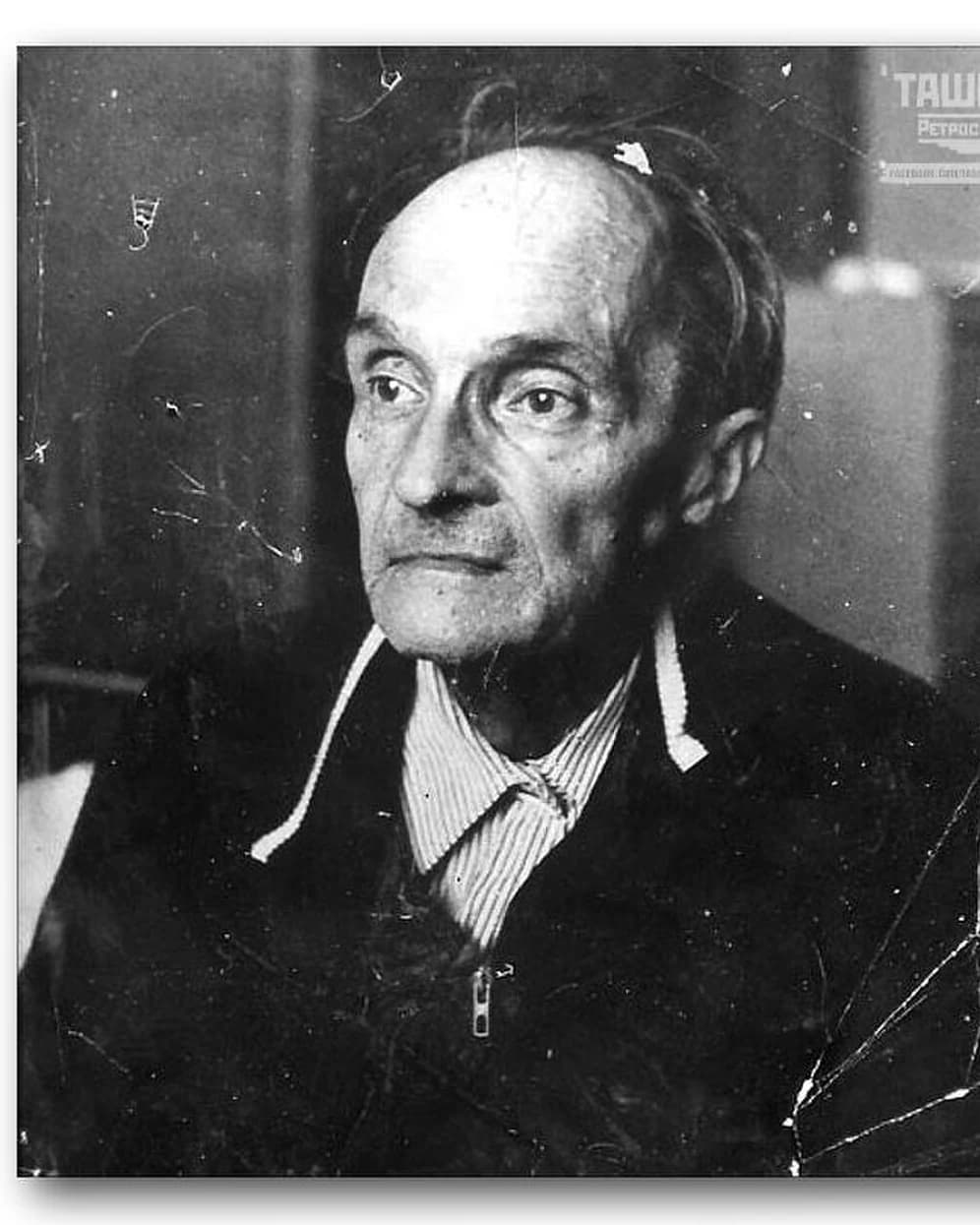
Igor Savitsky (1915–1984) graduated from the Surikov Institute as an etcher, and in 1950 went to Karakalpakstan as the artist of an archaeological expedition and stayed. He collected the folk art of the Karakalpaks, then thousands of works of Russian and Central Asian avant-garde art that were not exhibited in the USSR, and in 1966 opened a museum in Nukus that now bears his name.
Biography
At the museum in Nukus, works by Mikhail Shemyakin were for a time registered as the work of an “unknown artist”. When describing pieces by Vasily Lysenko, the director left out the artist’s name and made no mention of his having been a political prisoner. The director was Igor Savitsky, and such ruses were part of his way of collecting what could not be shown in the USSR of the 1960s.
He was born on 4 (17) August 1915 in Kiev, into a lawyer’s family. His father had Polish and Jewish roots; his maternal grandfather, Timofei Dmitrievich Florinsky, was a Slavist, a professor at Kiev University and a corresponding member of the Academy of Sciences. A French governess lived in the house, and the boy spoke French fluently. After the revolution the family moved to Moscow. There Igor trained as an electrician at the factory school of the Hammer and Sickle plant, while taking private drawing lessons from R. Mazel and E. Sakhnovskaya. From 1934 he studied in the graphic department of the Moscow Polygraphic Institute, then at the Moscow Art School in Memory of 1905, and in 1938–1941 at the Institute for the Advanced Training of Artists, in the studio of Lev Kramarenko, with whom he went on sketching trips to the Crimea and the Caucasus.
In 1941 Savitsky entered the Surikov Moscow Art Institute. Illness kept him out of the army, and from 1942 to 1944 he lived with the institute in evacuation in Samarkand. There he first saw the art of Central Asia, met Robert Falk and Konstantin Istomin, and studied painting with Nikolai Ulyanov. His diploma from the graphic faculty, in the speciality of etching, is dated 3 December 1946.
Four years after his diploma he left for Karakalpakstan, and Nukus became his home for more than thirty years.
He was invited by T. A. Zhdanko, an ethnographer with the Khorezm Archaeological and Ethnographic Expedition of the USSR Academy of Sciences, which was led by Sergei Pavlovich Tolstov. Savitsky was the expedition’s artist, but with Zhdanko he travelled around the auls collecting objects made by the Karakalpaks, a small people living among the deserts of the lower Amu Darya. These journeys took hold of him, and Karakalpak art, little studied at the time, became his main subject. The local people nicknamed him “the junk man”, though, as acquaintances recalled, without mockery. From 1956 he was a researcher in the applied art department of the Karakalpak Research Institute of Economics and Culture; from 1959 he worked at the Institute of History, Language and Literature of the Karakalpak branch of the Uzbek Academy of Sciences, and later at the Karakalpak Museum of History and Local Lore.
He did not give up painting. His Karakalpak acquaintances remembered his views from ancient fortresses: lilac walls above golden sand, ash-silver earth. He admitted to one of them that he had not expected the sands here to be so delicate. He is sometimes called the founder of the Karakalpak school of landscape painting; how far that description rests on the paintings themselves is hard for me to judge.
In 1957–1966 Savitsky organised many trips around the districts of the Karakalpak ASSR and collected jewellery, carpets, clothing, coins and carved wood. In 1963 his only book appeared, “Folk Applied Art of the Karakalpaks: Woodcarving”, and in 1964 he received the title of Honoured Art Worker of the Uzbek SSR. He convinced the authorities that a museum was needed: on 5 February 1966 the State Art Museum of the Karakalpak ASSR opened in Nukus, with Savitsky as its director. In 1968 he received the republic’s Berdakh Prize.
From there the collection went where a provincial museum does not usually go. At first Savitsky bought Central Asian artists of the Uzbek school: Alexander Volkov, Ural Tansykbayev, Nikolai Karakhan, Viktor Ufimtsev. Then he reached the Russian avant-garde and those who worked after it: Robert Falk, Mikhail Kurzin, Vera Mukhina, Kliment Redko, Lyubov Popova, Ivan Kudryashov, Vera Pestel, Solomon Nikritin, Georgy Echeistov, the Amaravella group. Many of these names were banned under Stalin and still in the 1960s, their works classed as formalism. Savitsky sought out the artists themselves or their heirs all over the country and carried canvases and sheets to Nukus by the hundreds and thousands, though he risked being branded an “enemy of the people”. I think distance helped him too: Nukus lay far from those who decided what could be shown. In 1968–1969 the collection was exhibited in Moscow, at the Museum of Oriental Art, then in Tallinn, Lvov, Leningrad, Alma-Ata, Ufa, Kazan and Tashkent. The USSR Ministry of Culture began paying for his purchases. In 1975 he was allowed to select for the museum part of the gift that Fernand Léger’s widow, Nadia Léger, had made to the ministry.
He spent his last months in a Moscow hospital and turned the ward into a study: he wrote scholarly descriptions and articles, letters to institutions and to the republic’s leadership, and negotiated new purchases with owners. He died there on 27 July 1984. A farewell was held in Moscow, at the Museum of Oriental Art, and he was buried in the Russian cemetery in Nukus; the inscription on his monument calls him a saviour of beauty.
In 1986 a solo exhibition of his paintings and graphic works was held at the same museum. In 2002 Savitsky was posthumously awarded the Uzbek order “For Outstanding Merits”. In 2010 the documentary film “The Desert of Forbidden Art” by Amanda Pope and Tchavdar Georgiev was released, in which Ben Kingsley speaks in his voice. The museum in Nukus bears his name. By the museum’s count, Savitsky’s legacy comprises 7,452 paintings, 25,223 graphic works, 1,322 sculptures, 7,562 objects of folk art, 1,902 coins and 8,618 archaeological finds.
Profile notes
Profile and sources
Image
Artist image
mytashkent.uz; Wikimedia Commons; CC BY 3.0.
