
13.03.1871–16.05.1960
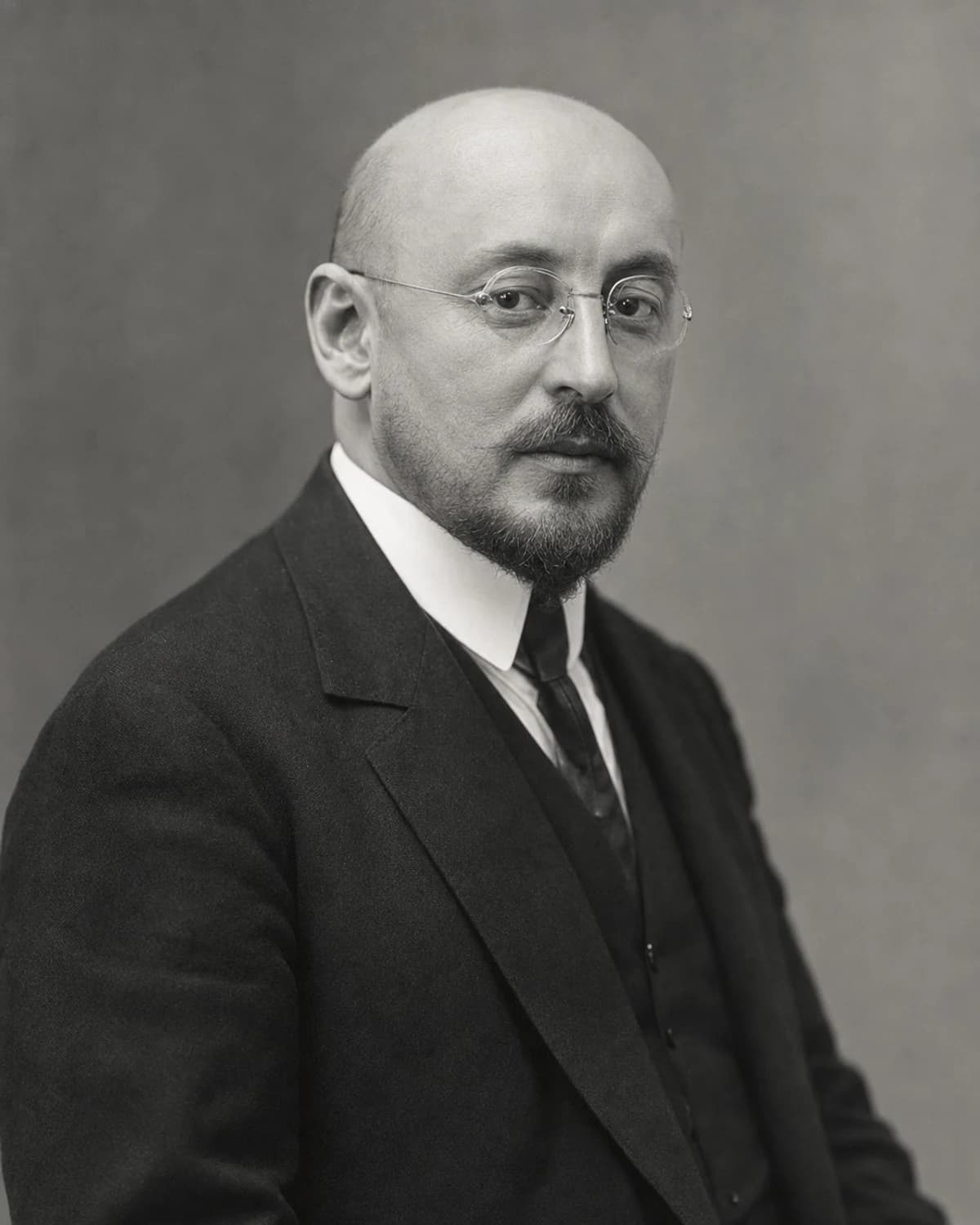
Igor Grabar
Igor Grabar (1871–1960) studied under Repin and at Anton Ažbe’s school in Munich, and painted his best-known pictures, snow and winter azure, in 1903–1907. Afterwards painting long gave way to the “History of Russian Art”, the Tretyakov Gallery and restoration: in 1918 he founded restoration workshops in Moscow that now bear his name.
Biography
Grabar himself called February to April 1904, the first months of the war with Japan, the high point of his painting. It was then that the three canvases he considered his principal works appeared: “February Azure”, “March Snow” and “Piles of Snow”. He painted in separate strokes, at times almost in dots. Malevich later remarked that without its linear perspective, a legacy of the narrative nineteenth century, “March Snow” would have merged into a continuous painterly fabric.
Snow and winter remained his favourite subjects into old age.
He was born on 25 March 1871 in Buda or Pest (there was as yet no single Budapest), into a Rusyn family. His father, the lawyer Emmanuil Grabar, held pro-Russian views and in the late 1860s was elected to the Hungarian parliament; his maternal grandfather, Adolf Dobryansky, was a well-known figure of the Russian movement in Transcarpathia and Galicia. In the early 1870s his father was forced to leave Hungary, and in 1876 he moved to Russia, passed the examination qualifying him to teach French and German, and became a teacher at the gymnasium in Yegoryevsk, in Ryazan Governorate, under the surname Khrabrov. By 1880 his sons had joined him. Igor attended the Yegoryevsk progymnasium and, from 1882, the Tsesarevich Nicholas Lyceum in Moscow, graduating in 1889 with a gold medal. He took back his real surname, spelt in Russian with a G, only in the early 1890s.
He graduated from the law faculty of St Petersburg University in 1893, but spent his time there mostly on other things: he wrote stories for magazines, edited the humour sheet Shut (“The Jester”), then worked for Niva, drew illustrations to Gogol signed “Igor Khrabrov”, and attended Pavel Chistyakov’s studio. In 1894 he entered the Academy of Arts and joined Repin’s class; among his fellow students were Jawlensky, Marianne von Werefkin, Roerich and Rylov. He soon grew disillusioned with the Academy and in May 1896 left with Dmitry Kardovsky for Munich, for Anton Ažbe’s private school. Before long he became an assistant there, and in 1899 even an equal partner of his teacher, whom he described as a weak painter, a superb draughtsman and an outstanding teacher. Munich works of these years include “Lady with a Dog” and “Lady at the Piano” (both 1899). There he also took a course in architecture at the Polytechnicum, though he never sat the final examinations.
In 1901 Grabar returned and showed twelve paintings at the World of Art exhibition; one went straight to the Tretyakov Gallery. From 1903 he lived in Moscow, was among the founders of the Union of Russian Artists, and exhibited in Paris at the Salon d’Automne and at Diaghilev’s exhibition of Russian art in 1906. His relations with the founders of the World of Art never settled: Benois remembered his patronising tone and complete lack of a sense of humour. In 1908 Grabar left the group and put down his brush for books.
The publisher Knebel entrusted him with the monograph series “Russian Artists” and then with the “History of Russian Art”. Grabar took on architecture himself when it became clear that no one had properly studied Russian buildings of the eighteenth century and earlier; he shut himself in the archives for a year. In the summer of 1909 he designed the Zakharyin Hospital, in the manner of Palladio, in what is now Khimki. The first issue came out in 1910. Early in 1915 Knebel’s printing works burned down during an anti-German pogrom, Grabar’s archive was lost with it, and the publication stopped. Of its 2,630 pages, about 650 were his own, all of them on architecture.
In 1913 he was elected trustee of the Tretyakov Gallery. Grabar rehung the collection on historical, chronological and monographic principles and bought new French painters and young Russians, which caused a loud scandal that reached the State Duma; Vasnetsov, Nesterov and Vladimir Makovsky spoke out against him. The city authorities approved the reform in 1916. In 1917 the gallery’s catalogue appeared with new attributions: for it the sitters were identified, and some four thousand works were measured and examined from the back. To my mind, this catalogue says more about Grabar than many of his landscapes. He remained trustee until the mid-1920s.
After the revolution he worked in the museum department of Narkompros, and in 1918 he set up the Central Restoration Workshops, which he ran until 1930. From 1919 his expeditions searched for icons and murals in the Russian North and in Yaroslavl and cleaned them; Rublev’s “Trinity” was restored with his participation. This work went on within a campaign of confiscating church and private valuables; Grabar accepted it as a given and tried to preserve the objects and set up local museums for them. From 1921 he taught a course in scientific restoration at Moscow University.
In 1930 he gave up his administrative posts and returned to painting. The public long took the “Portrait of Svetlana” (1933), painted in a single day, for a portrait of Stalin’s daughter, although it shows a different girl. In 1937 his autobiography “My Life” and the two-volume “Repin” were published; for the latter he received the Stalin Prize, first class, in 1941.
In 1943 Grabar proposed making good the losses of Soviet museums from the collections of Germany and its allies, and headed the bureau of experts that drew up lists of works. From 1944 he was again scientific director of the restoration workshops and director of the new Institute of Art History of the Academy of Sciences, which was preparing a multi-volume “History of Russian Art”; he worked on it to the end. In 1947 he was among those who initiated the restoration of the Andronikov Monastery and the creation there of the Andrei Rublev Museum of Old Russian Art. In 1956 he was made People’s Artist of the USSR.
Grabar died in Moscow on 16 May 1960 and was buried in the Novodevichy Cemetery. In the same year the restoration workshops he had founded were named after him.
Related context
Associations
Works connected through artistic movements, cultural context and period. Priced works available in this market appear first.








Profile notes
Profile and sources
Image
Artist image
На основе открытого изображения: Boris Kustodiev; Wikimedia Commons; Public domain.
