
30.01.1817–17.03.1876
Ignacio Merino
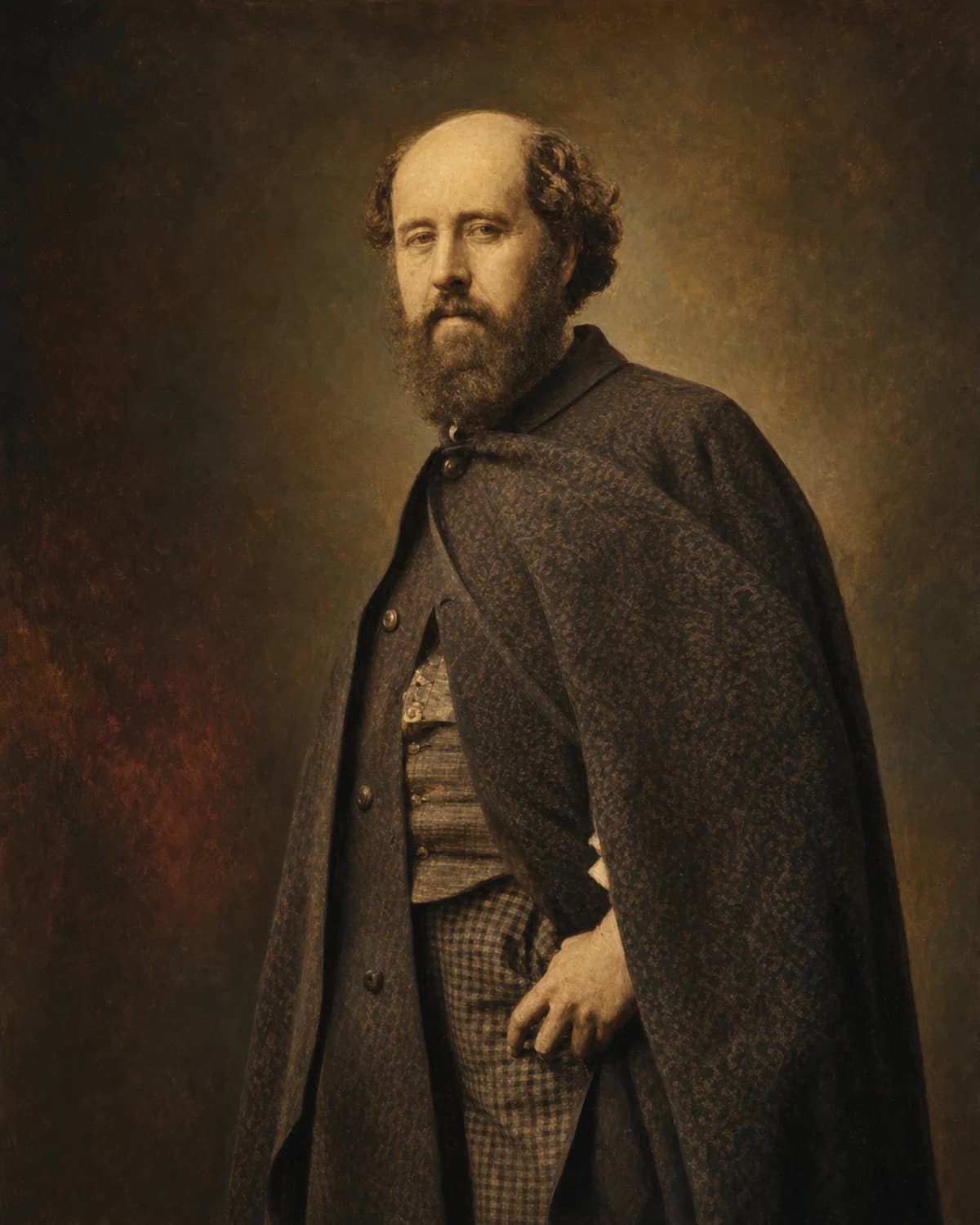
Ignacio Merino (1817–1876) was born in Piura, went to Paris to study as a ten-year-old boy and lived there, all told, for more than thirty-five years. In Lima he directed the Academy of Drawing and Painting, where Francisco Laso and Luis Montero studied with him. He painted historical and literary subjects and scenes of everyday life in Lima; in Peru he is regarded as the founder of the national school of painting.
Biography
In 1852 the Paris illustrated magazine Musée des familles published “Martin Paz”, one of the first stories by the young Jules Verne. It is set in Lima. Verne is generally thought to have taken the idea from an exhibition of costumbrista paintings by the Peruvian artist Ignacio Merino, who by then had been living in Paris again for two years.
Merino spent most of his life in France, although in Peru he is called the founder of the national school of painting.
He was born on 30 January 1817 in Piura, in the north of Peru. His father, José Clemente Merino, was a royal judge, subdelegate and military commander of the district of Piura; his mother, Micaela María Muñoz, came from an aristocratic family of Trujillo. It is said that as a very small child he drew the outlines of sailing ships in the sand of the beach. Around 1827, at the age of about ten, he was sent to study in Paris, alone, without his parents. There he completed the lycée with a baccalaureate and began to paint under Raymond Monvoisin and Paul Delaroche. From Delaroche, to whom he was closer, he kept an attachment to history: he painted European historical subjects in his teacher’s spirit, while Peruvian themes he almost always treated as genre scenes, in the costumbrista manner.
In 1838 the twenty-year-old Merino returned to Peru. He became assistant director and then director of the Academy of Drawing and Painting, founded in the days of the viceroy José Fernando de Abascal. The painters of the next generation passed through the academy: Luis Montero, Francisco Masías and Francisco Arrese, all natives of Piura, and, above all, Francisco Laso from Tacna. In the 1840s Merino painted portraits of the Peruvian saints Rose of Lima and Martín de Porres (the latter is kept in Lima Cathedral) and scenes of city life: “Jarana de Amancaes”, “Limeños en el portal”. To a subject from his own country’s history he devoted only one painting, “The Entry of General Orbegoso into Lima”, which shows Luis José de Orbegoso entering the capital after his victory in the civil war of 1834.
In 1850 he left for Paris for good, to work in the studio of Eugène Delacroix, and never returned to Peru. In 1854 a luxury edition of Esteban Terralla y Landa’s satirical poem “Lima por dentro y fuera” (1797) came out with 92 wood engravings after his drawings; he worked on it with the Paris printer A. Mézin and the draughtsman A. Jourdain. The landscapes, portraits and street scenes in this book later served him more than once as studies for canvases. To my mind, these engravings show best how he gathered the types and scenes of Lima that he then carried over into painting. His best-known picture became “Columbus before the Doctors of Salamanca”: at the Paris Exposition des Beaux-Arts, in 1863 according to one source, it won a third-class medal; it was later bought by the government of President José Balta and is now in Lima. From the same Paris period comes “The Apparition of the Archangel in the House of Tobias”. He took many subjects from Shakespeare, Walter Scott and Cervantes.
Ignacio Merino died in Paris on 17 March 1876 and was buried in Père Lachaise Cemetery. He left his paintings and part of his fortune to the Municipality of Lima. In 1925 thirty-three of his canvases became the first acquisitions of the newly founded Ignacio Merino Municipal Art Gallery, which is still open in Lima today.
Related context
Associations
Works connected through artistic movements, cultural context and period. Priced works available in this market appear first.








Profile notes
Profile and sources
Image
Artist image
На основе открытого изображения: Bibliothèque nationale de France; Wikimedia Commons; Public domain.
