
1954–present
Hossein Nuri
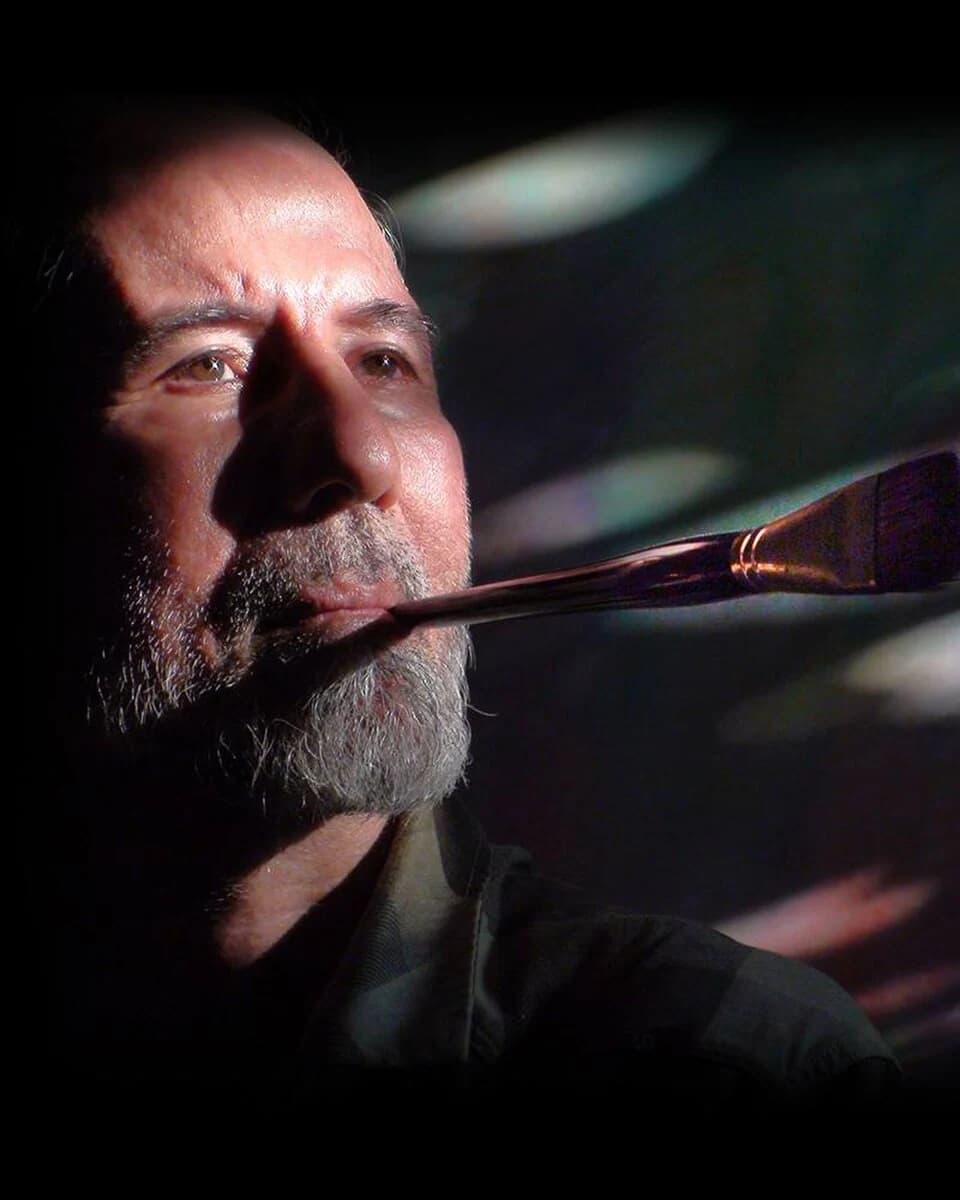
Hossein Nuri, a native of Mashhad, wrote his first play while still at school; after his arrest he lost the use of his arms and legs and began to paint with the brush held in his mouth. He is the author of plays staged in the 1980s and 1990s, the director of the film “My Arms Flew” (2019) and the creator of a painting manner called “Reflection”, shown in Paris in 2004.
Biography
In 1972 Hossein Nuri, a seventeen-year-old schoolboy, wrote a play that criticised the existing order and defended human rights. The performance was interrupted a few minutes after it began: military personnel were present at the school.
He was born on 1 July 1954 in Mashhad. His father died when he was three, and his mother raised him together with his brother, a year older. His inclination for drawing showed in primary school, where he attended specialised classes. After finishing it in Mashhad he won a scholarship and went to study in Tehran, at the Farah Industrial Boarding School. The school, according to the available accounts, was closely watched by SAVAK, the secret service of Iran under the Shah. After the performance Nuri was arrested. Under torture he lost the ability to move his arms and legs. He was moved to a hospital while remaining under SAVAK supervision, and in the end was released to his family, who were then living in Torbat-e Jam. By some accounts he spent about two years in hospital; by others he went home at once. He went on painting, holding the brush in his mouth; he uses a wheelchair.
After the revolution Nuri returned to the theatre and staged his plays in various cities. At that time, by his own account, a student of applied physics, Nadia Maftouni, saw him at a meeting with students of Sharif University of Technology in Tehran. Later Nuri lived in Torbat-e Jam, then in Mashhad and Tehran.
In the 1980s and 1990s he wrote and staged a series of plays: “The Purgatory Stop” (1981), “The Crimson Cloak” (1982), “The Last Festival” (1983), “The Circus” (1985), “Companion” (1990), “Beloved” (1991), “Intuition” (1994) and “The Seeker” (1996). It seems to me that his choice of material is telling: Nuri himself said in an interview that bringing philosophical ideas into a play for a mixed audience is difficult, and he did it all the same. “The Crimson Cloak” won first prize for playwriting at the Fajr theatre festival, held in Iran, in 1983–84 (1362 in the Iranian calendar); the play, so it is said, was also performed at the front during the Iran–Iraq War. In Mashhad a theatre is named after him: the Ustad Hossein Nuri Theater. He made documentaries and television programmes, and in the 2000s he adapted several of his own plays for television, among them “The Last Festival”, “The Circus” and “Beloved”. He took part as a co-writer in a series about the Virgin Mary: the film version was released in 2000, and the extended television version was shown on networks in many countries. In 2019 he wrote and directed the feature film “My Arms Flew”, based on events in his own life. The film was screened and awarded at festivals in Iran, India, Germany, Italy, the United States and Canada. Nuri served on festival juries in Iran and India (Jaipur, New Delhi), in 2020 was a juror at the Resistance International Film Festival, and in 2024 was program director of the Red Rock Film Festival.
In 2004, at an exhibition in Paris, Nuri presented a new manner called “Reflection” (Réflexion): a combination of improvisation and calculated design, executed in oil and acrylic on large canvases. French painters suggested the name, and he agreed. Many of the works are diptychs in which one half mirrors the other; they use many bright colours, and butterflies often appear. Over four decades he has held more than a hundred solo exhibitions in cities across Iran, as well as in Paris, Beijing, Berlin, Algiers, Beirut and Vienna.
In February 2006, during the protests against the cartoons of the Prophet Muhammad in the Danish newspaper Jyllands-Posten, Nuri brought his painting of the Virgin Mary to the Danish embassy in Tehran. He explained that he was answering ugliness with beauty. The next day a photograph of it appeared on the front pages of four Iranian newspapers, and Reuters and CNN reported on the event. Later Nuri received the state National Medal of Isar (2004–2005), and the philosopher Slavoj Žižek, speaking with Nadia Maftouni, singled him out for mention.
Profile notes
Profile and sources
Image
Artist image
Mahmoud Nuri; Wikimedia Commons; CC BY-SA 4.0.
