
26.02.1808–10.02.1879
Honoré Daumier
Honoré Daumier (1808–1879) drew for more than forty years for the Paris satirical papers La Caricature and Le Charivari: some four thousand lithographs of kings, deputies, judges and ordinary citizens. A caricature of Louis Philippe cost him six months in prison. The public hardly noticed his painting in his lifetime, but Baudelaire, Delacroix and Corot valued it; the first exhibition of his pictures was held a year before his death.
Biography
In 1834 the police noticed, in the window of the print dealer Ernest Aubert in the Galerie Véro-Dodat in Paris, a lithograph by Honoré Daumier, “Rue Transnonain, 15 April 1834”. The sheet showed the massacre that ended the April riots in Paris, and it had been made for the subscription publication L’Association mensuelle, whose proceeds went to defend the freedom of the press and to cover the legal costs of Le Charivari. The police tracked down and seized as many impressions as they could, together with the lithographic stone. All the sheets known today survived that raid.
Daumier was twenty-six, and he already knew prison.
He was born on 26 February 1808 in Marseille. His father, Jean-Baptiste Louis Daumier, a glazier and frame-maker, wrote verse and plays and in 1814 left for Paris in search of literary fame; two years later his wife and son followed. A book of verse was published and an amateur troupe staged a play, but the family lived in want, and at about twelve Honoré went to work: as an errand boy for a bailiff, then in Delaunay’s bookshop at the Palais-Royal, where artists dropped in. There he began to draw, and he spent his free time in the Louvre. In 1822 his father’s friend Alexandre Lenoir, founder of the Musée des Monuments français, took him in hand, and a year later the young man entered the Académie Suisse, where one could draw from the live model. Charles Ramelet taught him lithography, and in the late 1820s Daumier, often without signing, made advertisements, street scenes, portraits and caricatures for the publisher Zéphirin Belliard.
After the July Revolution of 1830 left-wing satirical papers sprang up in Paris, and Daumier, a convinced republican, went to work for them: first La Silhouette, then Charles Philipon’s La Caricature, where Grandville and Raffet drew alongside him and the young Balzac was literary editor. He is credited with saying that this fellow had Michelangelo in his blood. In December 1831 “Gargantua” appeared, a caricature of King Louis Philippe. In February 1832 Daumier was convicted of inciting hatred of the government and insulting the king and sentenced to six months in prison and a fine, but the sentence was suspended, and he carried on in the same vein. In August, after another print, he was arrested at his parents’ flat and sent to the prison of Sainte-Pélagie; from there he wrote that he was drawing a great deal, just to annoy the government. He was released on 14 February 1833. In the same years he modelled caricature busts of deputies in unbaked clay, the “Célébrités du Juste Milieu”; thirty-six survive, and they were cast in bronze only in the twentieth century.
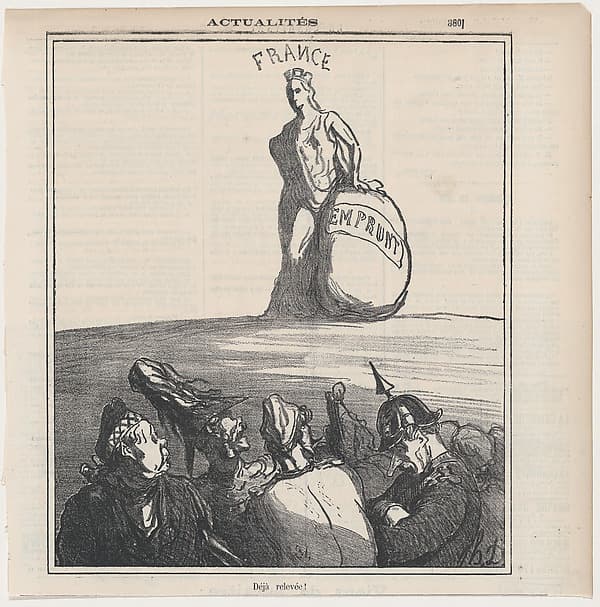
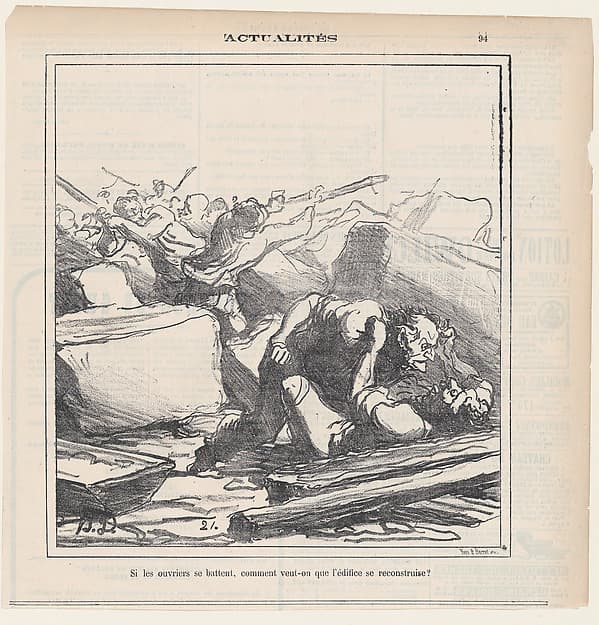
After Fieschi’s attempt on the king’s life, the September Laws of 1835 put an end to direct political caricature. By then Philipon was publishing Le Charivari, and Daumier, now working there, turned to manners. From 1836 came a hundred sheets on the swindler Robert Macaire, hero of a popular melodrama, then series on the newly invented photography, on Parisians, on the theatre. From 1845 appeared “Les Gens de justice”, merciless judges and greedy lawyers; it is thought that his time with the bailiff left its mark here. Money was still short: in April 1842 his furniture was sold at auction to pay his debts. In 1846 he married a seamstress, Alexandrine Dassy, and settled on the Île Saint-Louis, on the Quai d’Anjou, where he lived until 1863. Writers and artists gathered in the neighbouring Hôtel Lauzun; there Daumier met Baudelaire, who called him one of the most important men in caricature, and in modern art as well. Delacroix copied his drawings in order to learn from them.
The Revolution of 1848 briefly restored the freedom of the press. Daumier’s oil sketch “The Republic”, entered in the competition for an allegory of the new government, made the final twenty, but he never developed it; he was already known for missing deadlines. A commission from the Ministry of the Interior received in 1849 he dragged out for fourteen years, and in the end he gave the state a gouache, “The Drunkenness of Silenus”. In 1850 he invented Ratapoil, an agent of Bonapartist propaganda, and modelled a statuette of him; after the coup of 2 December 1851 politics left his prints again.
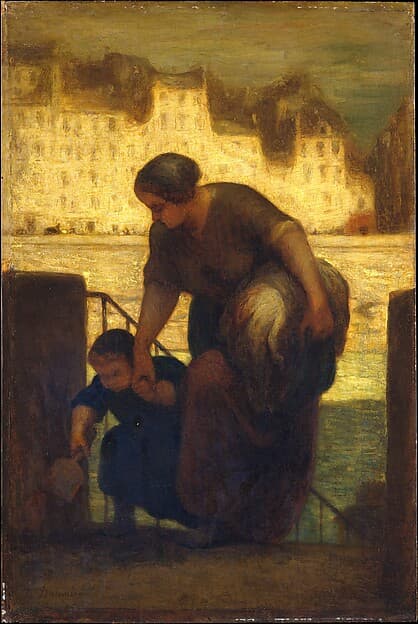
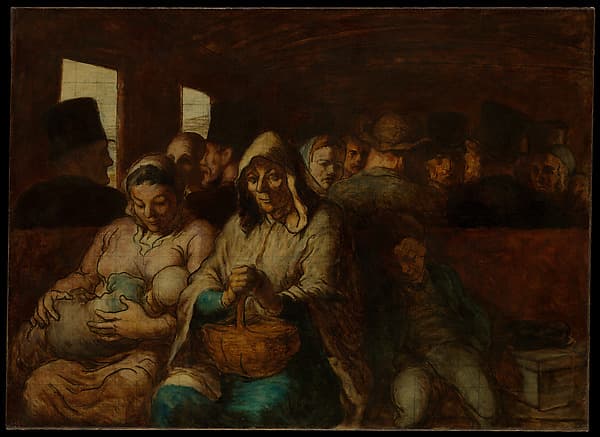
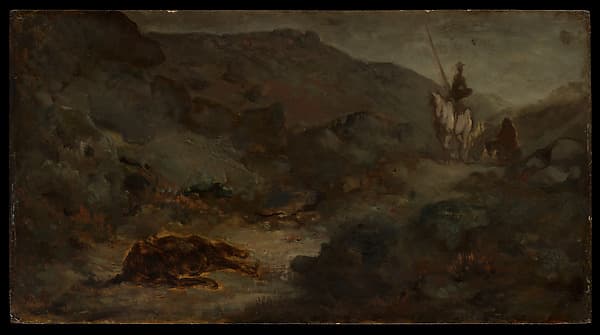
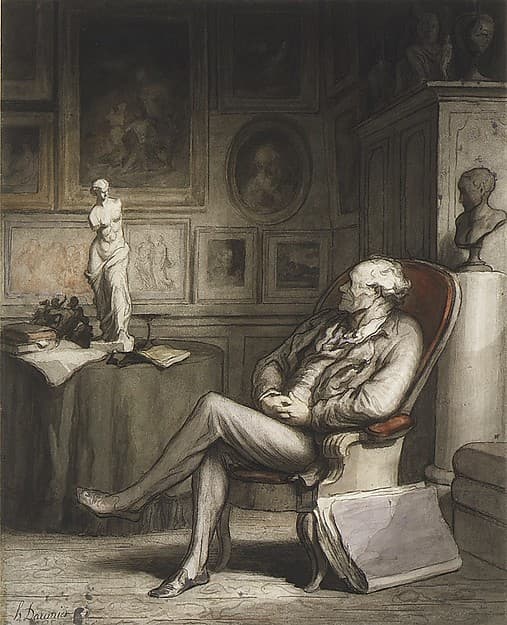
He took painting ever more seriously. In 1849 he showed at the Salon for the first time, with “The Miller, His Son and the Ass”, and from 1853 he spent his summers at Valmondois and Barbizon near Corot, Daubigny, Millet and Rousseau. He painted lawyers, the theatre, travelling players, print collectors, “The Laundress” (1861), “The Third-Class Carriage” (1864), emigrants, Don Quixote, sometimes the same subject up to twenty times. The public did not notice these pictures; fellow artists valued them. In 1860 Le Charivari let him go, and hard years followed: Daumier sold his furniture, in 1863 left the Île Saint-Louis for Montmartre, and returned to the paper only under a new contract. From 1865 he lived at Valmondois. Corot, the story goes, secretly bought the little house Daumier rented and gave it to him, adding that he was doing it not for his friend’s sake but to annoy the landlord. The tone, to my mind, is the same as in Daumier’s own letters from Sainte-Pélagie.
Daumier’s eyesight was failing; he published his last political lithograph on 24 September 1872. He twice declined the Legion of Honour, under the Empire and under the Republic, but in 1877 he accepted a state pension. In 1878 friends organised the first retrospective of his painting at Durand-Ruel’s, 94 pictures and 200 drawings; it was prepared by a committee headed by Victor Hugo. It brought no money, but it changed the view of Daumier as a painter.
He died at Valmondois on 10 February 1879. A year later his body was moved to the Père Lachaise cemetery in Paris and buried beside Corot and Daubigny.
Artist works
Works by the artist
Works by Honoré Daumier available in this edition of NEOARCA.
Related context
Associations
Works connected through artistic movements, cultural context and period. Priced works available in this market appear first.








Profile notes
Profile and sources
Image
Artist image
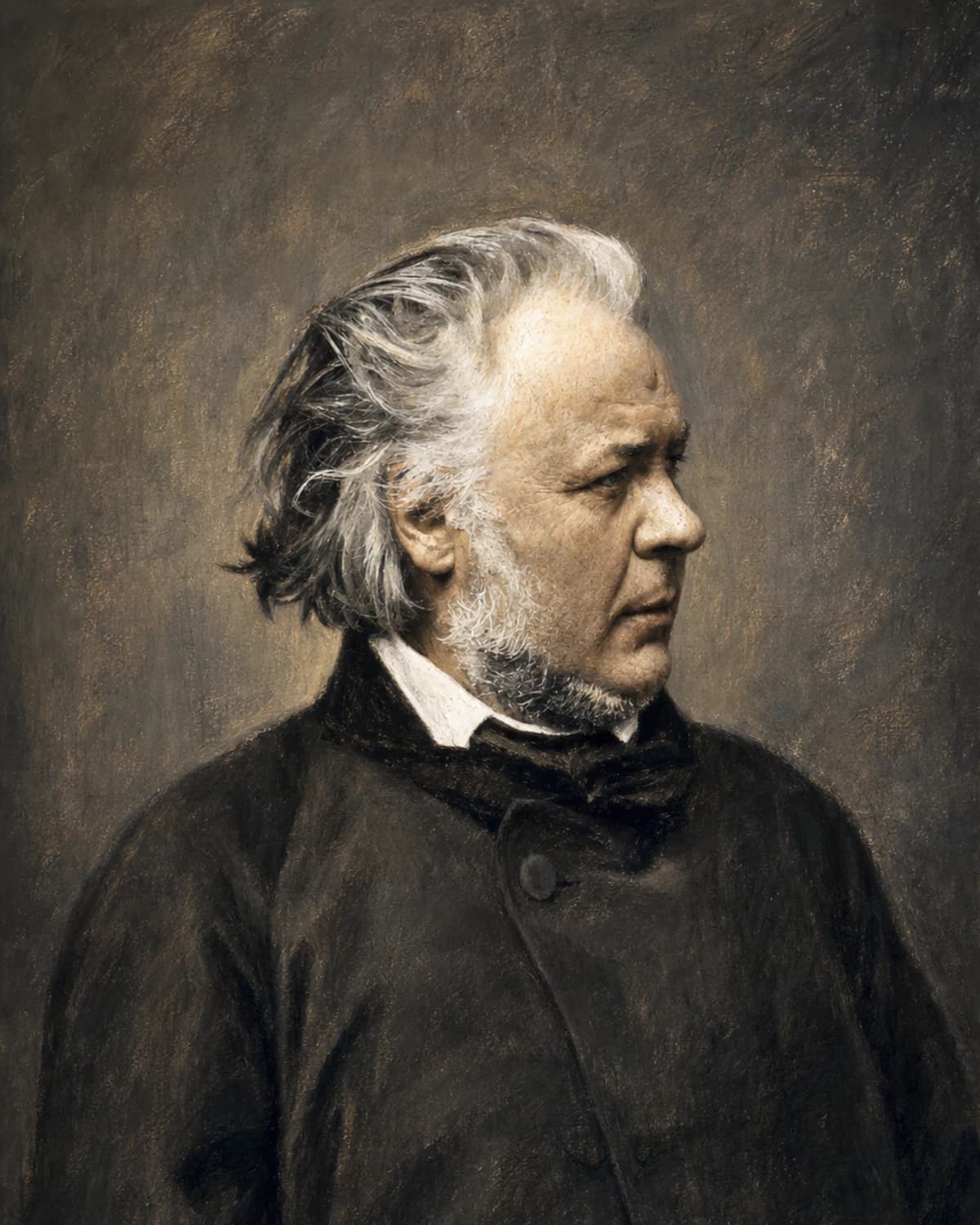
На основе открытого изображения: Nadar; Wikimedia Commons; Public domain.
