
31.10.1760–10.05.1849
Hokusai
Hokusai (1760–1849) worked in Edo for about seventy years and changed his artistic name at least thirty times. He began in the studio of Katsukawa Shunshō with pictures of kabuki actors, went on to illustrate books and publish the “Hokusai Manga”, and after seventy made the series “Thirty-Six Views of Mount Fuji”, with “The Great Wave off Kanagawa”. In the nineteenth century his prints had a strong influence on European artists.
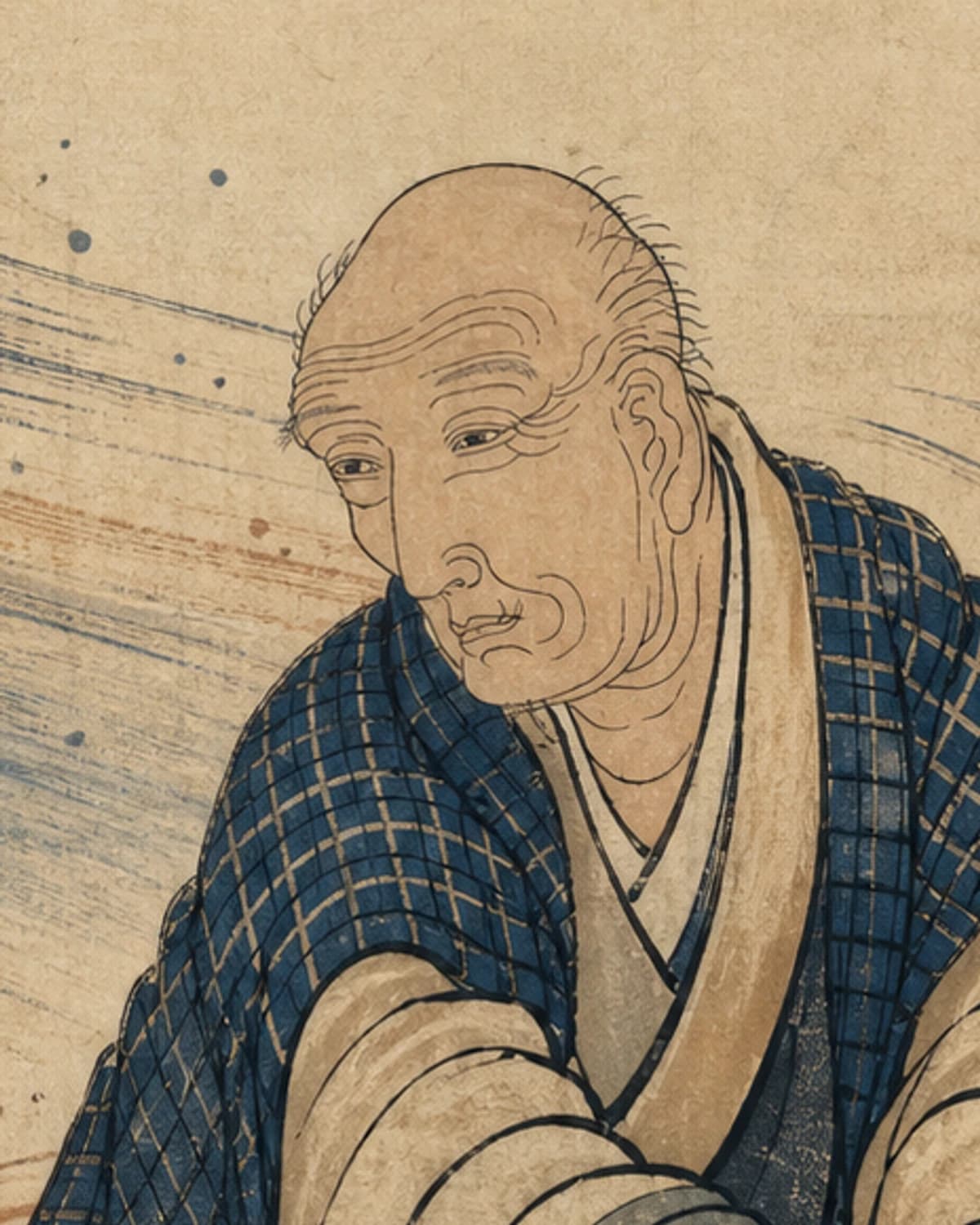
Biography
In 1834 Hokusai, by then past seventy, wrote an afterword to the book “One Hundred Views of Mount Fuji”. Its gist is roughly this. I have been drawing since I was six, but nothing I made before seventy is worth anything. At seventy-three I came to understand something of the structure of animals, birds, insects and fish, and of how grasses and trees grow. I shall keep improving; by ninety I shall reach the essence of things, and by a hundred and ten every dot and every line of mine will be alive. He signed it with a new name: Gakyō Rōjin Manji, “the Old Man Mad about Painting”.
There is a joke in this, but no pose. He thought of himself as a student to the end.
He was born in 1760 (on 31 October, by the traditional conversion from the Japanese calendar) in Edo, today’s Tokyo, in the Honjo quarter of Katsushika district. The name by which he is known, Katsushika Hokusai, comes from that district. His childhood name was Tokitarō. According to tradition, the boy was adopted by a craftsman who made mirrors for the shogun’s court; how true that is would be hard to say, since little is known about his early years. What is known is that as a teenager he trained with a woodblock cutter. The cutter transfers someone else’s drawing onto the block, and Hokusai knew that craft from the inside when he later came to draw for cutters himself.
Around 1778 he entered the studio of Katsukawa Shunshō, famous for his pictures of kabuki actors, and was given the name Shunrō. Edo was then a huge city of theatres, pleasure quarters, cheap books and comic verse. Ukiyo-e, “pictures of the floating world”, served it as popular print, advertising and fashion all at once.
Hokusai could not stay within one school. He studied Kanō painting and Chinese painting, and pored over Dutch prints with their unfamiliar perspective. He had no fewer than thirty names: Shunrō, Sōri, Hokusai, Taitō, Iitsu, Manji and others. Even by the standards of Japanese artists, for whom a change of name was quite ordinary, this is a record, and a new name usually meant a new period. He is said to have moved house about ninety times (the figure comes from anecdotes and is hard to check).
For a long time he made his living from illustration: novels, poetry collections, surimono (expensive prints made to private order, for the New Year, for instance). And he knew how to put on a show. In 1804, at a festival in Edo, he painted a huge Daruma, the founder of Zen Buddhism, with a broom and buckets of ink; the picture is said to have covered about two hundred square metres. On 5 October 1817 he repeated the act in Nagoya, at the Hongan-ji temple: a sheet eighteen metres by eleven, a crowd of onlookers, a popular song made up about the event, and the nickname “Master Daruma” for the artist himself. The original was destroyed in 1945, but the handbills Hokusai gave out to advertise the performance survive; they are kept in the Nagoya City Museum.
In 1814 the first volume of the “Hokusai Manga” came out in Nagoya. “Manga” here means “random sketches”; at the time the word had nothing to do with comics. It was meant as a manual for pupils and a way to earn a little extra, and it turned into an encyclopedia: people at work, acrobats, fish, plants, spirits, grimaces. By 1820 twelve volumes had appeared, and three more were published after his death.
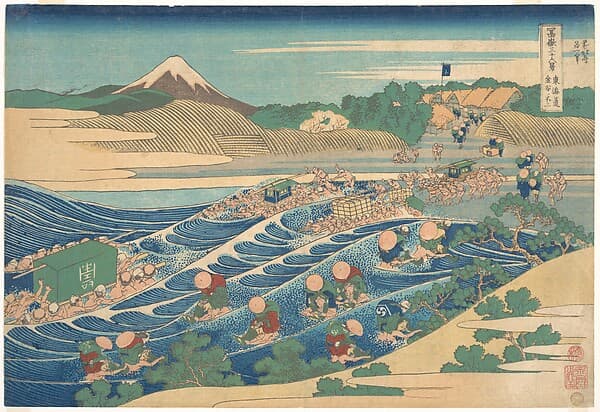
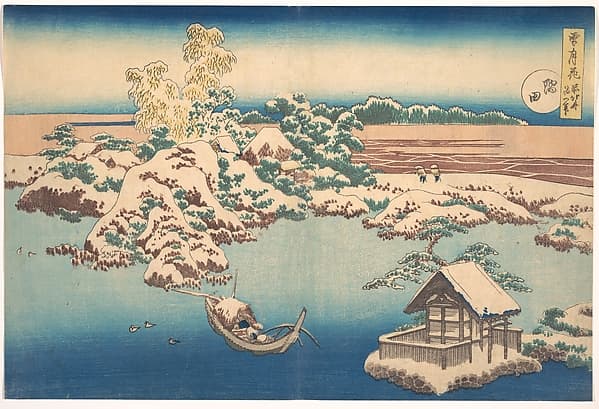
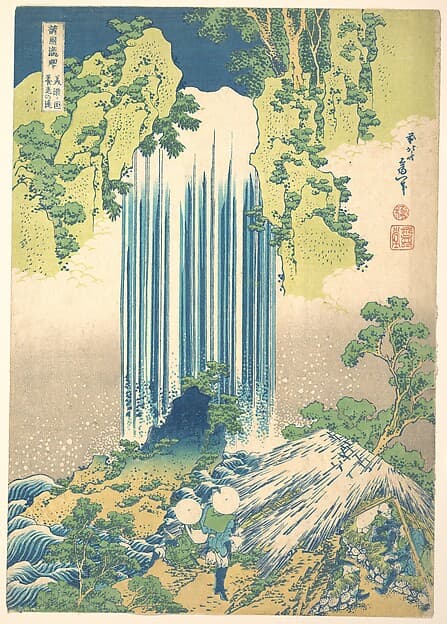
The thing we connect with Hokusai first of all came out around 1830–1832, when he was already past seventy: “Thirty-Six Views of Mount Fuji”. The series sold so well that ten more sheets were printed for it. The mountain behaves differently from print to print. In “Red Fuji” it fills the whole sheet. In “The Great Wave off Kanagawa” it is a small triangle in the distance, while in the foreground the crest of a wave, with claw-like fingers, hangs over the boats. The blue of the series depends on Prussian blue, an imported pigment that Japanese printers had only just begun to use. Then followed “A Tour of the Waterfalls of the Provinces”, “Unusual Views of Celebrated Bridges in the Provinces” and the book series “One Hundred Views of Mount Fuji”.
In his last years he lived in poverty, and working beside him was his daughter, Katsushika Ōi, a strong artist in her own right. Where her hand ends and her father’s begins in the late works is something specialists are still trying to settle. At eighty-three Hokusai went to Obuse in Shinano Province at the invitation of a wealthy patron, Takai Kōzan, and lived there for several years. He painted the ceilings of festival carts (“Male Wave” and “Female Wave”) and the ceiling of the Ganshō-in temple. He died on 10 May 1849 in Edo, in the Asakusa quarter. Before he died, so the story goes, he said: if heaven gave me ten more years, no, even five, I would become a real painter. He is buried at the Seikyō-ji temple.
His books reached Europe in the middle of the nineteenth century. Félix Bracquemond, Edgar Degas and Claude Monet leafed through volumes of the “Manga”; asymmetry, the cropped edge, the flat patch of colour and the high viewpoint passed from the Japanese to the Impressionists. Van Gogh wrote to his brother about “The Great Wave”. And when the score of Debussy’s symphonic sketches “La Mer” was published in 1905, the same wave went on the cover.
Artist works
Works by the artist
Works by Hokusai available in this edition of NEOARCA.


Related context
Associations
Works connected through artistic movements, cultural context and period. Priced works available in this market appear first.





Profile notes
Profile and sources
Image
Artist image
На основе открытого изображения: missing name; Wikimedia Commons; CC0.
