
1797–12.10.1858
Hiroshige
Utagawa Hiroshige (1797–1858), a master of the Japanese colour woodblock print, ukiyo-e, made the road and the weather the real subjects of his prints: travellers in rain and snow, the stations of the Tōkaidō, mist over Edo. His best-known series are “The Fifty-three Stations of the Tōkaidō” and the vertical “One Hundred Famous Views of Edo”. Monet and Van Gogh collected his prints, and in Russia Bilibin and Dobuzhinsky looked to him.
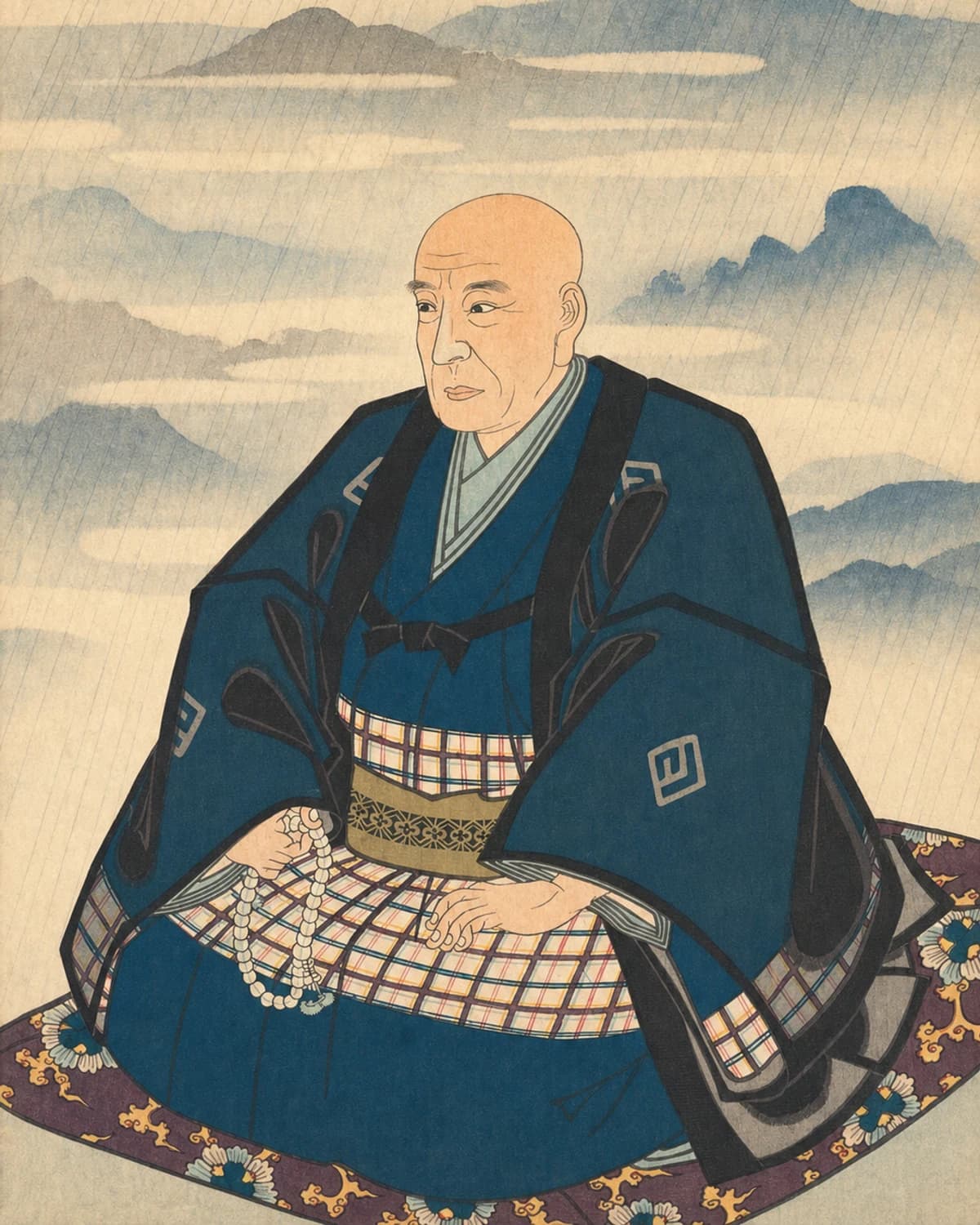
Biography
In 1832 an official procession set out from Edo for Kyoto, and travelling with it along the Tōkaidō road was the artist Andō Tokutarō, who signed his prints with the name Hiroshige. His official position got him a place in it: he was registered as a fire warden, which carried the small privileges of the lowest samurai class. On the way he made sketches.
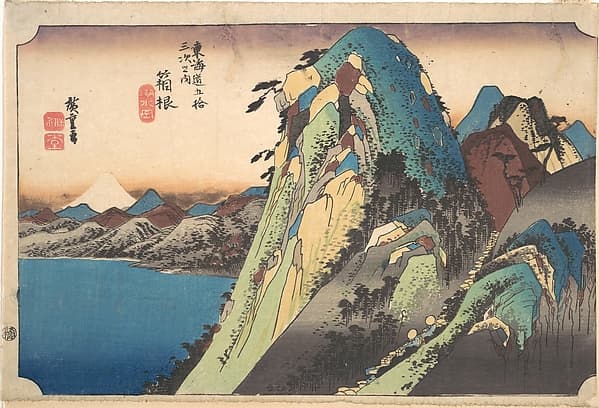
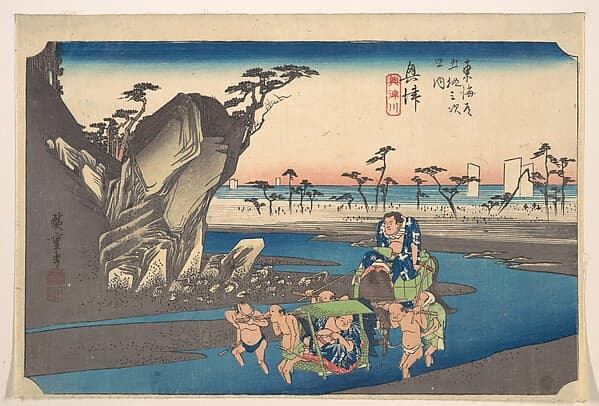
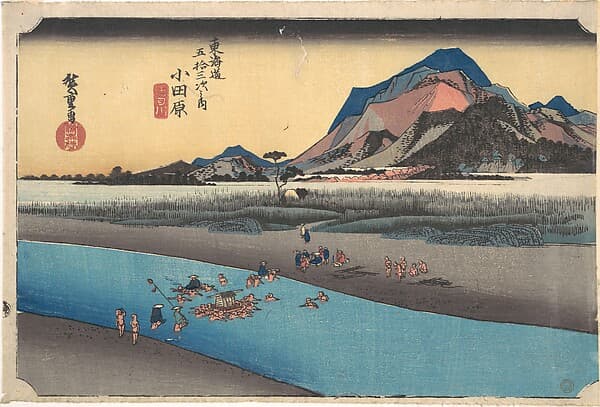
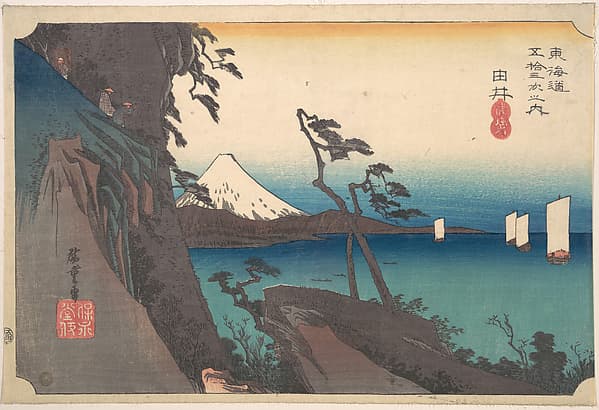
From them came “The Fifty-three Stations of the Tōkaidō” (1833–1834). Some 490 kilometres of road, station by station, with dates, place names and the stories of fellow travellers, and sometimes with episodes from Jippensha Ikku’s “Hizakurige”, a comic novel about two hapless travellers on the same highway. The series sold so well that it had to be issued in three versions, one of them made together with Kunisada.
He was born in 1797 in Edo, by the Yayosu quay in the Yaesu district, into a samurai family. His great-grandfather had served the Tsugaru clan in the north, his grandfather taught archery, and his father, adopted into the Andō family, inherited the post of fire warden for the quay. His mother died early in 1809 and his father in the same year, having managed to pass his post on to his twelve-year-old son: looking after fire safety at Edo Castle. The post left plenty of free time. At about ten the boy studied Kanō-school painting with Okajima Rinsai, who lived in the same fire barracks, and at around fourteen he took up painting in earnest and asked to be taken on as a pupil by Toyokuni of the Utagawa school. Toyokuni had too many pupils, and on a librarian’s recommendation another master of the same school, Toyohiro, accepted him. In 1812 the young man was allowed to sign his work, and he chose the name Hiroshige. Besides the Utagawa manner he studied the academic Kanō school, the Chinese-influenced nanga, the realistic Shijō school and, apparently, Western linear perspective.
His first years went on the usual Utagawa wares: book illustrations, beauties, kabuki actors. In 1823 he handed the fire warden’s post on to his son. When Toyohiro died in 1828, Hiroshige declined to become his successor.
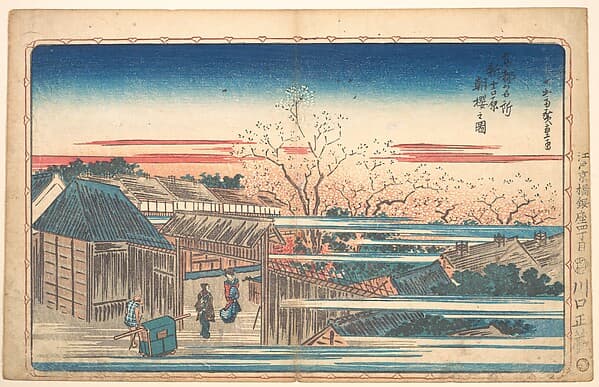
The landscapes began around 1829–1830, with “Eight Views of Ōmi”; at the same time he was drawing more and more birds and flowers. Around 1831 came “Famous Places in the Eastern Capital”, which show the influence of Hokusai, whose “Thirty-six Views of Mount Fuji” had just been published. Hokusai builds a print rigidly and boldly. Hiroshige, I think, cares more about the state of the air than the shape of the mountain: he printed a single area several times over and made wide use of bokashi, a smooth gradation of colour, although both techniques meant extra work for the printers.
He never went further west than Kyoto, so his views of Naniwa (present-day Osaka) and Ōmi Province were drawn from book illustrations.
His first wife once sold some of her clothes and combs to pay for his sketching trips. She died in October 1838, and Hiroshige married Oyasu, sixteen years his junior, the daughter of a farmer from Tōtōmi Province. Around the same time came the two series “Eight Views of the Edo Environs”, in which every print is accompanied by a comic kyōka poem. In 1835–1842, together with Keisai Eisen, he published “The Sixty-nine Stations of the Kisokaidō”: of the seventy prints, forty-six are his. In “Famous Views of the Sixty-odd Provinces” he was one of the first to turn the landscape print upright. How much he made in all is hard to say: the figures given range from 5,400 prints to more than eight thousand works. He was paid little for a series, his income was roughly twice a day labourer’s wage, and in his will he left instructions for paying off his debts.
In 1856 Hiroshige withdrew from the world and took Buddhist vows. That same year he began “One Hundred Famous Views of Edo”, which he himself considered his best work. The money for the series was advanced by a wealthy Buddhist priest who was in love with the daughter of the publisher, Uoya Eikichi, a former fishmonger. The prints are vertical, and in the foreground there is often something huge, cut off by the edge of the sheet: a branch, a post, part of a person or an animal, while the landscape recedes far into the distance. The device came from Western art and was there to create depth. The series was printed lavishly, with mica for shimmer, embossing and glue-mixed pigment for gloss. In all, 118 prints were issued.
It was this series that Europe took to. Van Gogh copied two prints from his own collection, Monet studied Hiroshige’s compositions closely, and his influence has been traced in Whistler and Cézanne. In 1883 Louis Gonse, director of the Gazette des Beaux-Arts, called him the finest landscape painter of the nineteenth century. Dobuzhinsky later admitted that whenever he chose an unexpected viewpoint for a composition he kept Hiroshige’s example constantly before his eyes. The deep blue of his prints, often mistaken for indigo, was made from a pigment brought from Europe; in the West it came to be called “Hiroshige blue”.
He had several pupils. A young printmaker, Shigenobu, married his daughter Otatsu and after his teacher’s death took the name Hiroshige II; the marriage broke up in 1865, Otatsu married another pupil, Shigemasa, and he became Hiroshige III. Both worked in their master’s manner, but neither achieved his success.
Hiroshige died in Edo on 12 October 1858, aged sixty-two, leaving a farewell poem, and was buried at a Zen temple in Asakusa. “One Hundred Famous Views of Edo” went on being printed without him; two of the prints were added by Hiroshige II.
Artist works
Works by the artist
Works by Hiroshige available in this edition of NEOARCA.


Related context
Associations
Works connected through artistic movements, cultural context and period. Priced works available in this market appear first.






Profile notes
Profile and sources
Image
Artist image
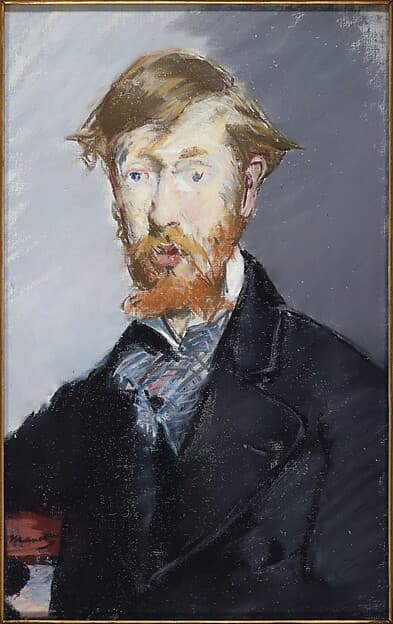
На основе открытого изображения: Utagawa Kunisada; Wikimedia Commons; CC0.
