
26.10.1862–21.10.1944
Hilma af Klint
Hilma af Klint (1862–1944) painted her first series of abstract pictures for the “Temple” in 1906, at the age of forty-four, well before the first non-objective works of Kandinsky, Malevich and Mondrian. She did not exhibit these canvases and left more than 1,200 works and about 150 notebooks. The wider public saw them only in the 1980s.
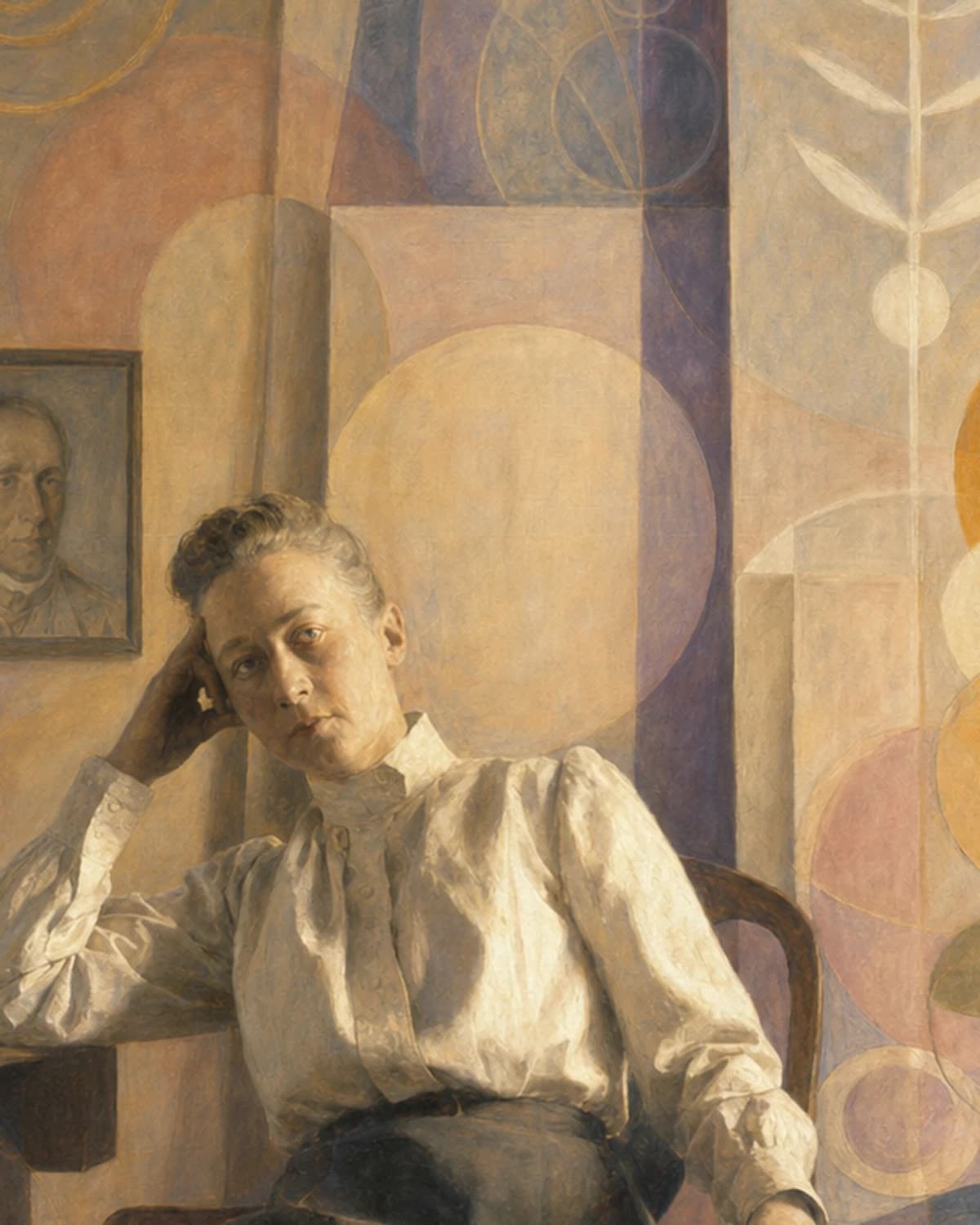
Biography
In the late 1970s the Moderna Museet in Stockholm was offered, as a gift, the paintings of a Swedish artist who had died more than thirty years earlier. The museum declined. Forty years later the same museum signed a long-term cooperation agreement with the foundation bearing her name, and a Hilma af Klint Room opened there.
She was born on 26 October 1862 in Karlberg, in Solna, the fourth child of Victor af Klint, a naval officer, and Mathilda Sonntag. The family spent summers at their farm, Hanmora, on Lake Mälaren; from her father Hilma inherited an interest in mathematics, and her impressions of nature later echoed in the plant motifs of her paintings. The family moved to Stockholm, and she studied at the Technical School (now Konstfack), then at the Royal Academy of Fine Arts, from 1882 to 1887, working in portraiture, botanical drawing and landscape, and graduated with honours. The Academy gave her a studio in the building on Hamngatan. There she painted landscapes, portraits and botanical drawings and lived on what they earned; for an unmarried woman of the time, such independence was rare.
Another life ran alongside. In 1880 her younger sister Hermina died, and spiritual inquiry became the main concern of Hilma’s life. She took part in séances, read Helena Blavatsky and took an interest in Rosicrucianism. At the Academy she met Anna Cassel, and later, together with Cornelia Cederberg, Sigrid Hedman and Mathilda Nilsson, she formed the group The Five (De Fem). From 1896 to 1906 they met on Fridays: prayer, meditation, a reading from the New Testament, a séance. The “messages” they received were written down. According to her notes, “spiritual guides” named Gregor, Clemens, Amaliel and Ananda made contact with them. As early as 1896 she made her first “automatic” drawings.
In 1906, by her own account, she was commissioned to paint pictures for the “Temple”. She recalled that the canvas came without sketches, that she did not know what would be depicted, and that she did not change a single brushstroke. The work went on in two phases, in 1906–1908 and 1912–1915. The series comprises about two hundred paintings (the sources give 193 and 196), grouped in sub-series. The Ten Largest date from 1907: canvases of roughly 240 × 320 cm on the stages of human life, from childhood to old age. In her scheme blue stands for the female principle, yellow for the male, pink and red for love, physical and spiritual. The paintings are full of letters, words, spirals, shells and lilies. The critic Daniel Birnbaum suggests that Anna Cassel may have had a hand in the Temple paintings too.
In 1908 the Austrian mystic Rudolf Steiner, founder of the Anthroposophical Society, saw her work in Stockholm. He did not interpret it, and said it would not be understood for another fifty years. Hilma, apparently, stopped painting for four years afterwards. Later she herself asked Steiner whether the work should be preserved; the answer was that it should not be destroyed.
After the Temple, the “spiritual guidance”, as she believed, came to an end. She went on painting without it, more often in watercolour and on a smaller scale. In 1917 she had a studio on Munsö, next to her cottage, Furuheim. After her mother’s death in 1920 she settled with Thomasine Andersson, her mother’s former nurse, and in the 1920s she spent long periods in Dornach, in Switzerland, at the centre of the Anthroposophical Society, studying its archives. Motifs from anthroposophy appeared in her work.
It is commonly held that she never showed her abstract works. But Julia Voss has found evidence to the contrary: in 1928 Hilma travelled to London for the World Conference on Spiritual Science, taking large paintings with her, and they were shown there. To my mind this alters the familiar image of a recluse, although which canvases she took, probably from the Temple series, remains a supposition.
She died on 21 October 1944 in Djursholm near Stockholm (administratively this is Danderyd) after a traffic accident. She is buried at Galärvarvskyrkogården in Stockholm.
She left more than 1,200 paintings and about 125 notebooks to her nephew, Vice Admiral Erik af Klint, on condition that they not be shown for twenty years. The boxes were opened in the late 1960s, and few people knew what was in them. In 1986 her works were shown in Los Angeles at the exhibition “The Spiritual in Art: Abstract Painting 1890–1985”, organised by Maurice Tuchman. This is generally regarded as the beginning of the international recognition of her art.
Related context
Associations
Works connected through artistic movements, cultural context and period. Priced works available in this market appear first.








Profile notes
Profile and sources
Image
Artist image
На основе открытого изображения: Anonymous Unknown author; Wikimedia Commons; Public domain.
