
1450–08.1516
Hieronymus Bosch
Hieronymus Bosch, born Jeroen van Aken, lived all his life in ’s-Hertogenbosch in Brabant, belonged to the town’s Brotherhood of Our Lady and painted heaven, hell and human sins on oak panels, peopled with unheard-of hybrids. His “Garden of Earthly Delights”, “Haywain” and “Seven Deadly Sins” were bought by Philip II of Spain and are now in the Prado. About twenty-five paintings are now accepted as his beyond dispute.
Biography
In the middle of the panel a huge eye is painted. In the pupil stands Christ with his hand raised in blessing, and beneath him is the inscription: “Beware, beware, God sees.” Around the pupil are rays, and where the iris would be there are seven little scenes, one for each deadly sin: anger, pride, lust, sloth, gluttony, avarice, envy. This is “The Seven Deadly Sins and the Four Last Things”, a tabletop bought at the end of the sixteenth century by Philip II of Spain; it is now in the Prado. Even this piece is not entirely certain: specialists of the Bosch Research and Conservation Project allow that it may have been painted by the workshop rather than by the master himself.
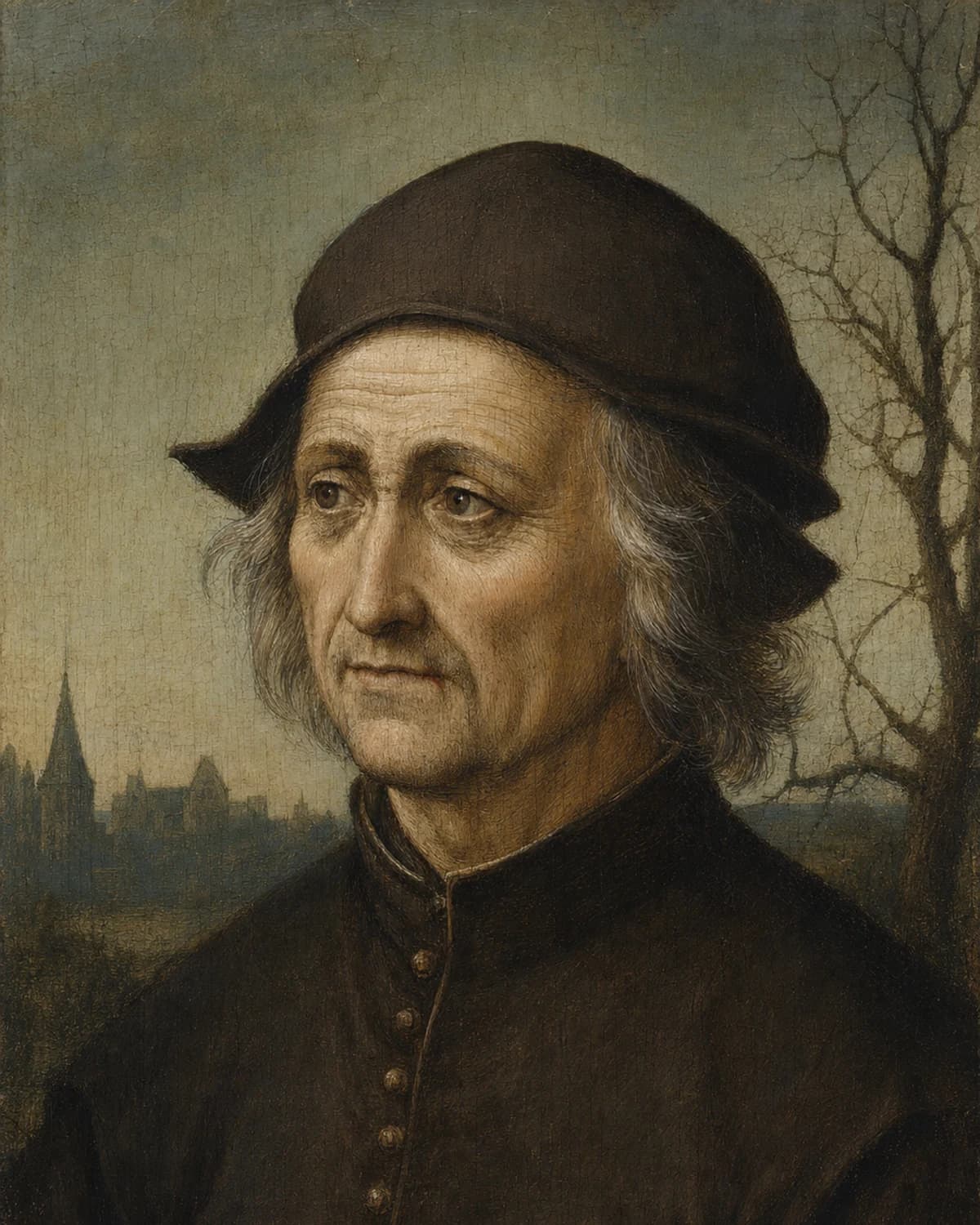
So it is with Bosch almost everywhere. He left no letters or diaries, and nothing is known about his character or about what he thought of his own paintings. All there is are short entries in the town books of ’s-Hertogenbosch and in the accounts of the Brotherhood of Our Lady. He did not date his paintings, and their titles were attached to them later by compilers of catalogues. Even his year of birth, around 1450, has been worked out from a drawing made shortly before his death in 1516: if it is a self-portrait, it shows an old man of nearly seventy.
His name was Jeroen (Jheronimus) Anthoniszoon van Aken. He was born in his grandfather’s house in ’s-Hertogenbosch, in the Duchy of Brabant, then part of the Burgundian Netherlands. The surname points to Aachen: his forebears came from there, as well as from Nijmegen. The family had been painters for at least three generations: his grandfather Jan van Aken (died 1454) painted pictures, as did four of his five sons, and his father, Anthonius, was artistic adviser to the Brotherhood of Our Lady. The van Aken workshop took on wall paintings, gilded wooden sculpture and made church furnishings. In 1463 a great fire destroyed four thousand houses in the town, and the thirteen-year-old Jeroen probably saw it. He first appears in the town records on 5 April 1474, together with two brothers and a sister. Around 1478 his father died, and the workshop passed to the son. He took his pseudonym from the colloquial name of his home town, Den Bosch, and signed several paintings with it.
Between 1479 and 1481 he married Aleid Goijaerts van den Meerveen, from a wealthy merchant family, who was several years older than he was. From her family she had inherited a house and land in nearby Oirschot. The marriage made the painter a well-to-do burgher.
In 1486 or 1487 Bosch joined the Brotherhood of Our Lady. This religious society, founded as early as 1318 and devoted to the veneration of the Virgin Mary, had about forty influential townsmen among its members and up to seven thousand outside members across Europe. According to the Brotherhood’s documents, he designed festive processions, painted the wings of an altarpiece for its chapel in St John’s Cathedral and even made a model for a candlestick. His patrons included some of the most influential families of ’s-Hertogenbosch and people far beyond the town. In September 1504 Philip the Handsome, ruler of the Netherlands, paid him an advance of 36 pounds for a “Judgement of God seated in Paradise, and Hell”; the commission is identified with the Vienna triptych “The Last Judgement”, although the dimensions in the contract are different.
He painted in oil, mostly on oak panels, and his palette is the usual one for his time: azurite for skies and distances, verdigris for foliage and foregrounds, lead-tin yellow, ochres and red lake for the figures. What is unusual is the way he painted. Netherlandish masters covered the panel with many transparent glazes so that no brushstroke would show, whereas Bosch often painted fast, almost sketchily, leaving a rough surface. Of his roughly sixteen triptychs, eight survive complete and five more in fragments. Only seven paintings bear a signature. Historians of the mid-twentieth century attributed thirty to fifty works to him; infrared reflectography, study of the underdrawing and tree-ring dating of the panels have since cut the list down considerably.
His best-known triptych, “The Garden of Earthly Delights”, shows the creation of the world on its closed wings. On the left God, unusually young, brings Eve to Adam among exotic animals; a unicorn drinks at the water, and there is a giraffe close by. In the centre is an endless plain full of naked people, giant berries, hybrid animals and stone growths. On the right is hell: night, cold colours, frozen water, explosions beyond the city gates and so many musical instruments that this wing has been nicknamed the “musical hell”. Art historians find irony both in the central panel and in the hell, and it allowed the painting to please conservative and free-thinking viewers alike. To my mind, of all the explanations of the “Garden” this is the most sober.
Even in his lifetime his paintings were collected in the Netherlands, Austria and Spain and copied a great deal. “The Haywain” exists in two versions, in the Prado and at the Escorial; “The Temptation of Saint Anthony” was taken to Portugal as early as the first half of the sixteenth century. The Spaniard Felipe de Guevara wrote in 1560 that Bosch was regarded as merely an inventor of monsters and chimeras, and argued against this view himself. The Escorial librarian José de Sigüenza remarked that others paint people as they look from the outside, while Bosch dares to paint them as they are inside. The direct heir to his manner was Pieter Bruegel the Elder. In the twentieth century the Surrealists claimed Bosch as their forerunner, and some scholars searched his paintings for heresy and alchemy. Today his pictures are more often read as moralising works, close to late medieval sermons. Copies of all his works are brought together at the Jheronimus Bosch Art Center in ’s-Hertogenbosch.
Bosch’s death is recorded in the accounts of the Brotherhood of Our Lady, and on 9 August 1516 a requiem mass was said for him in St John’s Cathedral. Where he is buried is unknown.
Artist works
Works by the artist
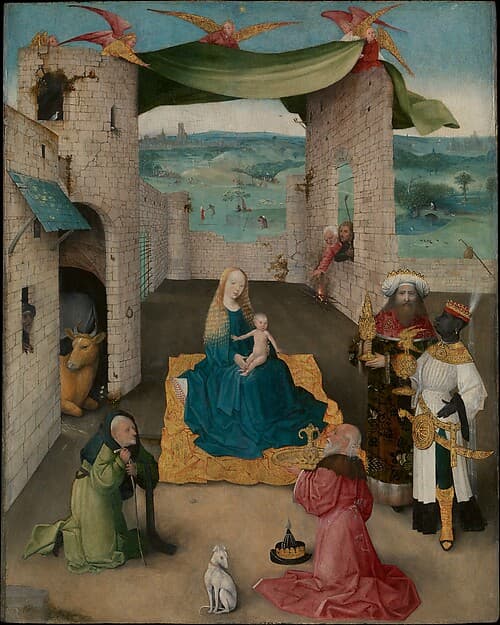
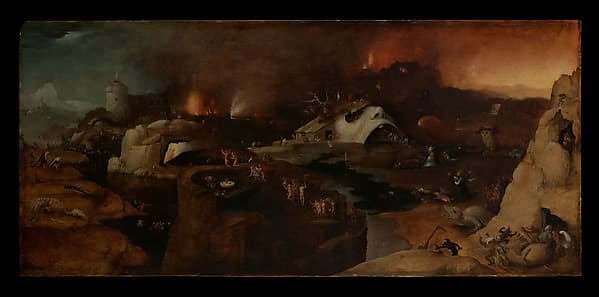
Works by Hieronymus Bosch available in this edition of NEOARCA.
Related context
Associations
Works connected through artistic movements, cultural context and period. Priced works available in this market appear first.
Profile notes
Profile and sources
Image
Artist image
На основе открытого изображения: Bosch, Hieronymus (Netherlandish painter and draughtsman, ca. 1450-1516) (depicted); Wikimedia Commons; Public domain.
