
1584–1645
Hidari Jingorō
Hidari Jingorō is the name under which Japan remembers a carver and temple carpenter of the early Edo period; he is credited with the “Sleeping Cat” above a gate of the Tōshō-gū shrine at Nikkō and the dragons on the gate of the Tōshō-gū at Ueno. Nearly a hundred works across the country bear his name, their dates spread over three centuries, so many regard him as a composite figure. The name Hidari means “left”.
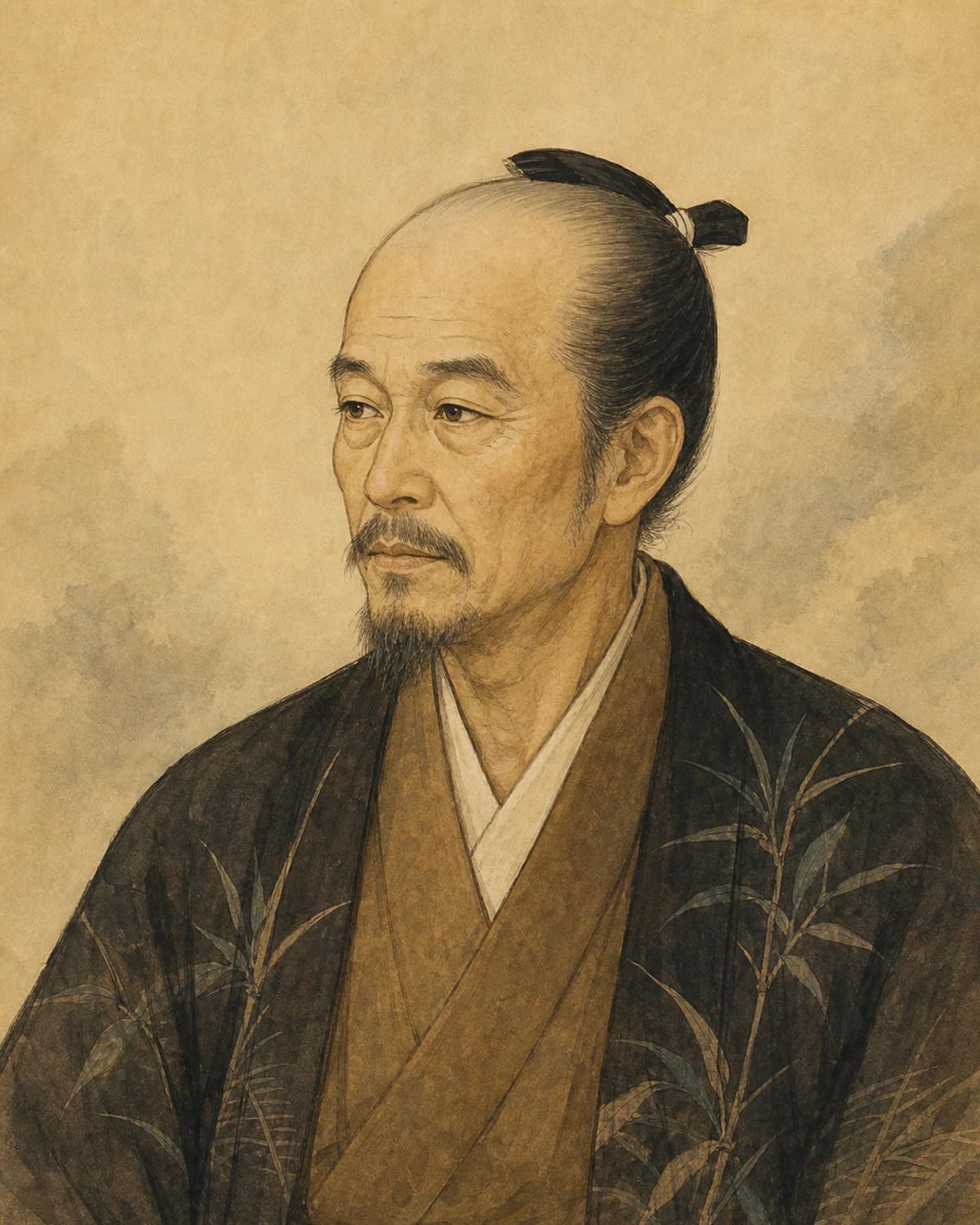
Biography
Above the Kuguri-mon gate at Nikkō, at the Tōshō-gū shrine dedicated to the shōgun Tokugawa Ieyasu, there is a small carved cat, asleep with its paws tucked in. This “Nemuri-neko” is said to be the work of Hidari Jingorō. Whether such a master ever existed is still undecided.
Tradition links his name to nearly a hundred works in Japan, from Sendai in the north to Izumo in the west. But they date from the late sixteenth century to the late Edo period, a span of some three hundred years, and different provinces are named as the master’s birthplace. Hence the old supposition that “Hidari Jingorō” became, over time, a common name for skilled craftsmen working in different regions, and that it was sometimes simply attached to other men’s work. The conventional dates of his life, 1584–1645, have no documentary support; scholars cautiously place the master’s activity at the beginning of the Edo period, roughly 1596–1644. There is also a detailed life story: birth in 1594 at Akashi in Harima Province, apprenticeship from 1606 to a master carpenter of the imperial court in Kyoto, a move to Edo in 1619, work on the rebuilding of the castle, service under a daimyō at Takamatsu, an honorary title, and death around 1651. There is little evidence for it, and Japanese authors retell it alongside the legends. Nor are all these works alike in manner: some of them do not resemble one another at all.
Some stories explain the name by his being left-handed. In others, jealous carpenters cut off his right arm and he went on working with his left; yet another version makes him a blacksmith’s apprentice whose master cut off his hand for disobedience, after which the young man went to Kyoto to learn how to build temples. There is also a prosaic explanation: “Hidari” may have come from “Hida no Jingorō”, that is, “Jingorō from Hida”, a province famous for its carpenters. And in one anecdote the sixteen-year-old master built a pagoda so well that the ruler said there was no one to his right. Then Jingorō would be the left.
The best-known story about him recalls the myth of Pygmalion. On a journey he saw a very beautiful woman and carved her statue in wood. When he sat down beside it and began to drink wine, the statue started to copy his movements without feeling; a soul awoke in it only when a mirror was set before it.
Besides the cat at Nikkō, he is credited with two dragons, one ascending and one descending, on the Chinese Gate of the Tōshō-gū at Ueno; the “forgotten umbrella” he supposedly left in the beams of the Miei-dō hall at Chion-in in Kyoto; the carp for a float of the Gion Festival; and a tiger and a “tethered dragon” at the Chichibu shrine. Most of these are wood carvings for temples and shrines, animals and deities. He is also called a painter, an architect and even a kōdan storyteller, but there is nothing to check this against.
Stories about him were told in kōdan, naniwa-bushi and rakugo; among them are “The Bamboo Narcissus”, “The Rat” and “The Dragon Drinking Water”. In Takamatsu, in Kagawa Prefecture, there is a Hidari Jingorō museum.
Related context
Associations
Works connected through artistic movements, cultural context and period. Priced works available in this market appear first.


Profile notes
Profile and sources
Image
Artist image
На основе открытого изображения: Ogata Gekkō (Japan, 1859-1920); Wikimedia Commons; Public domain.
