
1832–1907
Hermenegildo Bustos
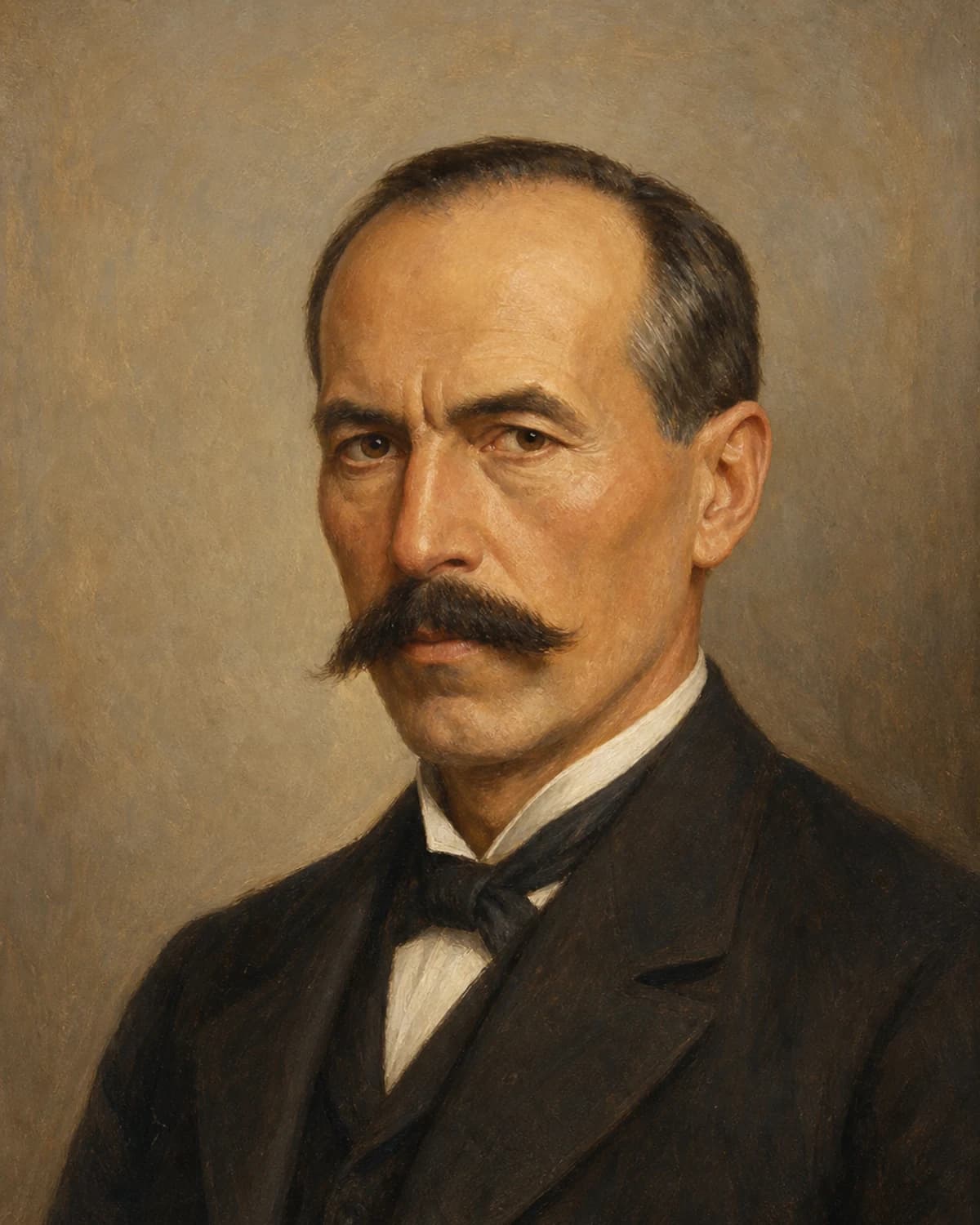
Hermenegildo Bustos (1832–1907) spent his whole life in the village of Purísima del Rincón in the state of Guanajuato and painted portraits of his neighbours, signing them on the back as an “amateur”. His only self-portrait, of 1901, carries an inscription calling him an “Indian of this village”. Recognition came after his death, when his work was shown in Mexico, Europe and Tokyo.
Biography
In 1901, six years before his death, Hermenegildo Bustos painted a self-portrait and for the occasion made himself a coat. On the canvas he wrote: “Hermenegildo Bustos, Indian of this village of Purísima del Rincón, born 13 April 1832.”
On the backs of his portraits he usually wrote that they had been painted by “Hermenegildo Bustos, amateur”.
He was born in Purísima del Rincón into a devout Catholic family; his parents were José María Bustos and Serafina Hernández. According to some accounts his ancestors were descended from Indians attached to the local mission. He called himself an Indian, although scholars point out that his ancestry was mixed. The sources give his birth date differently: 13 or 21 April. His youth fell in hard years for the country: a cholera epidemic, the Desamortización (the confiscation and sale of Church property) and the formation of the Mexican state.
Like his father, he kept a kind of parish chronicle for the village, recording names, dates and events. In the course of his life he worked as a tinsmith, tailor, carpenter, mason and musician; he was drawn to history, astronomy and architecture, left drawings of comets and eclipses, and for many years looked after an orchard. Several sculptures for the village churches are also attributed to him, among them an Ecce Homo and a Virgen de los Dolores (Our Lady of Sorrows).
He had no formal artistic training, apart from a few months with Juan Nepomuceno Herrera, a portrait painter from nearby León. What Herrera could have taught him is hard to say: by report, he kept Bustos more as a helper on odd jobs.
His first known painting is dated 1850, when Bustos was eighteen: a portrait of a priest, Vicente Arriaga. In 1852 he painted a posthumous portrait of his father, who had died a year earlier. In 1854 he married Joaquina Ríos. Over the following years he painted portraits of nearly all the notable families of the district: the Arandas, the Estradas and above all the Valdivias, of whom many works survive. In 1856 he portrayed the fifteen-year-old Francisca Valdivia, and in 1862 he painted her again with her son and infant daughter; the severe face of the mother holding her child is rendered with great precision.
In February 1858 the village hosted Benito Juárez for two weeks, just after he had become president; he set up his office in the town hall. Bustos came there one morning with the idea of painting his portrait, and Juárez agreed. The picture stayed in the artist’s house until his death and was later destroyed.
His manner is recognisable. The sitter’s body is reduced to the necessary minimum, the hands are occupied with some object, and the face is painted with strong psychological force. He worked mainly in oil. From 1870 the number of portraits fell noticeably. In 1884 he gave up the rectangular format he had kept to in all his earlier works. In 1892 he painted the Aranda family; later one of its members was depicted by Diego Rivera in a mural. Among his pictures there are also still lifes, for example one with fruit, a scorpion and a frog (1874).
Bustos died in Purísima del Rincón on 18 June 1907 (by other accounts, 28 June) and was buried in the cemetery of his native village. His wife had died a year before. The parish priest Gil Palomares had photographed the two of them on 23 April 1901. After his death many of the portraits were taken down from the walls of local houses.
After the Mexican Revolution the country reassessed its cultural heritage, and Bustos’s work was noticed. A portrait of Joaquina Ríos was included in Roberto Montenegro’s book “Pintura Mexicana” (1933), but as the work of an anonymous painter. The first biographical note on him appeared in the catalogue of the exhibition “Twenty Centuries of Mexican Art” at the Museum of Modern Art in New York in 1940, and it was inaccurate: it describes him as born in the late eighteenth century. His paintings were shown in Mexico City (1951), Paris and Stockholm (1952), London (1953) and Tokyo (1955). In 1956 part of the municipality was renamed Purísima de Bustos. His portraits of Vicenta de la Rosa de Reyes and Manuel Desiderio Rojas are in the Museo Nacional de Arte in Mexico City. Octavio Paz wrote about Hermenegildo Bustos in 1985.
Related context
Associations
Works connected through artistic movements, cultural context and period. Priced works available in this market appear first.








Profile notes
Profile and sources
Image
Artist image
На основе открытого изображения: Hermenegildo Bustos (1832 - 1907) – Painter (Mexican) Born in Guanajuato. Died in Guanajuato. Details on Google Art Project; Wikimedia Commons; Public domain.
