
07.07.1933–02.04.2019
Herman Braun-Vega
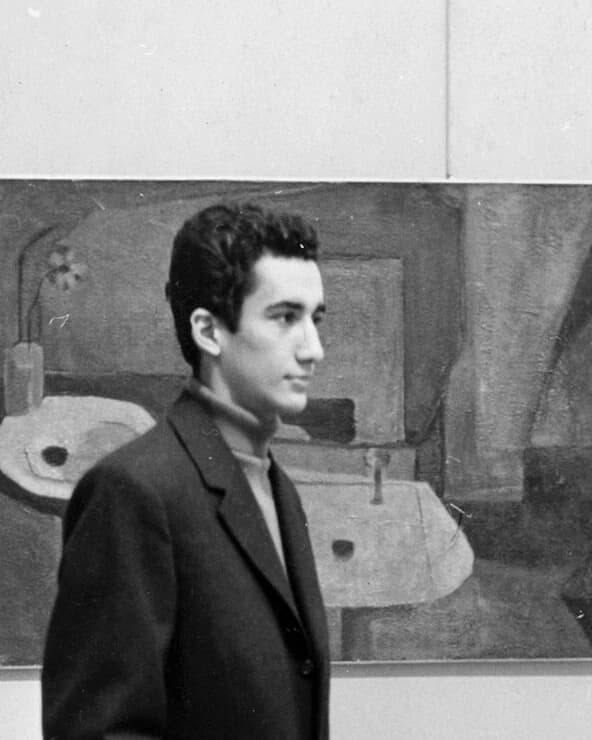
Herman Braun-Vega (1933–2019), a native of Lima, lived in France from 1968 and built his pictures on quotations: figures from Velázquez, Ingres, Vermeer and Picasso meet Peruvian peasants, markets and newspaper cuttings in his work. He added his mother’s surname, Vega, to his father’s in 1984. In 1980 he represented Peru at the Venice Biennale.
Biography
In 1968, at the Picasso Museum in Barcelona, Herman Braun saw the series that Picasso had devoted to Velázquez’s “Las Meninas”. On his return to Paris he set himself a challenge and, as Picasso once had, painted in two and a half months fifty-three pictures under the collective title “Velázquez Laid Bare, Accompanied by the Meninas”. The result is almost a storyboard: in harsh side light and contrasting colours it shows what might have been happening in the studio before the figures took their places in the famous canvas. The series was shown by the Galerie 9 in Paris, and the critics received it well. The main polyptych, of seventeen panels, is now in the Museum of Antioquia in Medellín, and two other pictures are in the Blanton Museum in Austin.
He was thirty-five. He later called Picasso his father and Velázquez his master.
He was born on 7 July 1933 in Lima and at birth was named Germán Braun. His father, Francisco Braun Weisbrod, was born in 1902 in Székesfehérvár, in Austria-Hungary, and was the first of the family to move to Peru; his mother, Armida Vega Noriega, came from Iquitos in the Amazon. His father brought back art reproductions from Paris and had them framed, and his elder brother Max was the first to decide to become a painter; Herman wanted the same. In 1950 he studied for a year and a half at the School of Fine Arts in Lima under Carlos Quízpez Asín, and at the end of 1951, at eighteen, he followed his brother to Paris. The French pronunciation of the name Germán irritated him, and from then on he went by Herman. His brother, who signed his pictures Fernando Vega, introduced him to the poet Jean Sénac. Herman lodged at the Hôtel du Vieux-Colombier, where artists lived, and for the first time saw originals by masters he had known from reproductions. From then on he taught himself, in museums and among other artists.
Soon he had to give up painting. He went into interior design with the designer Jean Royère, who charged him with opening a decorating agency in Peru; in 1955 Braun returned to Lima and opened an agency with the architect Juan Günther, yet even a successful business could not keep him from painting. The works he painted in Lima from 1963, free and impetuous, come close to abstraction; sometimes he gave his figures lines of speech, as in a comic strip, or divided the canvas into panels. After his brother’s sudden death on Ibiza in 1965 he painted his portrait framed by large letters reading “My Brother Max”, with the word “Ibiza” where the heart should be. In November 1967 he returned to Paris, and in May 1968 the triptych “Liberty? Equality? Fraternity?” was his first response to the events of the day.
For the next ten years he took the old masters apart one by one. In the series “Picasso in a Luncheon on the Grass” (1969–1970) Picasso himself steps into Manet’s picture, and the painting “Guests on the Grass” entered the Musée d’Art Moderne de la Ville de Paris at the end of 1970. In the series “The Turkish Bath in New York” (1971–1972), after Ingres, painted wooden frames spilling over onto the image appeared for the first time, along with newspaper cuttings. In “The Abduction of the Sabines after Poussin” (1973–1974) Poussin’s soldiers assaulting civilians sit beside cuttings about the military coup in Chile. In 1975–1977 he studied Rembrandt’s graphic work in the Louvre and the Rijksmuseum, made an album of seven prints about forgery with an introduction by Alain Jouffroy, and for the first time set Rembrandt’s “Anatomy Lesson” beside a photograph of the dead Che Guevara. It seems to me that his mature manner begins with that comparison.
From 1978 he painted portraits of his friends and invited them to take part in the work: Vladimir Veličković, Wifredo Lam, Eduardo Arroyo, who himself arranged a still life of his own belongings on the table, Gérard Fromanger, who scattered coloured confetti over his own portrait, and the writers Jorge Semprún, Julio Ramón Ribeyro and Alfredo Bryce Echenique. He showed ten such portraits in 1980 at the 39th Venice Biennale, where he represented Peru.
His 1981 exhibition in Lima, for which, he said, he had been preparing for twelve years, brought together everything from which his manner was later formed: a clear pictorial language, systematic quotation from other painters’ pictures, Peruvian faces and landscapes, newspaper cuttings. In “Buenos días Vermeer” Vermeer’s woman with a water jug is separated by a wall from a Latin American shanty town; in “The Cheaters”, after Georges de La Tour, the servant is replaced by a Peruvian peasant woman; this was how he depicted the relations between the rich North and the poor South. In 1984, for the exhibition “Paysages Mémoire” at the Théâtre du Rond-Point in Paris, he painted canvases two metres by three, and from then on signed himself Braun-Vega, adding his mother’s surname to his father’s in the Spanish manner. At the 18th São Paulo Biennial in 1985 these canvases made him, in the curator’s words, the star of the show. The 1992 retrospective in Madrid was timed for the five-hundredth anniversary of Columbus’s voyage, and for it he painted the series “Peru–Spain: Bare Memories” with drawings by the chronicler Guamán Poma de Ayala and prints by Goya. When the sociologist Zygmunt Bauman, in his book “Liquid Life”, counted him among the representatives of “liquid art”, Braun-Vega replied with a letter: for thirty-five years he had been working against a world without memory.
In 1999 he bought an old factory in Arcueil outside Paris, designed its conversion himself and set up his home and studio there. He finished his last paintings in 2014. In 2009 Süleyman Demirel University in Isparta, Turkey, gave him an honorary doctorate, and in 2010 and 2017 Peru awarded him state orders. His last exhibition in his lifetime, “Windows of Art, Soul and Life”, was held in 2018 at UNESCO headquarters in Paris.
Herman Braun-Vega died on 2 April 2019 in Paris. That same year thirty-three artists dedicated an exhibition to him at the Cultural Centre of the Pontifical Catholic University of Peru.
Profile notes
Profile and sources
Image
Artist image
Unknown author Unknown author; Wikimedia Commons; CC BY 4.0.
