
26.07.1859–23.07.1922
Henryk Weyssenhoff
Henryk Weyssenhoff (1859–1922) spent his childhood in the Urals, where his father, a participant in the uprising of 1863, had been exiled. He studied in Warsaw under Wojciech Gerson and at the Imperial Academy of Arts in Saint Petersburg, graduating with a silver medal for “Transport of the Wounded”. He painted lyrical landscapes with forest animals and birds, lived on an estate near Minsk and illustrated books by his cousin.
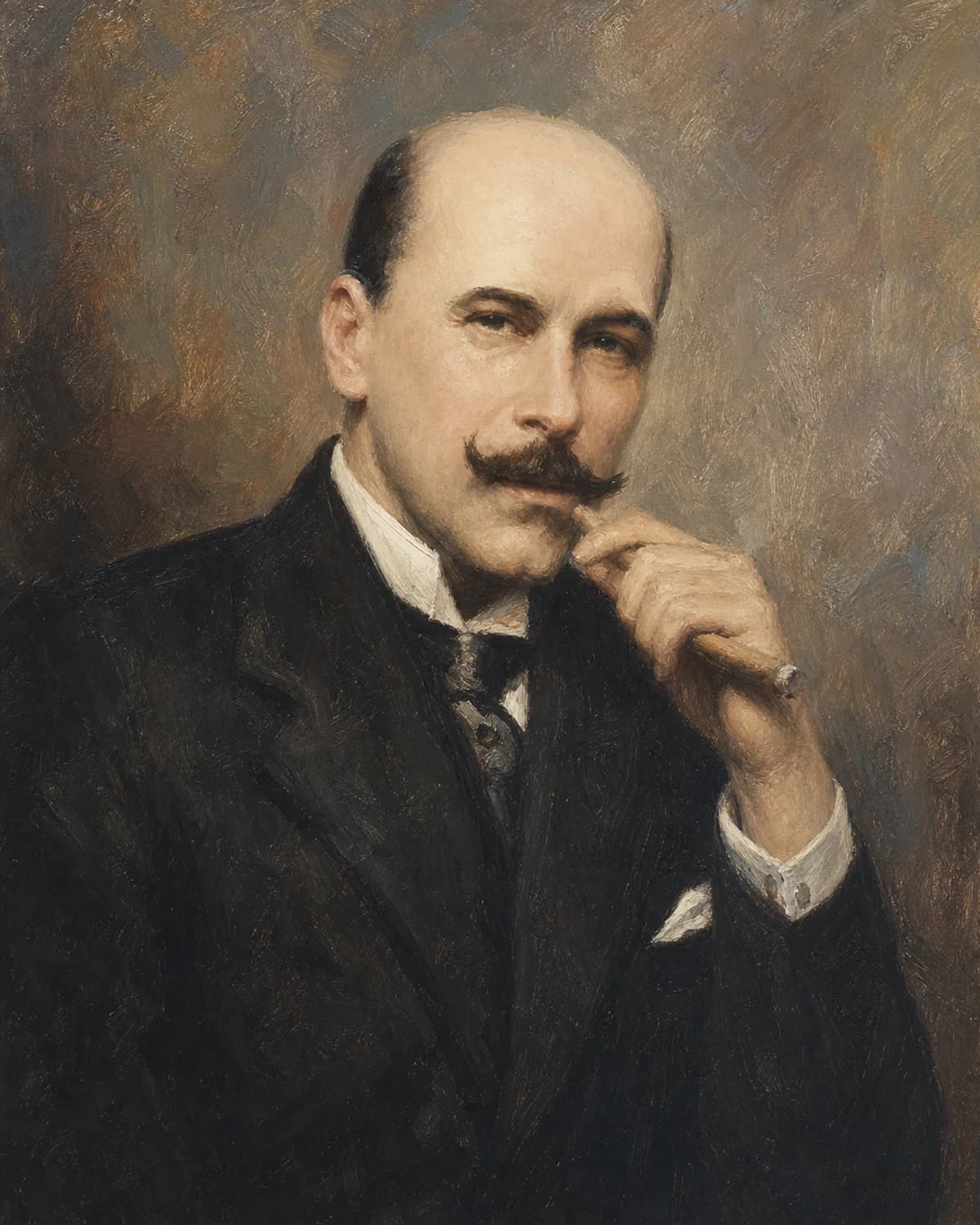
Biography
His first drawing lessons came in exile, in the Urals, from a fellow exile, the painter Lucjan Kraszewski, brother of the writer Józef Ignacy Kraszewski.
Henryk Bonawentura Kazimierz Weyssenhoff was born on 26 July 1859 (14 July, Old Style) in Pokrevno (in Lithuanian, Pakriaunys), near Kaunas, then in the Russian Empire. The family came from the old nobility of Livonia; the branch with the Swan coat of arms had settled there in the seventeenth century. In 1863 his father, a writer, was exiled to Siberia for taking part in the January Uprising against Russian rule. His mother followed with the children as far as she could, and his childhood was spent in the Urals.
In 1874 his father was pardoned but forbidden to live in his native region, and the family settled in Warsaw. There Henryk began studying under Wojciech Gerson, in the drawing class. Henryk Siemiradzki noticed the young man’s work, and with his help Weyssenhoff entered the Imperial Academy of Arts in Saint Petersburg in 1880. He studied there until 1885. For the composition “Transport of the Wounded” he received a silver medal and the title of Artist. In 1888 this picture was shown at an exhibition in Saint Petersburg, and beside it hung “Belarusian Cemetery. Rusakovichi”.
In 1889 he went to Munich and for a time worked under Alfred Kowalski-Wierusz. From the same year he took part in exhibitions: in Berlin (1891, “Cemetery”), in Lviv (1891, “A Corner in Polne”) and in Paris (1901, “Snow”). At the Exposition Universelle in Paris in 1900 one of his works received a silver medal. Later his paintings were awarded medals at other shows as well.
In 1903–1904 he lived in Paris, then settled on his parents’ estate of Rusakovichi, in what is now the Pukhavichy District of the Minsk Region. There he painted realist landscapes with a lyrical mood. A passionate hunter, he often placed forest animals and birds in them. It is said that tame bear cubs lived on the estate and that he painted them too; I have not been able to confirm this from other sources. For the agricultural and industrial exhibition in Minsk in 1901 he designed the sketches for the diploma. He also worked in graphic art and sculpture.
For his cousin, the writer Józef Weyssenhoff, he made a series of illustrations: for the book of poems “Erotyki” (1911) and for the novel “Soból i Panna” (1913). The novel is partly based on the manorial life of the Weyssenhoff family. In 1916 in Minsk he showed “Premonition”, “Struggle”, “Cloud”, “Silence”, “Belarusian Hunters” and “Hunters with Dogs”. He was a member of the Warsaw artists’ association Pro Arte.
During the First World War he had to leave the estate and move to Warsaw. He died there on 23 July 1922.
Related context
Associations
Works connected through artistic movements, cultural context and period. Priced works available in this market appear first.








Profile notes
Profile and sources
Image
Artist image
На основе открытого изображения: op unknown; Wikimedia Commons; Public domain.
