
21.06.1883–08.10.1960
Henry Lamb
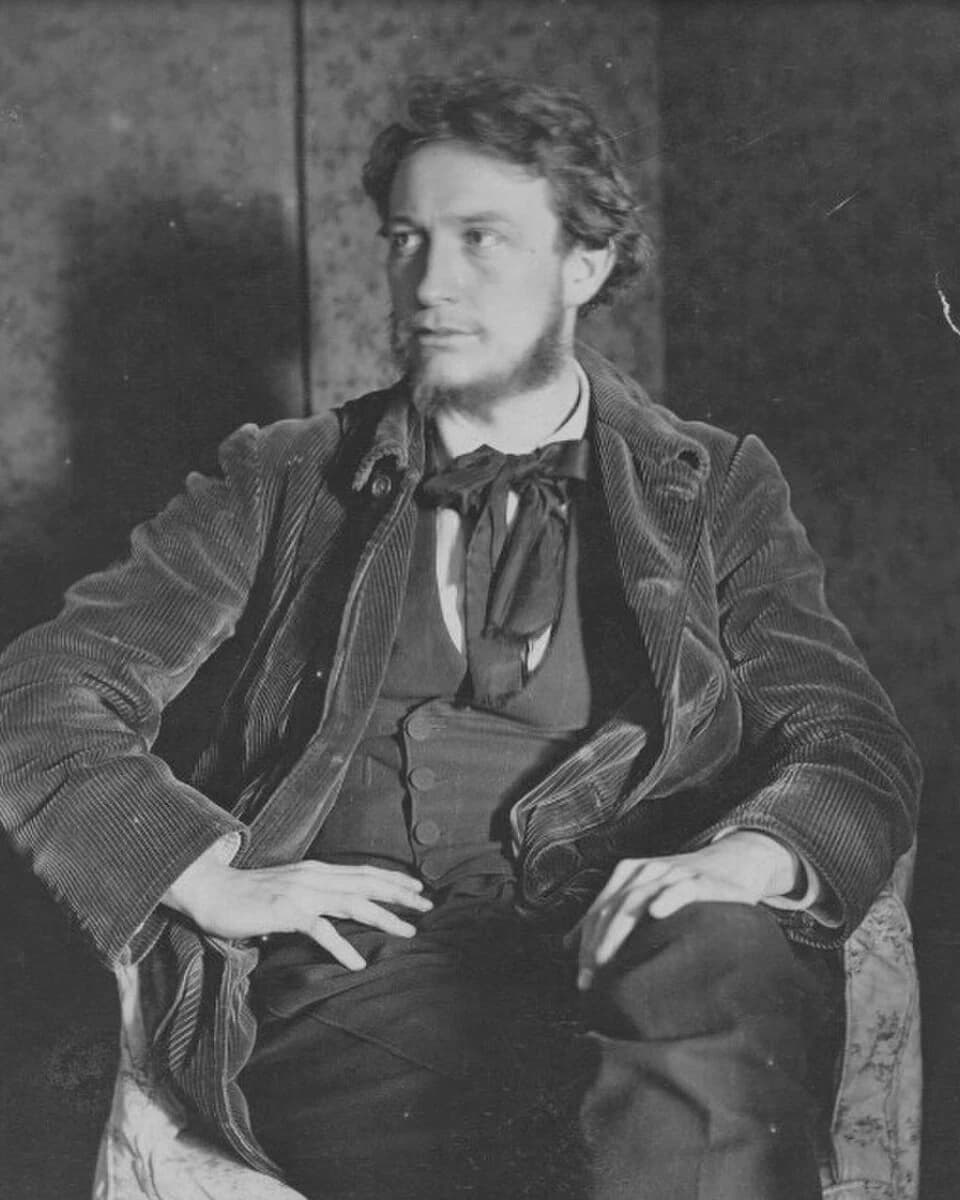
Henry Lamb (1883–1960) was born in Adelaide, grew up in Manchester and trained as a doctor before he took up painting in earnest. In 1911 he was among the founders of the Camden Town Group, and in 1913 of the London Group. In the First World War he served as a battalion medical officer, in the Second as a salaried war artist; his best-known work is the elongated portrait of Lytton Strachey.
Biography
In February 1918 the British War Memorials Committee of the Ministry of Information approached a battalion medical officer who had not yet been demobilised. A large painting was needed for a planned national Hall of Remembrance, and Henry Lamb was asked to paint it. He began work in March 1919, once out of uniform. The title came out as long as a line from a dispatch: “Irish Troops in the Judaean Hills Surprised by a Turkish Bombardment”. The canvas is in the Imperial War Museum.
By then Lamb was a doctor in earnest, qualified at Guy’s Hospital in London.
Henry Taylor Lamb was born on 21 June 1883 in Adelaide, South Australia. His father, Horace Lamb, taught mathematics at the University of Adelaide, and in 1885 he was given the chair of mathematics at the Victoria University of Manchester, so the family returned to England. Henry went through Manchester Grammar School and then into medicine: first the Manchester University Medical School, then Guy’s Hospital in London. In 1906 he gave up his studies. He entered the Chelsea School of Art, run at the time by William Orpen and Augustus John, and as a painter he followed John for a long while. In 1907 he studied in Paris at the Académie de La Palette, where Jean Metzinger, André Dunoyer de Segonzac and Henri Le Fauconnier taught. Yet he had not left medicine for good: eight years later he would have to go back to it.
In 1908, 1910 and 1911 Lamb worked in Brittany, and it was there that he painted “Death of a Peasant”, considered his principal picture. In 1911 he became one of the founders of the Camden Town Group, and in 1913 of the London Group. His portraits came out unconventional, and the best example, I think, is Lytton Strachey (1914), with its strongly elongated figure: this is the canvas people usually recall first when Lamb comes up.
When the First World War began, he went back to medicine and qualified as a doctor at Guy’s Hospital. In the Royal Army Medical Corps he served as medical officer of the 5th Battalion of the Royal Inniskilling Fusiliers, saw action in Palestine and on the Western Front, was awarded the Military Cross and, not long before the end of the war, was badly gassed. Whether he managed to draw at the front, and what of it survives, is hard to say.
After the war Lamb settled in Poole, Dorset, and lived there for several years. In 1928 he married Lady Pansy Pakenham, a daughter of the 5th Earl of Longford. Lamb was a fine pianist, and the novelist Margaret Kennedy, whose cousin George was one of his oldest friends, drew on his character and looks for the composer Lewis Dodd in her novel “The Constant Nymph”.
In December 1940 the War Artists’ Advisory Committee appointed him a full-time artist to the War Office. Throughout the war he painted portraits: senior commanders, rank-and-file soldiers, women in uniform, and also flying at Old Sarum aerodrome and tank exercises. He spent the winter of 1941 with the 12th Canadian Army Tank Battalion, then training in southern England, and afterwards painted members of the Auxiliary Territorial Service and Anti-Aircraft Command.
Honours came in the same years. In 1940 Lamb was elected an Associate of the Royal Academy, and in 1949 a full Member. From 1942 he was a trustee of the National Portrait Gallery, and from 1944 to 1951 of the Tate Gallery. The Imperial War Museum held an exhibition of his war work in 1958 and repeated it in 1961; the second Lamb did not live to see.
Henry Lamb died on 8 October 1960 in Salisbury, Wiltshire, at the age of 77. His work is held by the Imperial War Museum, by regional museums throughout Britain and by the Government Art Collection, while most of his portraits of Canadian servicemen went to the National Gallery of Canada after the war.
Related context
Associations
Works connected through artistic movements, cultural context and period. Priced works available in this market appear first.








Profile notes
Profile and sources
Image
Artist image
Unknown author Unknown author; Wikimedia Commons; Public domain.
