
07.02.1741–16.04.1825
Henry Fuseli
The Zurich pastor Johann Heinrich Füssli gave up the church and became an artist on the advice of Sir Joshua Reynolds. In England he is known as Henry Fuseli. He painted scenes from Shakespeare and Milton and relieved their tension with the grotesque; his best-known picture, “The Nightmare”, was shown in 1782. He became Professor of Painting at the Royal Academy in 1799 and its Keeper in 1804.
Biography
In 1799 an exhibition of forty-seven paintings after Milton opened in London: Fuseli had conceived a gallery of his own that could stand beside the Shakespeare Gallery of the publisher John Boydell. Many of the canvases were huge, and they had taken nine years to paint. Commercially the exhibition failed and closed in 1800.
He had begun very differently. Fuseli was born on 7 February 1741 in Zurich, the second child in a large family. His father, Johann Caspar Füssli, was a portrait and landscape painter and the author of a book on the lives of Swiss painters; his sisters Elizabeth and Anna also became artists. His father intended him for the church and sent him to the Carolinum, the Zurich college. There he received a classical education and made friends with a schoolmate, Johann Kaspar Lavater, later a theologian and poet. Under the influence of Johann Jakob Bodmer, Fuseli became absorbed in Homer, Dante, Shakespeare and Milton.
In 1761 he was ordained.
He did not remain a pastor in Zurich for long. With Lavater he took a stand against an unjust magistrate whose powerful family began to take revenge, and Fuseli had to leave (according to some accounts this happened in 1763, and the magistrate was Felix Grebel, bailiff of Grüningen). He travelled through Germany and worked at painting; in 1765 he reached England, where at first he lived by hack writing, translations and pieces for publishers. He showed his drawings to Reynolds, who advised him to put down the pen and take up the brush. To my mind, this is one of those rare cases where a single remark decided a fate: Fuseli himself, it seems, began painting in oils only at about the age of twenty-five.
In 1770 he went to Italy and stayed there until 1778. He changed his surname from Füssli to the more Italian-sounding Fuseli, and it stuck in England. In Rome he moved in the circle of Anton Raphael Mengs, and among the old masters he studied Michelangelo above all, and in the evenings looked at the marble statues of Monte Cavallo against a murky sky. He seldom drew from life: his school was the antique and Michelangelo. He thought exaggeration of proportion necessary in the higher branches of history painting, and in his drawings he elongated bodies and twisted figures into contorted poses.
In early 1779 he returned to Britain, stopping in Zurich on the way. In London a commission from Boydell for the Shakespeare Gallery was already waiting for him: Fuseli painted several pictures for it (according to some accounts, nine). He brought out the English edition of Lavater’s work on physiognomy and helped the poet William Cowper with his translation of Homer. In 1788 he married Sophia Rawlins, one of his models, and in the same year was admitted to the Royal Academy of Arts. On 10 February 1790 he was elected a full academician; his diploma work was “Thor Battering the Midgard Serpent”. Fuseli painted a portrait of the writer Mary Wollstonecraft, who pursued his attention and planned to go with him to Paris, but his wife put a stop to the acquaintance. He later said: “I hate clever women. They are only troublesome.”
In 1799 he was appointed Professor of Painting at the Academy. He taught with interruptions, returned to the chair in 1810 and held it to the end of his life. From 1804 he was also Keeper of the Academy. His chief theoretical work, twelve lectures, was begun in 1801. Antonio Canova, on a visit to England, was much taken with his work and in 1817, on returning to Rome, saw to it that Fuseli was elected to the Accademia di San Luca. His pupils included David Wilkie, Benjamin Haydon, William Etty and Edwin Landseer; William Blake was inspired by his work.
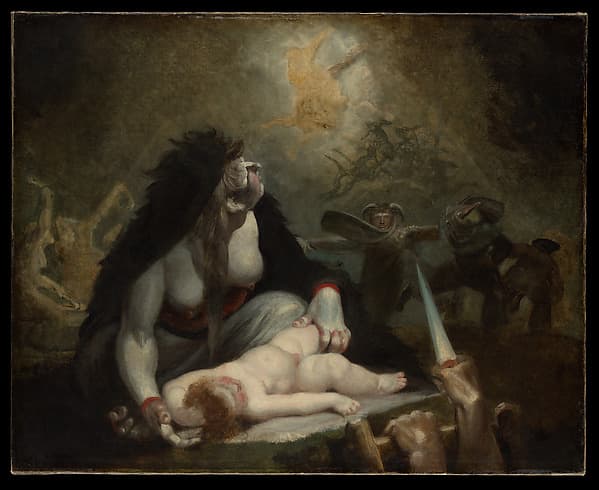
He painted more than two hundred pictures and exhibited only a small part of them. The first was “Joseph Interpreting the Dreams of the Baker and Butler”, and the one that drew attention was “The Nightmare”, shown in 1782 (dated to about 1781), which the artist himself repeated in several versions. In “Night-Hag Visiting the Lapland Witches” (1796) the same themes recur: horror, dark magic, sexuality. His sketches and drawings number about eight hundred; they are often ranked above his paintings. He painted no landscapes: “Damn Nature! she always puts me out”, he said. By some accounts he painted only two portraits. His fairy scenes, for example “Titania and Bottom” from “A Midsummer Night’s Dream”, combine the fantastic with a rough humour. Goethe called him “my dear friend”, but saw mannerism in his painting.
After decades of good health Fuseli fell ill in April 1825, at the house of the Countess of Guildford on Putney Hill; the doctors could not name the illness. The day before he died he still spoke with John Knowles, his future executor and biographer (1831). He died on 16 April 1825 (by some accounts, on the 17th). His body was taken to Somerset House, and on 25 April he was buried in the south crypt of St Paul’s Cathedral, not far from Reynolds and John Opie.
Artist works
Works by the artist
Works by Henry Fuseli available in this edition of NEOARCA.
Profile notes