
21.05.1844–02.09.1910
Henri Rousseau
Henri Rousseau (1844–1910), a Paris toll collector nicknamed Le Douanier, took up painting at about forty and learned only by copying in the Louvre. From 1886 he showed at the Salon des Indépendants, where the critics laughed at him until Jarry, Apollinaire and Picasso took his side. The jungles of “The Sleeping Gypsy”, “The Hungry Lion” and “The Dream” were painted by a man who never once left France.
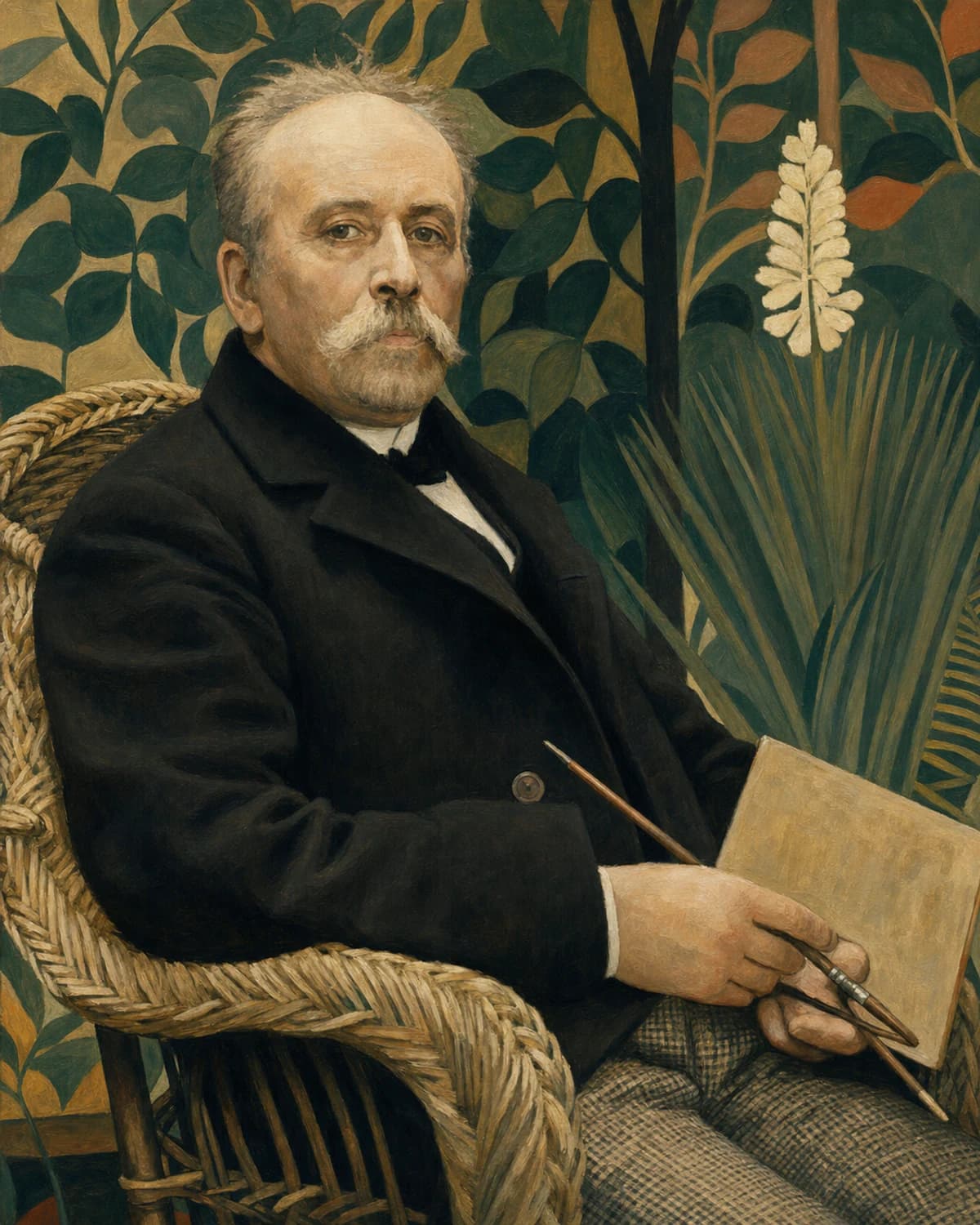
Biography
In 1897 Rousseau offered the mayor of his native Laval “The Sleeping Gypsy” for the town: a woman in a striped dress asleep in a moonlit desert, a jug and a mandolin beside her, a lion standing over her with the tip of its tail curled in a whimsical flourish. The mayor answered with a sneer. Rousseau, by all appearances, sincerely believed himself an heir to the academic tradition and did not understand how his manner differed from the accepted one.
He was born on 21 May 1844 in Laval, in the department of Mayenne, the son of a tinsmith; as a child he worked in his father’s shop. At the Laval school he won prizes for drawing and music, but his father fell into debt, the house was seized for non-payment, and the family left town. There followed a job with a lawyer, a start on studying law, an affair involving a petty perjury and an escape from it into the army: four years, from 1863. There he listened to soldiers back from the Mexican expedition, and the legend that he himself had fought in Mexico was later spread by his admirers; the documents do not support it. After his father’s death, in 1868, Rousseau moved to Paris to support his widowed mother, entered the municipal service and married Clémence Boitard, a joiner’s daughter. From 1871 he collected the octroi, the duty on goods brought into Paris. Hence the nickname Le Douanier, the customs officer, though the job had nothing to do with real customs.
He began painting around 1880, with no teachers. He himself said that he had no master other than nature and admitted only a little advice from two academicians, Félix Clément and Jean-Léon Gérôme. In 1884 he obtained a permit to copy in the Louvre. In 1886, at the Salon des Indépendants, which took in those whom the official Salon kept out, his “A Carnival Evening” appeared: the costumes of the figures rendered more carefully than the figures themselves, the branches of the trees outlined, the clouds as dense as cotton wool. From then on he showed there almost every year, some twenty canvases in seven years, and each time the critics laughed. The first serious review came in 1891: Félix Vallotton wrote of “Tiger in a Tropical Storm” that the tiger stalking its prey “ought not to be missed; it’s the alpha and omega of painting”. Rousseau would not return to the jungle for more than ten years.
In 1888 Clémence died. Of six children, by the early 1890s one daughter remained, and he sent her away to relatives.
In 1890 he painted himself with a palette against a precisely rendered view of Paris and called the canvas “Myself, Portrait-Landscape”, insisting that he had invented a new genre: first a favourite place is painted, then a person is set into it. In 1893, at forty-nine, he retired, rented a studio in Montparnasse and lived there to the end. The pension was small, and he gave drawing lessons at home, took odd jobs where he could and for a short time drew covers for Le Petit Journal. It was then that the young Alfred Jarry, struck by his pictures, sought him out and brought him into the circle of the Mercure de France; “War”, shown at the Salon des Indépendants of 1894, received a glowing review there. In 1899 Rousseau married a second time, to Joséphine Noury, and in 1903 he was widowed again.
The turn came in 1905, when “The Hungry Lion Throws Itself on the Antelope” hung beside canvases by Matisse, Vlaminck and Derain at the exhibition where the word “Fauves” was born; the word itself may owe something to his lion. Ambroise Vollard bought several works. In 1907 Berthe, Comtesse de Delaunay, mother of the painter Robert Delaunay, commissioned “The Snake Charmer” from him. Picasso came across a Rousseau canvas in a street shop, where it was being sold as an old support to paint over, and went to meet him; in 1908 he gave a banquet in his honour at the Bateau-Lavoir, half serious, half burlesque. At the table sat Apollinaire, Jean Metzinger, Juan Gris, Max Jacob, Marie Laurencin, André Salmon, Maurice Raynal, Daniel-Henry Kahnweiler, Leo and Gertrude Stein.
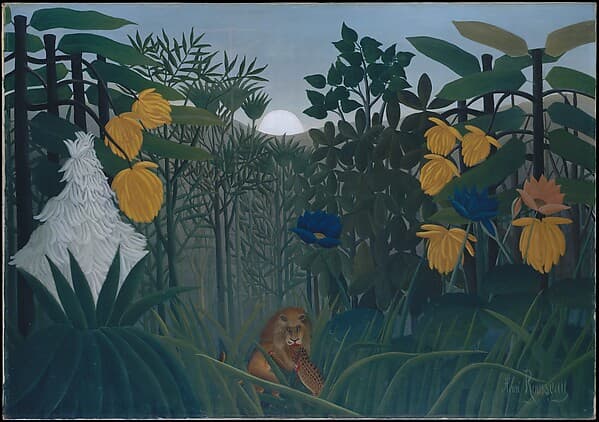
Rousseau never saw a jungle: he did not leave France. His tropics were assembled from the glasshouses of the Jardin des Plantes, the cases of stuffed animals at the Natural History Museum, pictures in children’s books, magazine illustrations and postcards from which he copied figures. He told the critic Arsène Alexandre that in the glasshouse, among the foreign plants, “it seems to me that I enter into a dream”. The World’s Fair of 1889, with its Senegalese, Tonkinese and Tahitian pavilions, also made a strong impression: he wrote a vaudeville about it that nobody staged. In the late canvases every leaf is painted separately, yet with an eye to the design of the whole branch; bright birds sit among the foliage, and in the centre something is almost always happening: “Fight Between a Tiger and a Buffalo” (1908), “Jaguar Attacking a Horse” (1910). In March 1910, at the Salon des Indépendants, he showed “The Dream”: a naked woman on a red plush sofa in the middle of a thicket, from which an elephant and two lions peer out, with a dark flute-player in the depths. Rousseau himself explained that the heroine was dreaming all of it. To my mind this is the best of his answers to the charge of absurdity.
He died on 2 September 1910 in the Necker Hospital in Paris, the same one where his son had died before him, and was buried in a common grave at the Bagneux cemetery. Seven people stood at the grave: Signac, Manuel Ortiz de Zárate, Robert and Sonia Delaunay, Brâncuși, the landlord Armand Queval and Apollinaire, who composed the epitaph; Brâncuși cut it into the stone. In 1911 the Salon des Indépendants mounted a retrospective, his paintings hung in the first exhibition of Der Blaue Reiter, Kandinsky praised them in 1912, and the dealer Wilhelm Uhde took up his reputation in earnest. On 12 October 1947 Rousseau’s remains were moved to Laval, to the Jardin de la Perrine; the relief on the tombstone was made by the same Brâncuși.
Artist works
Works by the artist
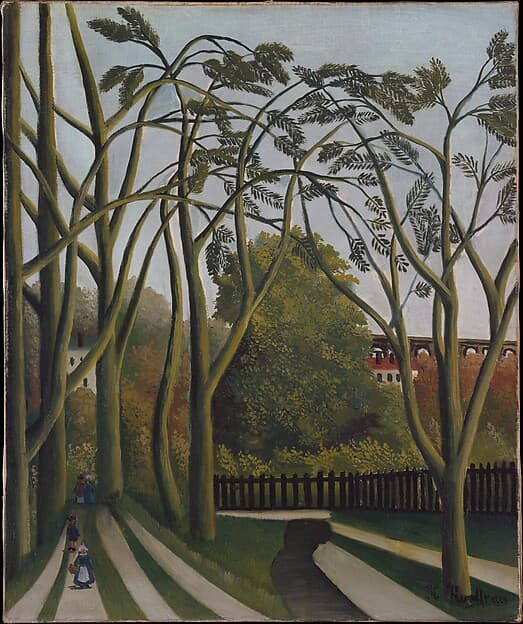
Works by Henri Rousseau available in this edition of NEOARCA.
Related context
Associations
Works connected through artistic movements, cultural context and period. Priced works available in this market appear first.








Profile notes
Profile and sources
Image
Artist image
На основе открытого изображения: Dornac; Wikimedia Commons; Public domain.
