
31.12.1869–03.11.1954
Henri Matisse
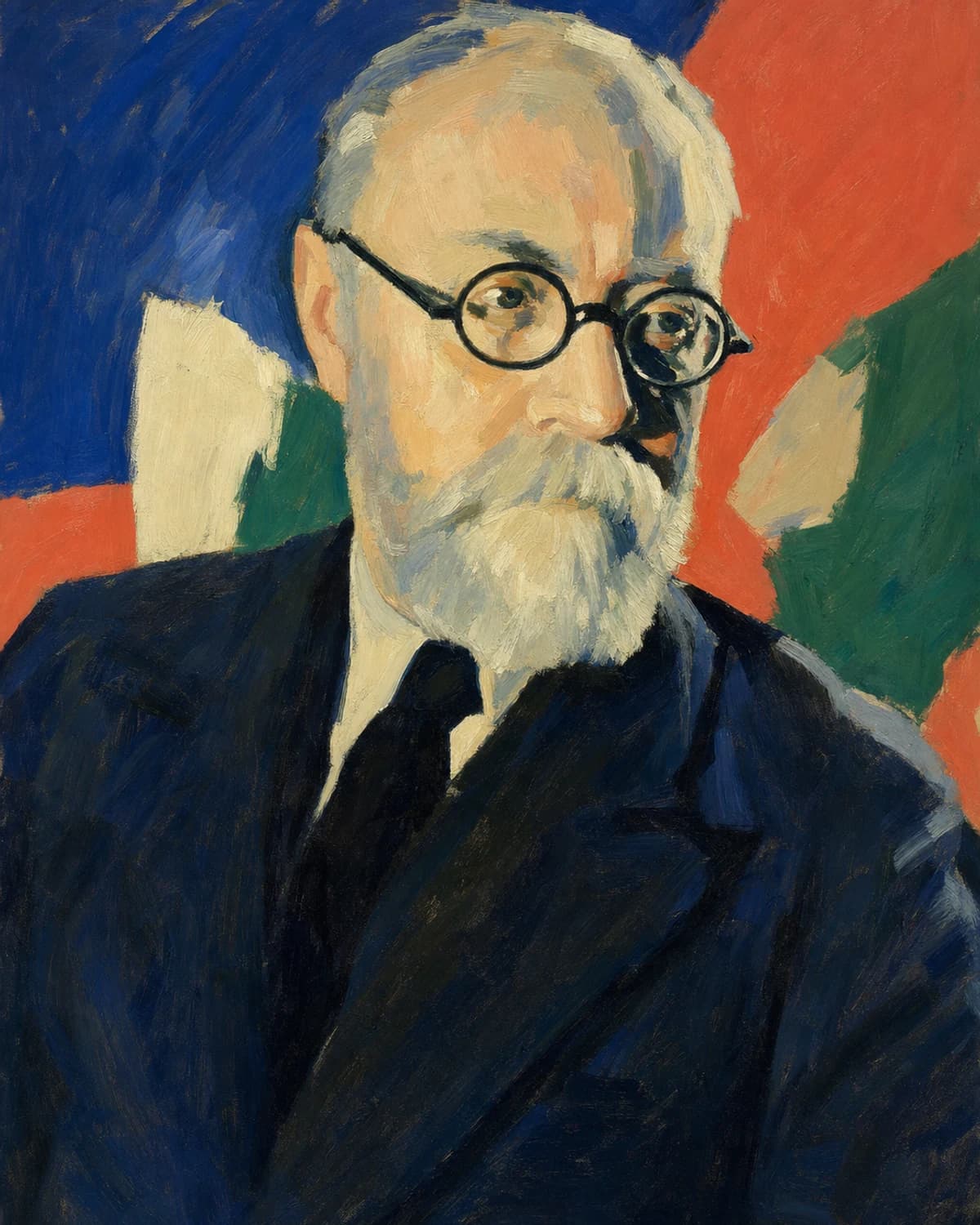
Henri Matisse (1869–1954) took up the brush only at nineteen, while recovering from an illness, and in 1905, together with André Derain, became a leader of the “wild beasts”, the Fauves. For Sergei Shchukin’s house in Moscow he painted “Dance” and “Music”, and from 1917 he lived in Nice. In his last years, when illness kept him from painting, he cut large compositions out of painted paper and designed the Chapel of the Rosary in Vence.
Biography
On 17 October 1905 the critic Louis Vauxcelles published a review of the Salon d’Automne in the newspaper Gil Blas. Amid the “orgy of pure tones” in one of the rooms stood a Renaissance-style sculpture, and Vauxcelles called it “Donatello among the wild beasts”. The word “fauves”, wild beasts, stuck to the painters in that room. Another critic, Camille Mauclair, compared the show to a pot of paint flung in the face of the public. Henri Matisse’s “Woman with a Hat” came in for the worst of it, and when Leo and Gertrude Stein bought the picture, the artist’s spirits rose considerably.
He was thirty-five. He had started painting sixteen years earlier.
Henri Émile Benoît Matisse was born on 31 December 1869 in Le Cateau-Cambrésis, in the north of France, the eldest son of a grain merchant, and grew up in nearby Bohain-en-Vermandois. His mother painted ceramics. At his father’s wish he trained in Paris as a lawyer and worked as a clerk, but in 1889, while he was convalescing after appendicitis, his mother brought him paints. He found, as he later put it, “a kind of paradise”, and decided to become an artist, much to his father’s disappointment. In 1891 he returned to Paris and studied at the Académie Julian under Bouguereau, then in Gustave Moreau’s studio, where his fellow students included Albert Marquet and Georges Rouault. In the Louvre he copied four paintings by Chardin. In the summer of 1896, on the island of Belle-Île, the Australian painter John Peter Russell, a friend of Van Gogh, introduced him to Impressionism and gave him a Van Gogh drawing; the earthy palette gave way to a bright one, and Matisse later called Russell his teacher. That same year the state bought two of the five pictures he showed at the Salon of the Société Nationale des Beaux-Arts.
In 1898 he married Amélie Parayre; together they raised his daughter Marguerite, born in 1894, and then their sons Jean and Pierre were born. His wife and daughter often sat for him. On Pissarro’s advice he went to London to look at Turner. There was no money, yet he ran into debt buying the work of those he admired: a plaster bust by Rodin, a painting by Gauguin, a drawing by Van Gogh, Cézanne’s “Three Bathers”. In Cézanne, in his structuring of the picture and his colour, he found his main support. His first solo exhibition, at Vollard’s in 1904, was not a success. That summer in Saint-Tropez, alongside Signac and Cross, came “Luxe, Calme et Volupté”, painted in separate strokes, and in 1905 at Collioure, together with Derain, the flat shapes and free colour of the coming Fauvism.
The movement broke up within a few years, but for Matisse the most fruitful period fell precisely in 1906–1917. In 1906 Leo Stein bought “The Joy of Life”, and at the Steins’ salon Matisse met Picasso, with whom he was both friend and rival all his life. After a trip to Algeria, to the oasis of Biskra, came “Blue Nude (Souvenir of Biskra)”. Friends helped him open a private school, the Académie Matisse, where he taught young artists until 1911. In 1908 his “Notes of a Painter” appeared. That same year the Moscow businessman and collector Sergei Shchukin commissioned panels for his house, and by 1910 “Dance” and “Music” were finished. In 1911 Matisse himself came to St Petersburg and Moscow and told journalists that old Russian icons were closer and dearer to him than Fra Angelico. The paintings bought by Shchukin and Ivan Morozov at last freed him from want. In 1909 he bought a house at Issy-les-Moulineaux. Moorish art in Seville, two journeys to Morocco in 1912–1913, “The Red Studio” (1911) with its open, unmodulated colour. When the Armory Show came to Chicago in 1913, a copy of his “Blue Nude” was publicly burned there.
In 1917 he moved to Cimiez, a suburb of Nice. The twenties are gentler: odalisques in oriental costume, interiors in which the room is set apart from the view beyond the window, designs for Diaghilev’s ballet “The Song of the Nightingale”. In 1925 he was made a Chevalier of the Legion of Honour. In 1930 he travelled to Tahiti and, on a commission from the collector Albert Barnes, took on a huge “Dance” for his foundation, arranging the forms out of cut coloured paper.
In the summer of 1940, when the Germans entered France, his son Pierre, a gallery owner in New York, begged him to leave. Matisse was about to set off for Brazil but stayed in Nice: if everyone of any worth left, he wrote to his son, what would remain of France? Amélie and Marguerite took part in the Resistance, and both were arrested. In 1941 he underwent a serious operation and for a long time was confined to his bed and his chair. That was when his late technique took shape. His assistants coated sheets of paper with gouache, he cut shapes out of them with scissors, and these were then arranged on the walls. This is how the book “Jazz” (1943–1947) was made, and “Oceania” (1946), with birds, fish and seaweed pinned straight onto the walls of the room. He called these years his second life. To my mind, not one of his early canvases is freer than these cut-outs.
From 1948 Matisse designed the Chapel of the Rosary in Vence: the stained glass, the vestments, the tabernacle door. It was consecrated on 25 June 1951, and he himself considered it his finest work. In 1952 a museum of his work opened in his native Le Cateau.
Henri Matisse died on 3 November 1954 in Cimiez, at the age of eighty-four, and was buried in the cemetery of the monastery of Notre-Dame de Cimiez. On the wall of his bedroom that day hung the maquette for a stained-glass window for the church at Pocantico Hills near New York, his last work.
Related context
Associations
Works connected through artistic movements, cultural context and period. Priced works available in this market appear first.








Profile notes
Profile and sources
Image
Artist image
На основе открытого изображения: Carl Van Vechten; Wikimedia Commons; Public domain.
