
24.11.1864–09.09.1901
Henri de Toulouse-Lautrec
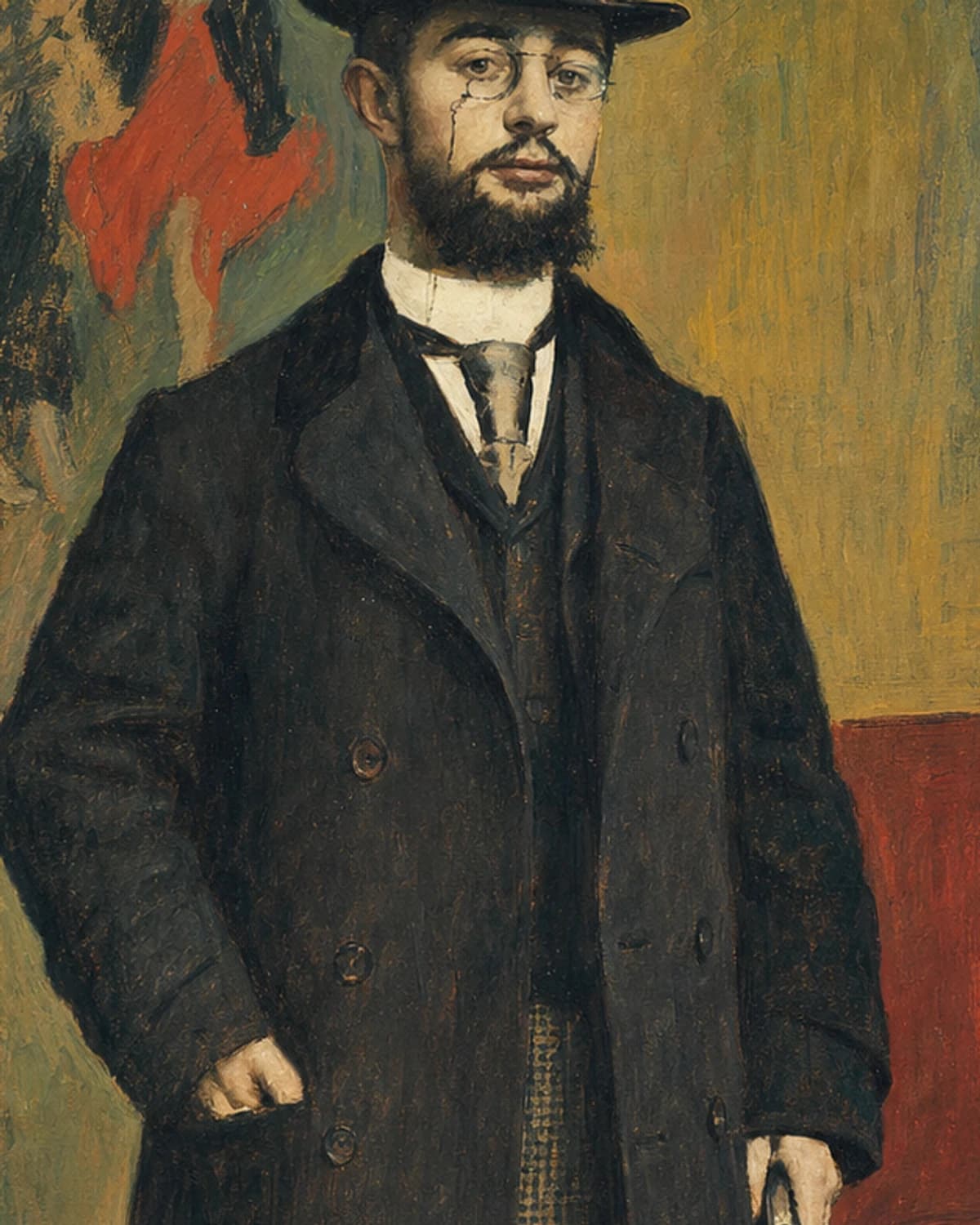
Henri de Toulouse-Lautrec (1864–1901), heir to an old comital family from Albi, lived in Montmartre from 1884 until the end of his life and painted its cabarets, circuses, dancers and brothels. He was one of the first to make colour lithographic posters: for the Moulin Rouge, for the café-concerts, for the chansonnier Aristide Bruant. In under twenty years of work he left 737 paintings and more than five thousand drawings.
Biography
In 1887 a certain Tréclau showed his work at an exhibition in Toulouse. The name had to be read with its syllables swapped, the way it is done in the Parisian slang called verlan, and it came out as “Lautrec”. This was how the heir of the Counts of Toulouse-Lautrec-Montfa signed himself, having just finished his training in Fernand Cormon’s studio in Paris.
He never did become a count, as it happens: the title passed on the father’s death, and his father outlived him.
Henri Marie Raymond de Toulouse-Lautrec-Montfa was born on 24 November 1864 in Albi, in the south of France, in the house of his great-aunts. His parents, Count Alphonse de Toulouse-Lautrec-Montfa and Adèle Tapié de Céleyran, were first cousins: their mothers were sisters. A younger brother, Richard, was born in 1867 and died the following year, after which the parents separated. His childhood was spent at the Château du Bosc and on the Céleyran estate near Narbonne, where the boy was taught riding, Latin and Greek. His father, an eccentric man with a taste for amusement, took him to fairs and to the circus. At about eight Henri lived with his mother in Paris and filled his school exercise books with sketches and caricatures, while a friend of his father’s, René Princeteau, who painted horses above all, gave him lessons; horses became the boy’s first subjects. In May 1878, at thirteen, he broke the neck of his right femur getting up from a chair, and in August 1879 he fell into a ditch and broke the left. The bones healed badly, his legs stopped growing, and with an adult torso his height stopped at 152 centimetres. The army, hunting and balls were closed to the only heir of the line. Later he would say that, but for his legs, he would have become a surgeon or a sportsman.
In Nice the young man’s progress in drawing so impressed Princeteau that he persuaded the parents to let him go to Paris, to the portrait painter Léon Bonnat. Henri arrived in Paris in 1882; his mother, who dreamed of a son who would be a fashionable and respected painter, used the family’s connections to get him into the studio. When Bonnat took up a new post, Lautrec moved to Cormon the same year and studied with him for five years. There he formed a circle of friends for life, and there he got to know Émile Bernard and Vincent van Gogh. In 1884 he settled in Montmartre.
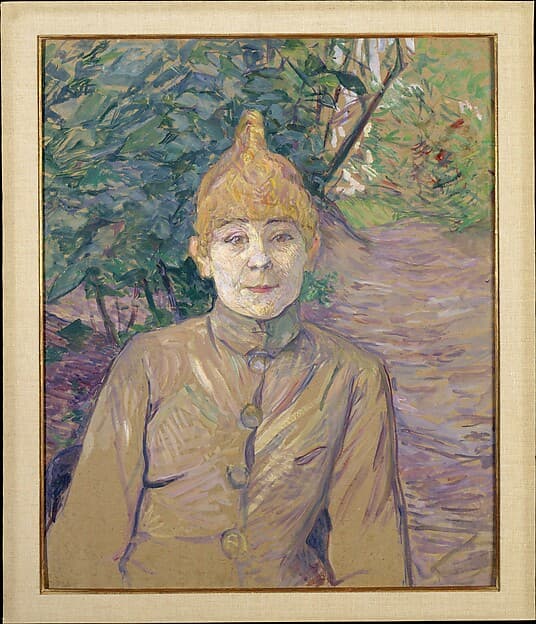
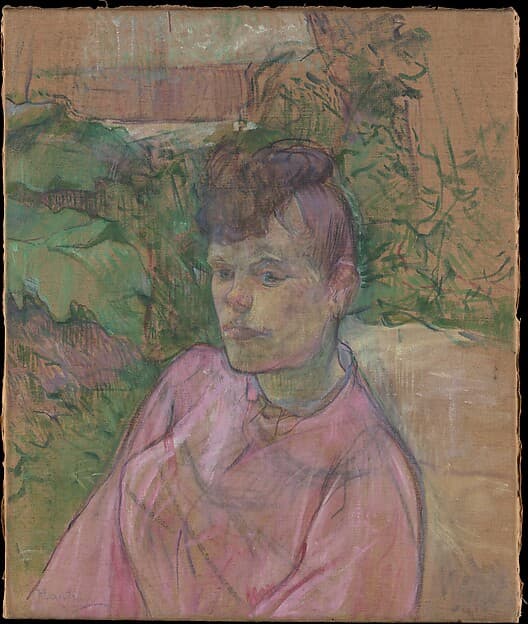
From 1885 his work hung in Aristide Bruant’s cabaret, the Mirliton. In February 1888 the Belgian critic Octave Maus invited him to show eleven works at the exhibition of Les XX (“the Twenty”) in Brussels, and Theo van Gogh bought his “Rice Powder” for the firm of Goupil. From 1889 to 1894 Lautrec exhibited regularly at the Salon des Indépendants. Out of doors, in a Montmartre garden, he painted the red-haired model Carmen Gaudin, who also sat for “The Laundress” (1888).
At the banquet of Les XX in 1890 the artist Henry de Groux disparaged Van Gogh’s paintings, and Lautrec challenged him to a duel. Signac declared that if Lautrec were killed, he would fight for Van Gogh’s honour himself. De Groux apologised and left the group, and the duel never took place.
When the Moulin Rouge cabaret opened in 1889, Lautrec was commissioned to make a series of posters. His mother had left Paris by then; money from the family arrived regularly, but the posters gave him, for the first time, earnings of his own. The cabaret kept a seat reserved for him, and two of his paintings hung at the entrance. His models were the dancers Louise Weber, known as La Goulue, and Jane Avril, the singer Yvette Guilbert, the clowness Cha-U-Kao and the dancer Valentin le Désossé. In 1892 the Café des Ambassadeurs commissioned from him a poster of Bruant, who had moved there. In lithography he made do with outline and flat patches of colour, having learned a thing or two from Japanese prints.
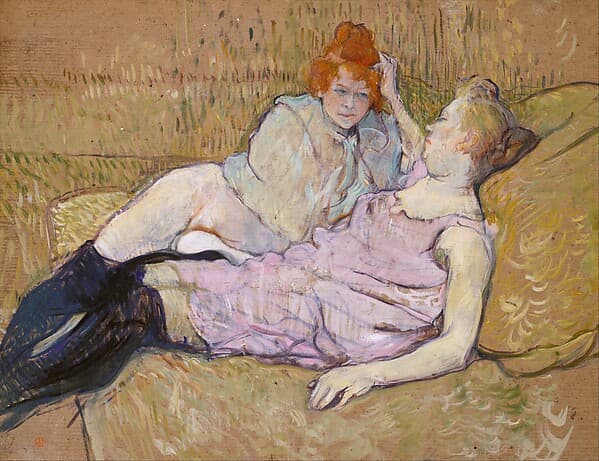
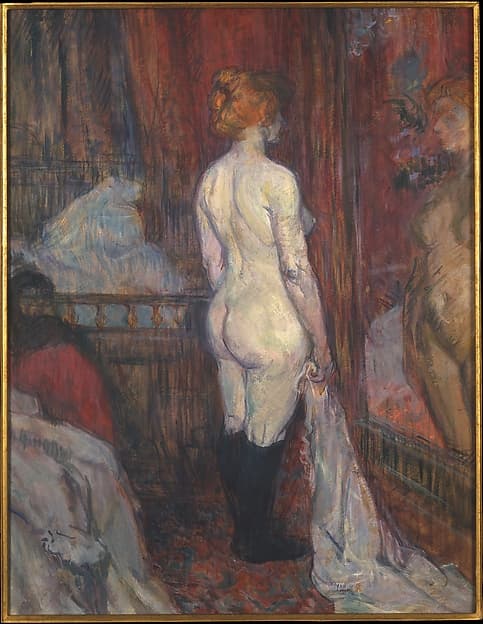
He was a constant visitor to the brothels and painted the women who lived there as closely as he painted the dancers. About a hundred drawings and some fifty paintings are devoted to the life of these women; in 1892–1893 came the series “Le Lit”, two women lying in one bed, and in 1894 he painted “The Salon in the Rue des Moulins” from memory, in his studio. A model, Lautrec said, is always a stuffed doll, but these women are alive.
He worked in pastel, chalk and charcoal on toned paper, tinting the drawing with watercolour and gouache, and in oil he painted with long, thin strokes, leaving the ground exposed. Many of his pictures are more accurately called drawings in coloured paint. To my mind, this is where his posters come from: an artist who drew in line even in oil was at home in lithography.
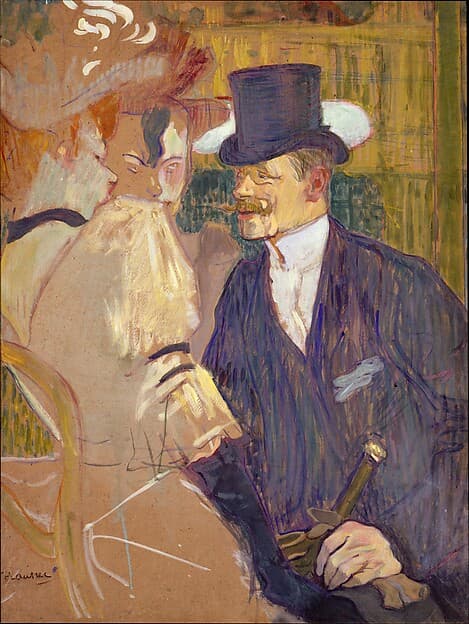
In London, where the family’s Anglophilia drew him, the firm of J. & E. Bella commissioned a poster for paper confetti from him; he made an advertisement for the Simpson bicycle chain and became friends with Oscar Wilde; when Wilde faced prison, Lautrec openly supported him, and he painted Wilde’s portrait in the year of the trial. He had solo exhibitions in Paris in 1896 and in London in 1898, but the critics received him mostly with hostility.
His cousins called him “Henri the cook”. In February 1895, at the Natansons’ house, he entertained three hundred guests, drew up the menu himself and did the cooking himself. After his death his friend Maurice Joyant published his recipes in the book “La Cuisine de Monsieur Momo, Célibataire” (1930).
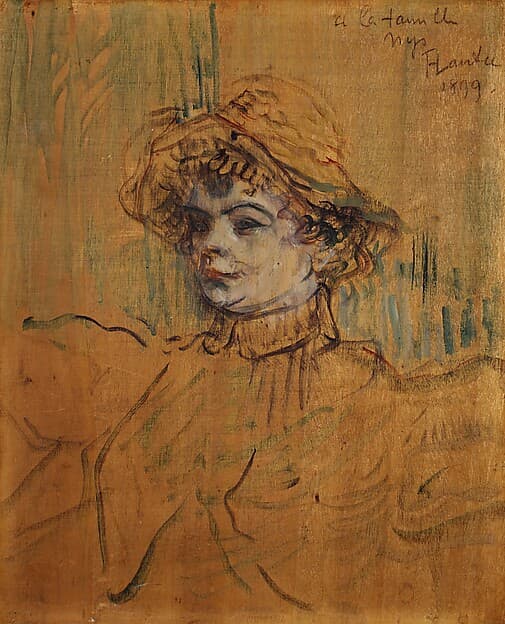
In February 1899, after long years of drinking, he collapsed from exhaustion, and his family placed him for three months in the Folie Saint-James sanatorium at Neuilly-sur-Seine. There he drew 39 circus portraits. On his release he went back to his studio and travelled widely around France. Henri de Toulouse-Lautrec died on 9 September 1901 at the Château Malromé, his mother’s estate in the Gironde, before he reached thirty-seven. He is buried in the cemetery at Verdelais, a few kilometres from the château.
In under twenty years he made 737 paintings, 275 watercolours, 363 prints and posters, 5,084 drawings and a few pieces of ceramics and stained glass. His mother and Joyant went on exhibiting his work, and with the countess’s money a Toulouse-Lautrec museum was opened in Albi; it has been open since 1922, and its collection of his work is the largest.
Artist works
Works by the artist
Works by Henri de Toulouse-Lautrec available in this edition of NEOARCA.
Related context
Associations
Works connected through artistic movements, cultural context and period. Priced works available in this market appear first.








Profile notes
Profile and sources
Image
Artist image
На основе открытого изображения: Paul Sescau; Wikimedia Commons; Public domain.
