
1981–present
Hend Kheera
Hend Kheera (born 1981) puts stencilled graffiti with short slogans on the walls of Cairo; most of her known pieces appeared in 2011 around Tahrir Square. She became the first woman graffiti artist to be featured in “Rolling Stone” and took part in the street campaign against sexual harassment. By profession she is a structural engineer, and she keeps making graffiti.
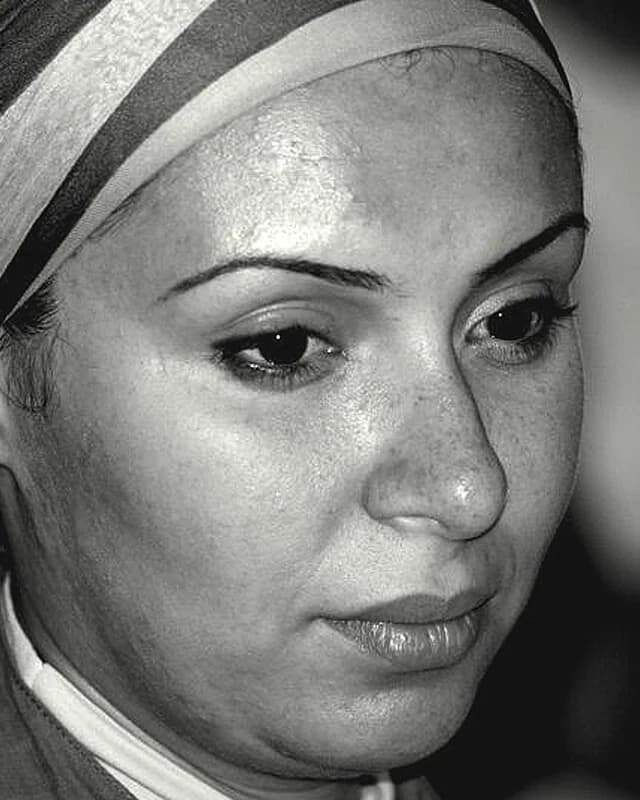
Biography
The outline of a woman, crossed out in red, and a caption in Arabic: “Don’t touch. Castration awaits.” Hend Kheera made this stencil after the case of Samira Ibrahim, who in 2011 took the military to court over a “virginity test” carried out by a doctor after several women were detained in Tahrir Square. The piece became the best known in her series against harassment.
Kheera was born in Cairo in 1981. At university she worked on the side as a fashion designer; she now works as a structural engineer, and graffiti is what she does in the evenings and at weekends.
She became widely known after the events of January 2011, when during the sit-ins she sprayed stencils on the walls around Tahrir, including the Mogamma, the main administrative building on the square. It was the moment when street art in Egypt came out of hiding all at once, and Kheera was among the first to be noticed. “Rolling Stone” ran a feature on her; no woman graffiti artist had appeared in the magazine before. There she explained why the wall: unlike a television channel, it cannot be ignored. Her characters come from books and films rather than from other artists: her walls have carried the actress Hend Rostom, known as the Egyptian Marilyn Monroe, and Ahmed Zaki in his role from the film “The Escape”. Another well-known piece is Jesus standing with his back to a tank about to run him over, holding a blank protest sign; it was shown in September 2011 in the group exhibition “This is not Graffiti” at the Townhouse Gallery in Cairo. Her subjects are the position of women in Egyptian society and the limits of the acceptable; the artist Mira Shihadeh worked alongside her in the street campaign against harassment.
In interviews Kheera has said that her street work never got her into trouble with the authorities, although some pieces were painted over or removed and some viewers found them offensive. Dating individual walls from photographs is hard: the layer of slogans on Tahrir changed faster than anyone could record it. Outside Egypt her work was included in the exhibition “Underpass in the Eyes of Freedom” at the Union Depot in Minneapolis.
Profile notes
Profile and sources
Image
Artist image
Lilian Wagdy; Wikimedia Commons; CC BY 2.0.
