
26.07.1937–22.03.1980
Hélio Oiticica
Hélio Oiticica (1937–1980) began in Rio de Janeiro with geometric painting, and by the mid-1960s he was making boxes with little doors, walk-in installations and capes that viewers put on themselves. His work “Tropicália” (1967) gave its name to the Tropicália movement in Brazilian culture. In 1959 he joined the Neo-Concrete group alongside Lygia Clark and Lygia Pape.
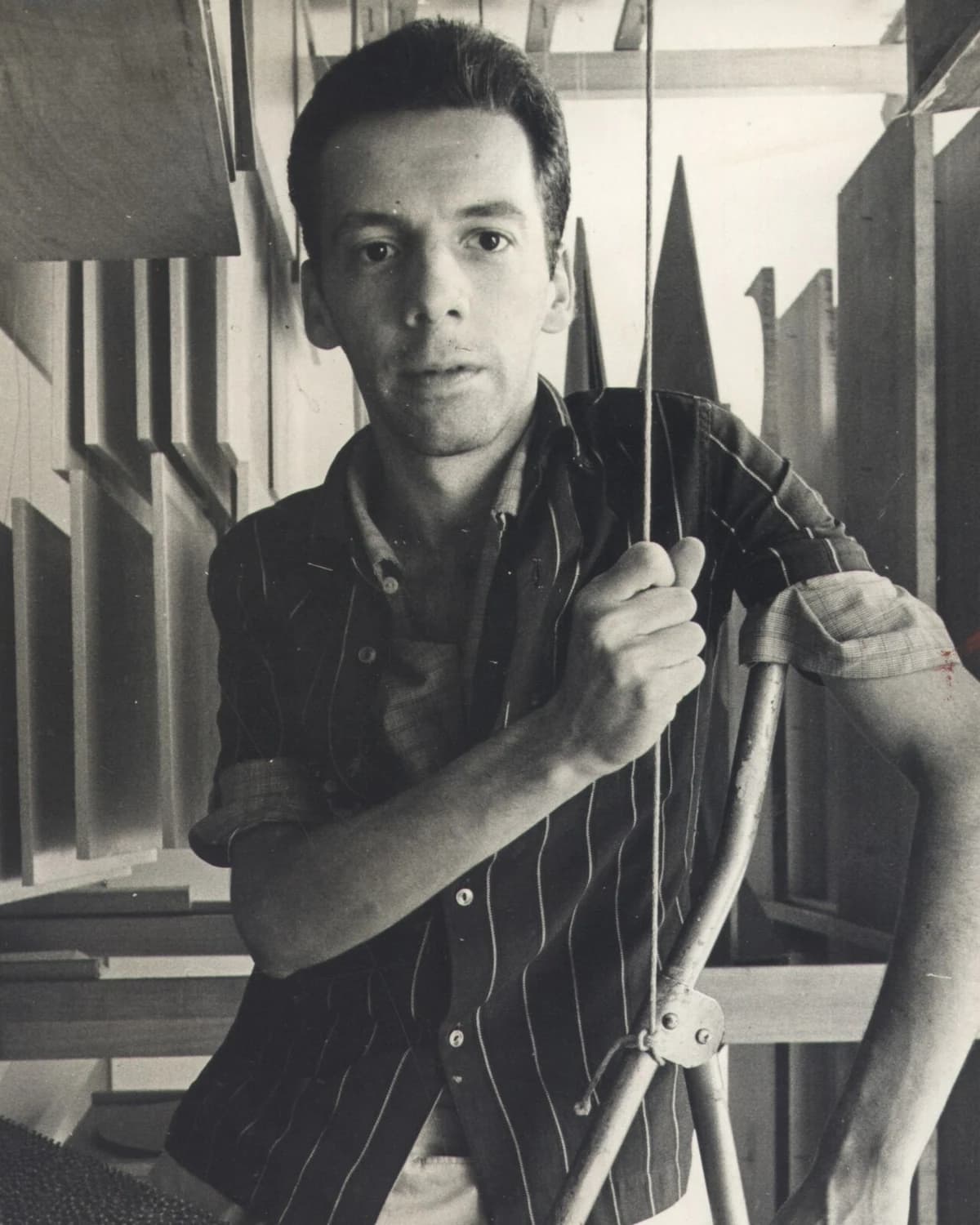
Biography
In 1967 in Rio de Janeiro, visitors were let inside an odd construction: cramped enclosures that looked like favela shacks, surrounded by palm trees, chairs, artificial vines and sand. They were free to wander through it. Hélio Oiticica called the work “Tropicália” and put into the word an irony aimed at the familiar picture of Brazil as a tropical paradise. A year later Caetano Veloso used the same word for a song, and around it the Tropicália movement took shape, which also became a protest against the military government.
Oiticica was born on 26 July 1937 in Rio de Janeiro, into an educated family of liberal views. His father, José Oiticica Filho, was an engineer, taught mathematics, studied butterflies and made experimental photographs, something new in Brazil at the time. His grandfather, a philologist, published an anarchist newspaper, “Direct Action”. Hélio and his two younger brothers, César and Cláudio, were taught at home. In 1947–1949 their father held a Guggenheim Foundation fellowship and worked at the National Museum of Natural History in Washington, and the boys went to elementary school there; in 1950 the family returned home.
From 1954 Oiticica took courses at the Museum of Modern Art in Rio de Janeiro under Ivan Serpa, and in 1955 he joined Grupo Frente, the group Serpa had founded. His work of the mid-1950s follows European models, Concrete art and the Dutch De Stijl: bright primary colours, geometry, an eye on Mondrian, Klee and Malevich. Quite soon the palette grew warmer and narrowed to orange, yellow, red and brown, and with few exceptions he kept to these colours all his life. The series of “Metaesquemas” belongs to the end of the decade: “Metaesquema 362” (1958) is in the Carnegie Museum of Art in Pittsburgh, and “Red Cutting the White” from the same year is in the Museum of Fine Arts, Houston.
In March 1959 the “Neo-Concrete Manifesto” was printed in Rio de Janeiro. It was signed by Amílcar de Castro, Ferreira Gullar, Franz Weissmann, Lygia Clark, Lygia Pape, Reynaldo Jardim and Theon Spanudis. They were arguing with the cool objectivity of Concrete art: a work was to behave like a living organism and enter into relations with the viewer and with real space. Oiticica joined the group that same year. At the same time came the monochromes called “Inventions”, small square wooden plaques measuring 30 by 30 centimetres, in which light, as he conceived it, was not to be depicted but embodied. He then moved on to suspended wooden constructions with barely perceptible shifts of colour between their parts. Over time they grew, and the later works of this kind are assembled from many hanging elements. The group broke up in 1961.
I think the next ten years are most easily described like this: colour comes off the wall and ends up in the viewer’s hands.
In the 1960s Oiticica made “Bólides”, small boxes with panels and doors that viewers opened and slid aside themselves; the glass “Bólide 05” (1965) is dedicated to Mondrian. Alongside them came the “Penetrables”, installations one walks into, and the best known of them became “Tropicália”. The “Parangolés”, layers of fabric, plastic and matting, were meant to be worn like a costume, and in motion they turned into moving sculpture. He staged the first experiments with them together with dancers from the Mangueira samba school, where he took part himself. A 1967 work, “Be an Outlaw, Be a Hero”, is in the Philadelphia Museum of Art.
From the mid-1960s he was shown abroad. In 1965 he took part in the London exhibition “Soundings Two” at the Signals gallery, together with Albers, Brancusi, Lygia Clark and Duchamp. In 1969 the curator Guy Brett organised his solo exhibition at the Whitechapel Gallery in London; the artist himself called it the “Whitechapel experience”. That same year he was artist in residence at the University of Sussex in Brighton, and in 1970 he was included in the exhibition “Information” at the Museum of Modern Art in New York.
Linked to that exhibition was a two-year Guggenheim fellowship, awarded in 1970. Oiticica moved to New York and stayed there for almost eight years. His first plan was to set up his walk-in structures in Central Park, a piece of Brazil in the middle of Manhattan, but no money could be found for it. He attended classes at New York University, made films and took photographs. He handed out colourful capes made from whatever materials were to hand to passengers on the subway and photographed them trying them on; in 1972 he photographed a young Brazilian wearing a parangolé on the rooftops of New York buildings. In 1973, with Neville D’Almeida, he began “Cosmococa”, a cycle of “block-experiments” with slide projections. More and more of his time went into writing and correspondence: among those he wrote to were Haroldo and Augusto de Campos, Silviano Santiago and Waly Salomão.
In 1978, after trouble with the immigration authorities, he returned to Rio de Janeiro. The walk-in installation “Macaléia” is dated to the same year; it is now in the Pérez Art Museum Miami. Hélio Oiticica died in Rio de Janeiro on 22 March 1980, at the age of forty-two.
His legacy was looked after by the artist’s brother César, an architect. In 2006–2007 the retrospective “The Body of Color” was shown in Houston and at Tate Modern in London. In October 2009 a fire broke out in César’s house in the Jardim Botânico district, and it took three hours to put out. By one estimate, about 90 per cent of the collection kept there was lost: paintings, most of the Parangolés and Bólides, including those shown at Tate, drawings, notes and books from the archive. The Brazilian Ministry of Culture took on the restoration of what survived. In 2017 the retrospective “To Organize Delirium” was shown at the Art Institute of Chicago, the Carnegie Museum of Art and the Whitney Museum in New York.
Profile notes
Profile and sources
Image
Artist image
Unknown Unknown; Wikimedia Commons; Public domain.