
12.12.1928–27.12.2011
Helen Frankenthaler
In 1952 Helen Frankenthaler painted Mountains and Sea by pouring heavily thinned oil paint onto unprimed canvas; Morris Louis and Kenneth Noland took up this soak-stain method, and the second generation of colour field painting is dated from it. For sixty years she worked in painting and printmaking, from lithographs in 1961 to woodcuts using dozens of blocks.
Biography
The canvas for Mountains and Sea (1952) lay on the studio floor, unprimed. Helen Frankenthaler thinned her oil paint with turpentine so heavily that it sank straight into the fabric and spread in translucent stains that looked like watercolour. She called her method “soak stain”. A year later, in 1953, Kenneth Noland and Morris Louis came to see the painting. Louis said afterwards that he saw in it a bridge between Pollock and what had become possible after him.
She was twenty-three at the time. She was born on 12 December 1928 in Manhattan, New York, the youngest of the three daughters of Alfred Frankenthaler, a justice of the New York State Supreme Court; her mother, Martha Lowenstein, had come over from Germany with her parents as a child. The family was educated and Jewish, and all three daughters were raised to have professional careers. She studied painting at the Dalton School in New York under Rufino Tamayo, then at Bennington College in Vermont, where Paul Feeley explained to her how a composition is built and where her early manner grew out of Cubism. She graduated in 1949, and in the summer of 1950, on the advice of the critic Clement Greenberg, she studied with Hans Hofmann. It was through Greenberg that she entered the New York art world.
The decisive moment was Jackson Pollock's exhibition at the Betty Parsons Gallery, where Autumn Rhythm and Lavender Mist were hanging. Frankenthaler recalled feeling that she had to live in this land and learn its language. The canvas on the floor she took from Pollock. Everything else, the liquid paint, the raw fabric, the light passing through colour, was her own. Her first solo exhibition was held in the autumn of 1951 at the Tibor de Nagy Gallery.
A good picture, she said, looks as if it happened all at once. For the sake of one such canvas she would readily throw away a dozen laboured ones.
In 1958 she married the painter Robert Motherwell (the marriage ended in 1971). In 1959 she won first prize for painting at the first Paris Biennale and took part in the second documenta in Kassel. In 1960 the Jewish Museum in New York showed a retrospective of her work of the 1950s, with a catalogue by the poet Frank O'Hara, then a curator at the Museum of Modern Art. That same year the term “colour field painting” was applied to her work for the first time. In the 1960s her compositions grew simpler: bands of colour at the edges of the canvas, single stains on white, almost geometric forms. Her canvases grew to three metres in height. From 1963 she switched to acrylic: over time oil stained and damaged the unbleached fabric, while acrylic gave both density and a crisp edge. In 1964 Greenberg included her in his exhibition Post-Painterly Abstraction, and in 1969 the Whitney Museum mounted a retrospective that later went to the Whitechapel Gallery in London, to Hanover and to Berlin.
In the 1970s she gave up soak-staining altogether; the paint grew thicker and the colour bright, almost Fauvist. In the 1980s, by contrast, came muted tones and a calm brushstroke. I think that through all these changes she kept working at one problem: how to keep a picture light without letting it turn empty.
Printmaking was a separate strand of her work. In 1961 she made her first lithographs with Tatyana Grosman at the lithography workshop on Long Island (Universal Limited Art Editions). In 1976 she took up the woodcut with the printer Kenneth Tyler: their first joint print was Essence Mulberry (1977), in eight colours, inspired by an exhibition of fifteenth-century prints at the Metropolitan Museum and by a mulberry tree that grew by Tyler's workshop. In 1995 they released The Tales of Genji, a series of six woodcuts on which they had worked for almost three years; Frankenthaler painted directly onto the wooden blocks. The print Madame Butterfly needed a hundred and two colours and forty-six blocks. She worked on paper all her life, in watercolour, gouache and pencil; she painted the series From the Tower from the view out of the turret of her studio in Darien, Connecticut.
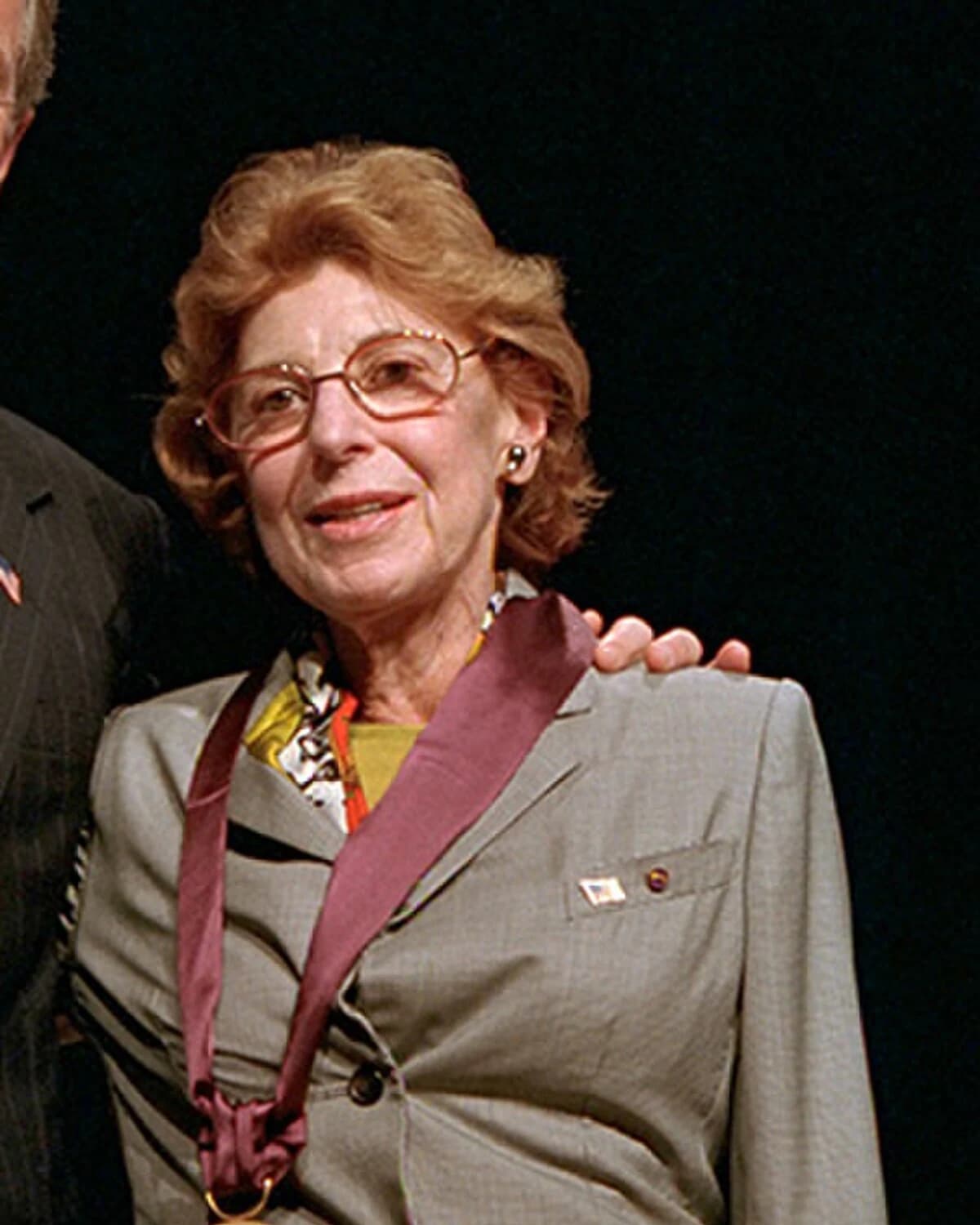
From 1985 to 1992 she sat on the National Council on the Arts. In 1989, in an article for The New York Times, she called any censorship dangerous but questioned the quality of the work the National Endowment for the Arts had supported, and the piece caused controversy. That same year her painting retrospective was shown in Fort Worth and then at the Museum of Modern Art in New York. She did not consider herself a feminist: being a “lady painter” was never an issue for her, she simply painted. In 2001 she was awarded the National Medal of Arts.
Helen Frankenthaler died on 27 December 2011 in Darien, where she had a house and studio, at the age of eighty-three. In her lifetime she had set up and endowed a foundation in her name in New York.
Profile notes
Profile and sources
Image
Artist image
Series: Photographs Related to the George W. Bush Administration, 1/20/2001 - 1/20/2009 Collection: Records of the White House Photo Office (George W. Bush Administration), 1/20/2001 - 1/20/2009; Wikimedia Commons; Public domain.
