
27.06.1878–01.09.1972
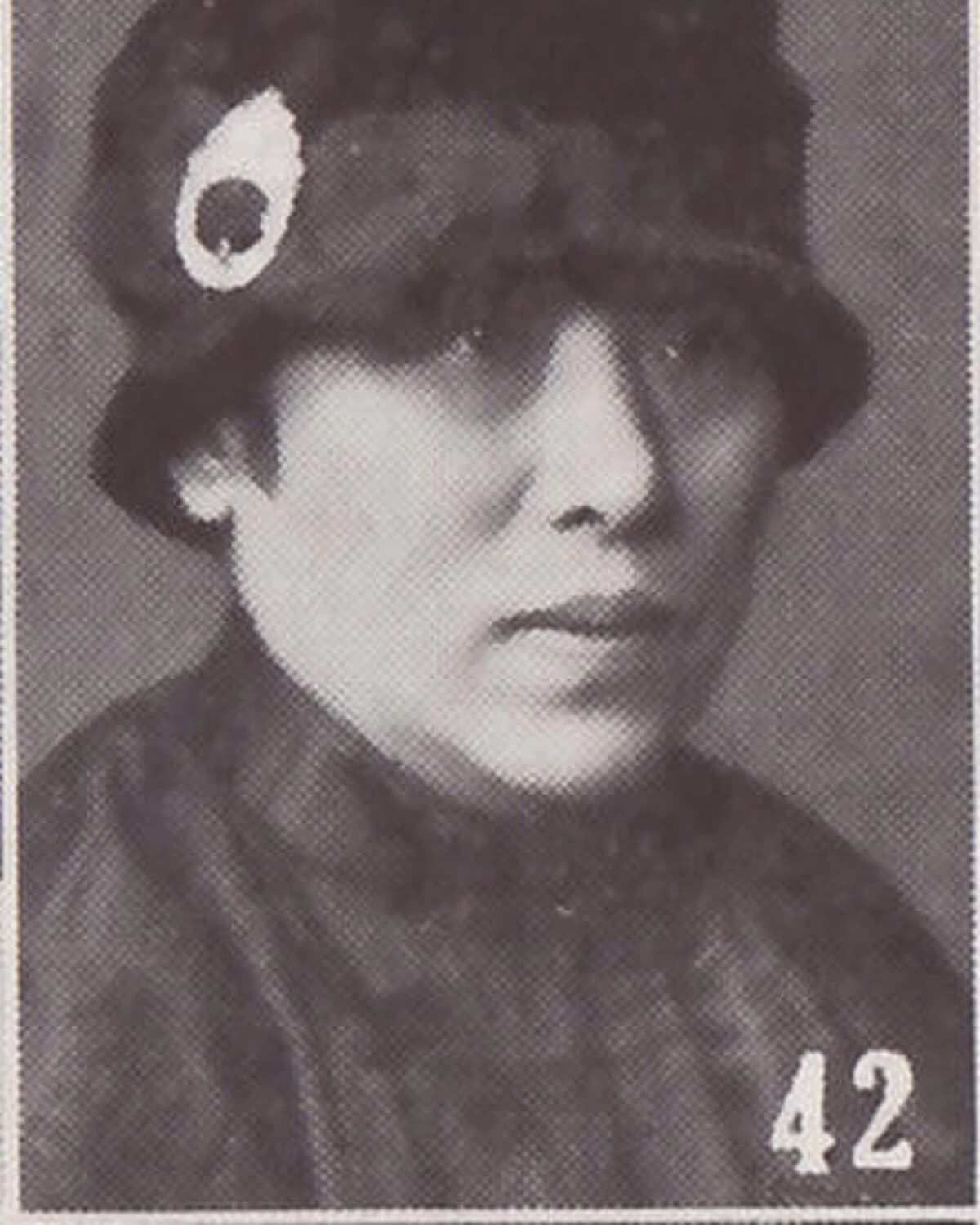
He Xiangning
He Xiangning (1878–1972) studied painting in Tokyo in the 1900s, between meetings of Sun Yat-sen’s revolutionary league, for which she sewed banners, and in the 1920s she sold her paintings to clothe and treat soldiers. All her life she painted plum blossom, pines, tigers and lions in the manner of the Lingnan School; in 1960 she headed the China Artists Association, and in 1997 China’s first national-level museum named after a single artist opened in Shenzhen, bearing her name.
Biography
In Tokyo in the 1900s He Xiangning studied painting at the Women’s Arts School under Tanaka Raishō, a painter to the imperial court, and in her remaining hours she designed and sewed flags and emblems for the underground league Tongmenghui. The house she rented served the league as a front.
So the two occupations ran side by side all her life: the brush and politics.
She was born on 27 June 1878 in Hong Kong, into the wealthy family of He Binghuan, a trader in tea and property from Nanhai in Guangdong, and was named He Jian at birth. She persuaded her father to have her educated with her brothers and flatly refused to have her feet bound; because of her “big feet”, in October 1897 she was married to Liao Zhongkai, an American-born Chinese who did not want a wife with bound feet. They turned out to have much in common: books, art and a wish to remake the country. So that her husband could study in Japan she sold her jewellery and raised three thousand silver dollars; in November 1902 he left, two months later she followed and entered the preparatory school of the Tokyo Women’s Normal School. In 1903 they met Sun Yat-sen and became two of the earliest members of his league. Between Tokyo and Hong Kong a daughter, Liao Mengxing, and, in 1908, a son, Liao Chengzhi, were born. In 1911, the year of the Xinhai Revolution, the couple returned to Hong Kong, and in 1914, after a failed rising against Yuan Shikai, they found themselves in Japanese exile once more.
In 1921 Sun Yat-sen set up a government in Guangdong and made Liao his finance minister. In Guangzhou He Xiangning, together with Soong Ching-ling, raised money for medicine and clothing for the soldiers and sold a good many of her paintings to do so. In August 1923 she joined the Central Executive Committee of the Kuomintang and took charge of its department for women’s affairs; on 8 March 1924 she held China’s first rally for International Women’s Day, and she opened schools and hospitals for women in Guangzhou. In August 1925, five months after the death of Sun Yat-sen, Liao Zhongkai, the leader of the party’s left wing, was assassinated in Guangzhou; she was beside him. In 1927, when Chiang Kai-shek’s Kuomintang turned on the Communists, many of the women from the medical units she had assembled and brought to Wuhan were killed, and after that she withdrew from party politics for twenty years.
Those twenty years became her time for painting. She lived in Hong Kong and Singapore, travelled across Europe and exhibited her pictures in London, Paris, Belgium, Germany and Switzerland. After the Mukden Incident of 1931 she returned to Shanghai and with Shen Junru founded the National Salvation Association against the Japanese invasion; she had to flee Shanghai in 1937 and Hong Kong in 1941, and spent the rest of the war in Guilin.
In 1948 she became one of the founders of the Revolutionary Committee of the Chinese Kuomintang, after 1949 she moved to Beijing and held high office: Vice Chairwoman of the Chinese People’s Political Consultative Conference (1954–1964), Vice Chairwoman of the Standing Committee of the National People’s Congress (1959–1972), Chairwoman of the Revolutionary Committee of the Kuomintang (1960–1972), Honorary Chairwoman of the All-China Women’s Federation. She worked until she was eighty, until 1959, and kept some of her posts afterwards. In July 1960 she was elected the third chairwoman of the China Artists Association.
She painted in the manner of the Lingnan School, and her favourite motifs are simple: plum blossom, pines, tigers and lions. Collections of her paintings, and of poems with pictures, appeared in her lifetime; a collected edition of her painting was published in Guangdong in 1979. I would not read her tigers as political allegories: there is nothing to support it.
He Xiangning died on 1 September 1972 in Beijing, in her ninety-fifth year, and is buried in Nanjing, in the Liao Zhongkai Mausoleum, beside her husband. On 18 April 1997 the He Xiangning Art Museum opened in Shenzhen, China’s first national-level museum named after a single artist; the calligraphy for its name was written by Jiang Zemin. In June 1998 China Post issued three stamps with her paintings.
Related context
Associations
Works connected through artistic movements, cultural context and period. Priced works available in this market appear first.








Profile notes
Profile and sources
Image
Artist image
Unknown; scanned by 天竺鼠 ( talk ) 17:19, 13 December 2010 (UTC); Wikimedia Commons; Public domain.
