
1539–19.03.1610
Hasegawa Tōhaku
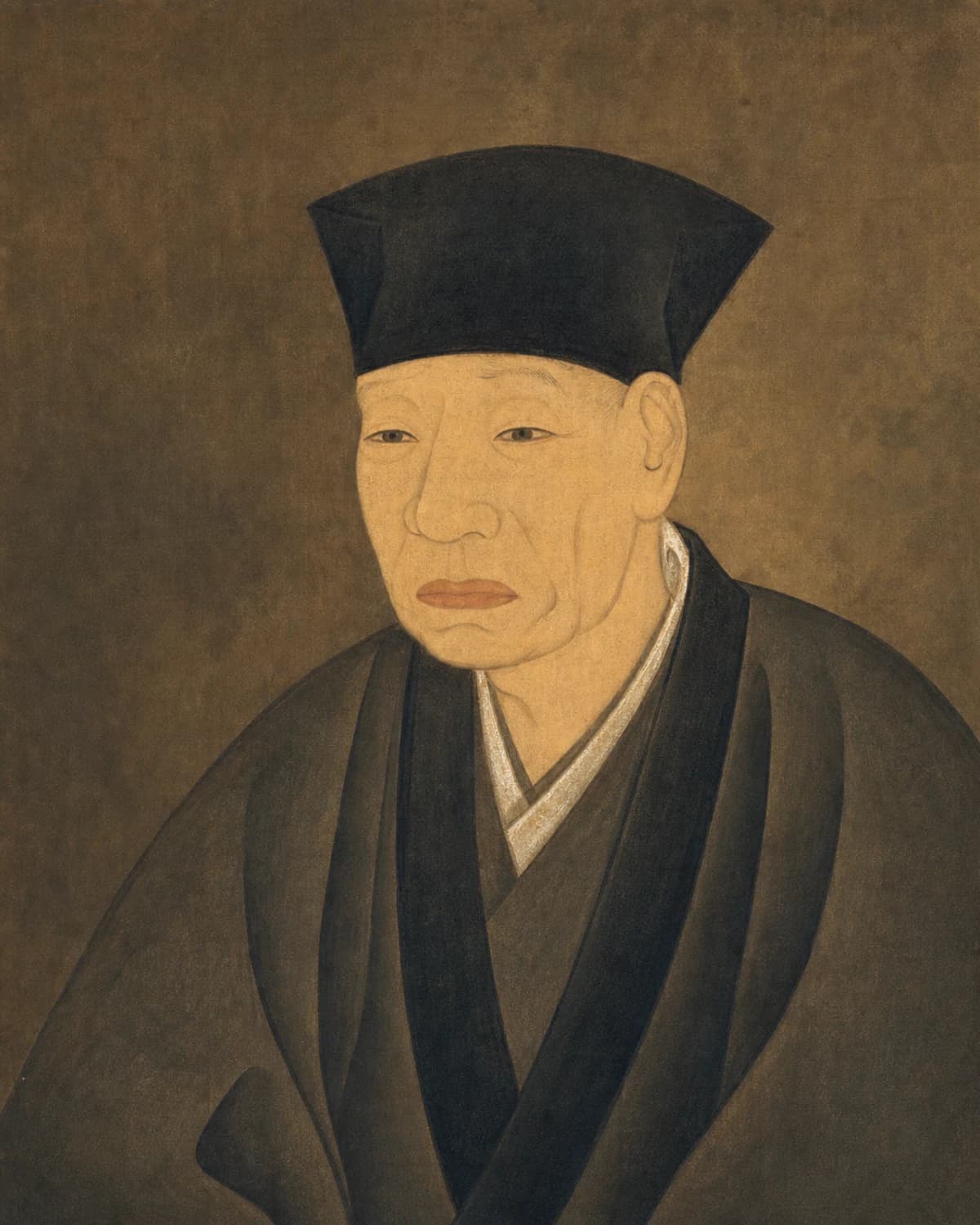
Hasegawa Tōhaku (1539–1610), the son of a cloth dyer from Nanao on the Noto peninsula, began with Buddhist images for provincial temples, moved to Kyoto at thirty, studied with the Kanō school and from the scrolls of Sesshū, and around 1590 painted in ink, on a pair of six-panel screens, pine trees in mist in which there is more untouched paper than line. “Pine Trees” is kept at the Tokyo National Museum as a National Treasure.
Biography
Two six-panel screens, each roughly one and a half metres by three and a half. In ink of varying density, from almost black to the palest grey, pine trees are painted: some stand out of the mist, others dissolve into it, and most of the paper is left empty. “Pine Trees” was made around 1590, and it is held to be the first painting of its size with nothing in it but pines.
There is a suggestion that it is only a sketch for a lost work in colour. That is hard to verify.
Tōhaku was born in 1539 in Nanao, in Noto province (now Ishikawa prefecture), into a noted local family of cloth dyers; at birth he bore the surname Okumura, and became a Hasegawa by adoption. He began as a painter of Buddhist images for the temples of his home province: attributed to him are a portrait of Takeda Shingen from the Seikei-in on Mount Kōya, the “Twelve Devas” from the Shōkaku-ji in Ishikawa and a portrait of Nawa Nagatoshi. By twenty he was a professional painter, and in his thirties he moved to Kyoto and went to study with the Kanō school, then headed by Kanō Shōei: large, bold paintings on gold leaf for the castles of the warlords, reflecting light around dim halls and displaying the owner's wealth. His “Maple” at the Chishaku-in (1593) is painted in this manner. At the same time, at the Daitoku-ji monastery, he gained access to scrolls by the Chinese master Mu Qi and by Sesshū, and for a while studied with Tōshun, Sesshū's successor. He revered Sesshū so much that he declared himself his heir in the fifth generation, but lost the lawsuit to Unkoku Tōgan. His own manner of ink painting moved away from the force of the Kanō school towards the restraint of the old masters; he was, moreover, a friend of the tea master Sen no Rikyū.
His chief rival was Kanō Eitoku, with whom Tōhaku contested the patronage of Oda Nobunaga and Toyotomi Hideyoshi. After Eitoku's death in 1590 Tōhaku was left the foremost master in the country and the official painter to Hideyoshi. In 1593 he and his workshop executed the wall and screen paintings for the Shōun-ji temple, commissioned by Hideyoshi; they were later moved to the Chishaku-in, where they survive and are registered as a National Treasure, together with the screen “Pine Tree and Flowering Plants”. The Hasegawa school was small, in essence himself and his sons, but it kept to his quiet, reserved aesthetic, in which, it seems to me, there was also a dissent from the Kanō display of power and wealth.
At sixty-seven the shōgun Tokugawa Ieyasu summoned him to Edo and granted him the honorary Buddhist title of hōgen. There Tōhaku stayed. He died in Edo on 19 March 1610.
Related context
Associations
Works connected through artistic movements, cultural context and period. Priced works available in this market appear first.
Profile notes
Profile and sources
Image
Artist image
На основе открытого изображения: painted by 長谷川等伯, calligraphy by 春屋宗園; Wikimedia Commons; Public domain.
