
11.05.1988–present
Harry Roldán Pinedo Valera
A Peruvian artist of the Shipibo-Conibo people, born in Pucallpa in 1988, who as a child helped his parents, themselves artists. He paints on cotton tocuyo cloth with natural pigments, depicting the animals and plants of the Amazon rainforest. His work has been shown in Lima, Paris, Madrid, Frankfurt and Newcastle, and is in the collection of the Weltkulturen Museum in Frankfurt.
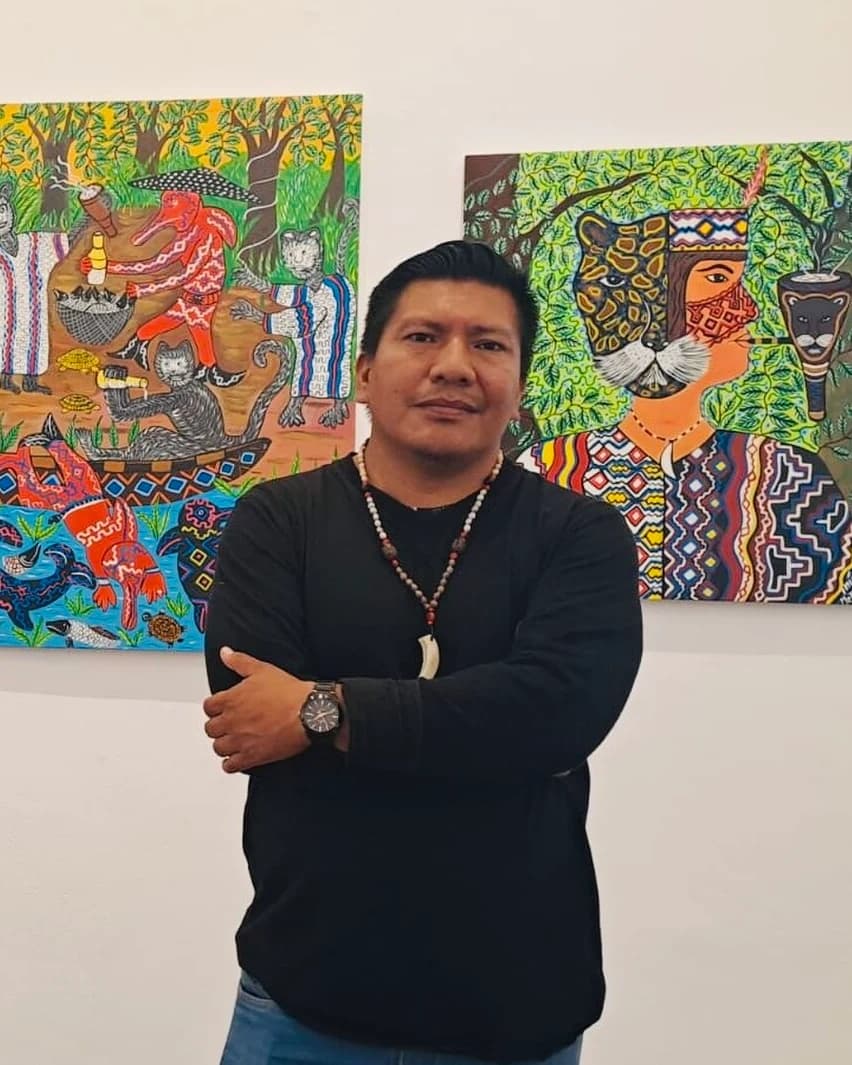
Biography
Harry Roldán Pinedo Valera, also known as Harry Pinedo, was born on 11 May 1988 in Pucallpa, in the Peruvian Amazon. He belongs to the Shipibo-Conibo people of the Ucayali region; in their language his name is Inin Metsa.
He learned to paint at home. His parents, Elena Valera and Roldán Pinedo, were artists, and as a boy he first helped them by filling in missing elements of their designs. In time his own manner grew out of this. The family moved to Lima in the mid-1990s or in 2000; sources differ. The artist lives in Cantagallo, an urban Shipibo community on the edge of the capital. In 2020 he received a bachelor’s degree in pedagogy for bilingual intercultural education from the Cayetano Heredia University in Lima, and since then he has taught at the Shipibo community school in Cantagallo.
His technique is traditional. He makes brushes from piri piri twigs or ronsoco hair, obtains his colours from local earth, and paints on plain cotton tocuyo cloth dyed with an essence from mahogany bark. For large formats he adds acrylic. In this way he tries to fix the oral traditions of the Shipibo-Conibo in colour and form. He is placed within Peruvian pictorial indigenismo, the movement that arose in the middle of the twentieth century. Earlier indigenista painters depicted almost exclusively the man of the Andes; Pinedo turned to the dweller of the rainforest and his world. His motifs are simple and flat, close to naïve art, but they derive from shamanic ideas: spirits of animals and plants, and visions into which he also brings his own experience of the ceremonial use of ayahuasca. The distinguishing mark of his pictures is the recurring patterns drawn from the animal world. To my mind this is the most recognisable thing in his work, though it is interpreted in different ways, most often as a sign of human life’s dependence on nature. His pictures also contain social criticism, but it is read as a call to protect the forest rather than destroy it.
His exhibitions began in 2010 with “Noche de Arte 2010” in San Isidro, Lima, followed in 2011 by “Amazonia I” in the Sala Ricardo Palma in Miraflores, in 2013 by “Mira!” in Belo Horizonte, and in 2014 by an exhibition of contemporary painting from the Peruvian Amazon in Paris. In 2018 he took part in “Ruraq Maki” at the Museo de la Nación in Lima, and in 2019 he showed work at ARCOmadrid, where Peru was the guest country. Later came “Place-Making, World-Making” at the University of Essex (2021), “Perú en mi Corazón” at the Maggy Stein gallery in Luxembourg (2022), “healing” at the Weltkulturen Museum in Frankfurt (2023), Pinta Miami (2024) and “Listening to the Voices of the Rivers” in Newcastle (2025).
Pinedo’s works are held by the Weltkulturen Museum in Frankfurt am Main, by the Cayetano Heredia University and by the Ministry of Culture of Peru in Lima.
Profile notes
Profile and sources
Image
Artist image
Harry Pinedo Valera; Wikimedia Commons; CC BY-SA 4.0.
