
28.04.1834–25.05.1911
Harry Bolus
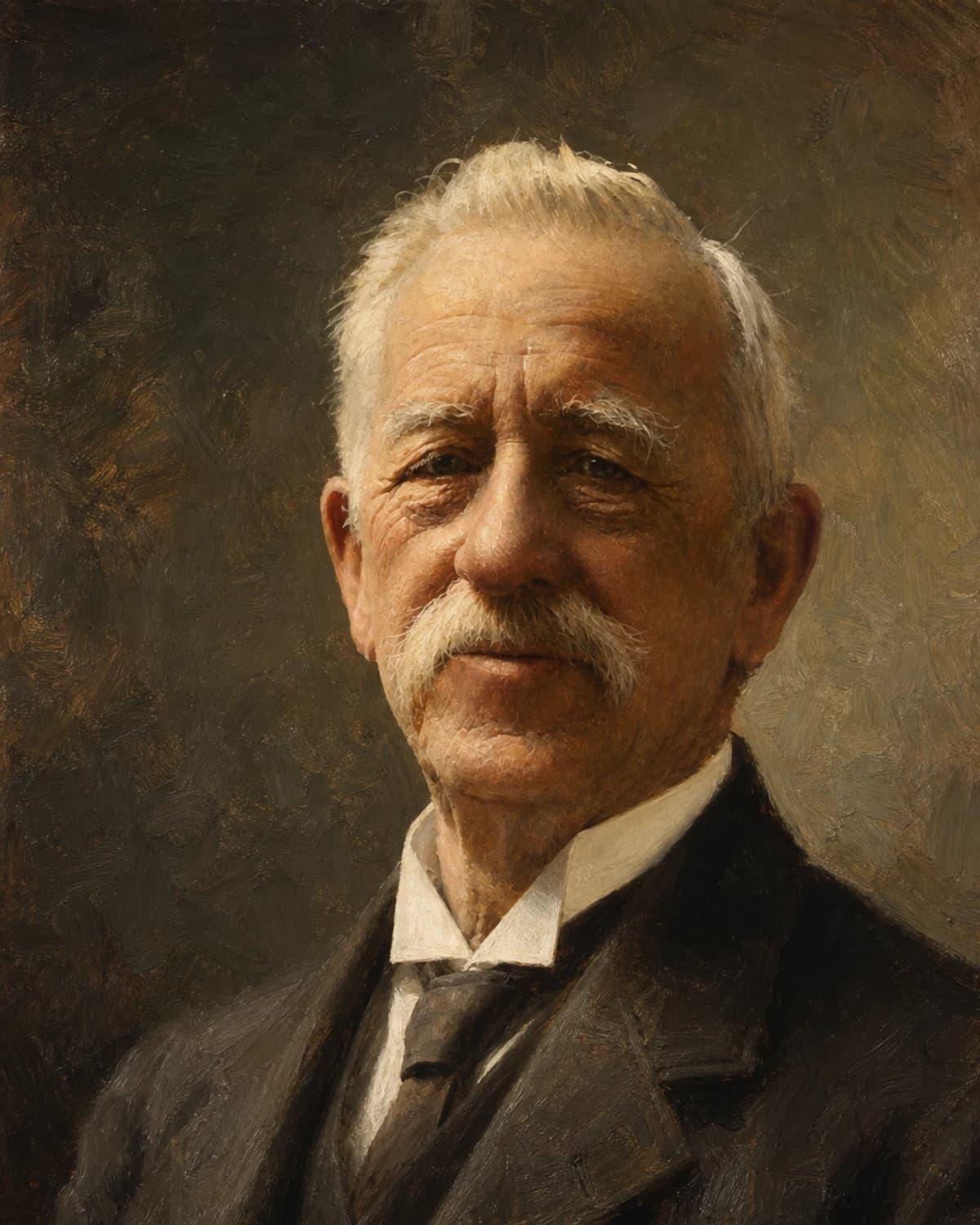
Harry Bolus (1834–1911) arrived in South Africa at fifteen as a naturalist’s assistant, grew rich as a stockbroker in Cape Town and from 1865 built up a herbarium that became the oldest in the country. He described the orchids of the Cape Peninsula and drew them himself: the 36 plates in his book of 1888 are his own work, and the multi-volume “Icones Orchidearum” went on appearing until his death. Five plant genera bear his name.
Biography
In October 1876 the steamer Windsor Castle, on which Harry Bolus was returning from England, struck a reef off Dassen Island, not far from Cape Town. The passengers were saved, but the boxes of plants and notes, the fruit of “forty happy days” at Kew, went to the bottom. Bolus was forty-two; he began collecting again from scratch.
He had come to South Africa almost by chance. Born on 28 April 1834 in Nottingham, he was educated at Castle Gate School, whose headmaster, George Herbert, corresponded with William Kensit of Grahamstown and received plants from him. Kensit asked for one of the pupils to be sent out as an assistant, and in March 1850 the fifteen-year-old Bolus stepped off the ship Jane at Port Elizabeth. He spent two years with Kensit, then lived in Port Elizabeth, paid a short visit to England and settled for nineteen years in Graaff-Reinet. In 1857 he married Sophia Kensit, the sister of his first employer.
Botany came in 1865: a friend, the mathematician Francis Guthrie, suggested it as an occupation that might take his mind off a family grief. Bolus began collecting plants and was soon corresponding with Joseph Hooker at Kew, William Harvey in Dublin and Peter MacOwan in Grahamstown; in 1869 Guthrie gave him a copy of De Candolle’s “Prodromus”, a gift he prized above all others. In 1875 Bolus joined his brother Walter in Cape Town, in the suburb of Kenilworth, where they opened the stockbroking firm Bolus Bros. The business did well, and the income let him buy expensive botanical books: complete sets of the London botanical journals, the large folios of Redouté, Jacquin, Ferdinand Bauer and Francis Masson. A year later came that first trip to Kew with Guthrie, and the shipwreck.
After that he worked in the field. Expeditions followed one another: Namaqualand in 1883, the Eastern Cape with Henry and Florence Flanagan and Ernest Galpin, in 1886 the route from Lourenço Marques through Barberton and Pretoria to Cape Town, the Orange Free State with the Flanagans in 1893–1894, the Transvaal and Swaziland in 1904–1906. With MacOwan, from 1884, he issued exsiccatae, series of standard herbarium specimens of South Africa. Orchids became his main subject: “A Preliminary List of the Cape Orchids” (1881), “A Sketch of the Flora of South Africa” (1886), “The Orchids of the Cape Peninsula” (1888), in which 117 species are illustrated by 36 plates he drew and coloured himself, and the multi-volume “Icones Orchidearum”, figures of the extra-tropical South African orchids: the first part, with fifty plates, came out in 1893, the second in 1896, a volume of a hundred plates in 1911, shortly after his death, and a third volume in 1913, prepared by his grand-niece Harriet Kensit, with nine plates painted for it by his son Frank. To my mind those 36 plates of 1888, done with his own hand, are what make Bolus an artist and not merely a commissioner of drawings. With Guthrie and N. E. Brown he worked up the Ericaceae for the “Flora Capensis”, and with Wolley-Dod compiled a list of the flowering plants and ferns of the Cape Peninsula. He seems to have been a quiet, unassuming man, yet one who did not shy from risk on the road.
He was a Fellow of the Linnean Society, a founding member and later president of the South African Philosophical Society (afterwards the Royal Society of South Africa), and received the medal of the South African Association for the Advancement of Science and an honorary doctorate of science from the University of the Cape of Good Hope. The herbarium he had begun in 1865, and his library, he gave to the South African College, now the University of Cape Town, where he endowed a professorship in his own name and left a trust for scholarships. From 1903 the curator of the herbarium was Harriet Kensit, who had been his assistant since her college days; she held the post until 1955. Today the Bolus Herbarium holds more than 350,000 specimens and is the oldest and third-largest collection of its kind in South Africa.
Bolus loved England and crossed the ocean twenty-eight times. He died on 25 May 1911 in England. Five plant genera are named after him: Bolusia, Bolusafra, Neobolusia, Bolusanthus and Bolusiella.
Related context
Associations
Works connected through artistic movements, cultural context and period. Priced works available in this market appear first.








Profile notes
Profile and sources
Image
Artist image
На основе открытого изображения: Unknown author Unknown author; Wikimedia Commons; Public domain.
