
1497–29.11.1543
Hans Holbein the Younger
Hans Holbein the Younger was born in Augsburg into a family of painters, spent about ten years in Basel working for printers and humanists, and from 1532 lived in England, where from 1536 he served as King's Painter to Henry VIII. He illustrated books by Erasmus of Rotterdam, drew the “Dance of Death” and painted “The Ambassadors”, with its anamorphic skull in the foreground.
Biography
In his will, made on 7 October 1543 at his home in Aldgate, Holbein described himself as a servant to the king’s majesty. Seven weeks later, on 29 November, the goldsmith John of Antwerp was already administering his estate. Where the artist was buried is not known, and the grave may never have been marked.
He was born in Augsburg, in 1497 according to some accounts, in the winter of 1497–98 according to others. His father, Hans Holbein the Elder, ran a large workshop in the city, and his older brother, Ambrosius, trained there too. Around 1515 the brothers moved to Basel, a centre of the printing trade, and worked for Hans Herbster, the city’s leading painter. They designed woodcuts and metalcuts for printers. In that same year pen drawings by them appeared in the margins of a copy of Erasmus of Rotterdam’s “The Praise of Folly”, and they show Holbein’s early sense of humour.
In 1517 he and his father painted murals, inside and out, on the house of the merchant Jakob von Hertenstein in Lucerne. A city record survives: on 10 December of that year he was fined five livres for fighting in the street with a goldsmith. He may have visited northern Italy that winter, but there are no documents for the trip.
In 1519 he returned to Basel. His brother fades from the records at about this time, and it is usually assumed that he died. Holbein married Elsbeth Binsenstock, the widow of a tanner and a few years older than he was, joined the painters’ guild and in 1520 took out Basel citizenship. They had four children. He painted his wife and the two eldest children in 1528; the portrait is in the Kunstmuseum Basel.
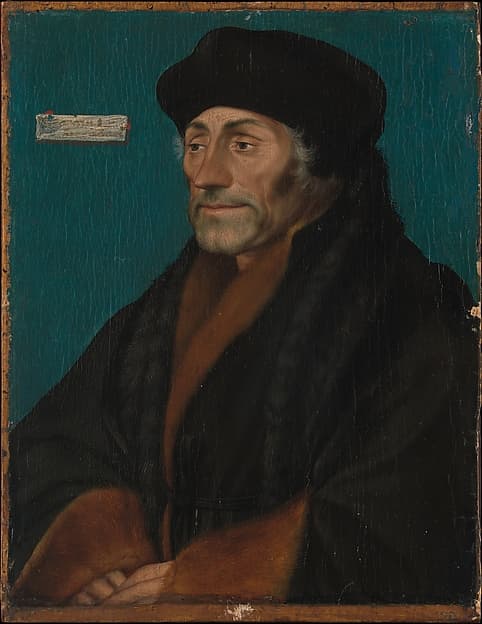
The Basel years were crowded. He painted murals for the Council Chamber of the Town Hall (only a few poorly preserved fragments survive), the “Solothurn Madonna” (1522), the “Darmstadt Madonna”, a portrait of the jurist Bonifacius Amerbach and, in 1522, “The Body of the Dead Christ in the Tomb”. In Dostoevsky’s novel “The Idiot”, Prince Myshkin says that looking at this picture could make a man lose his faith. For the publisher Johann Froben he designed woodcuts: the “Dance of Death” (1523–26, cut by Hans Lützelburger), illustrations to the Old Testament, the title page of Luther’s Bible and twelve alphabets of decorated initials. From 1523 he painted Erasmus, who needed likenesses to send to friends across Europe, and this made Holbein known beyond Basel.
In 1526, carrying a recommendation from Erasmus (“the arts are freezing” here, Erasmus wrote), Holbein went to England. On the way he stopped in Antwerp. In London Thomas More received him; the portrait he painted of More and a group portrait of More’s family are known only from a sketch and copies. He painted courtiers, William Warham, Archbishop of Canterbury, and the astronomer Nicholas Kratzer, and in 1527 he helped decorate the reception of French ambassadors at Greenwich.
From August 1528 he was living in Basel again, where he bought a house and later a second. The city had changed meanwhile: followers of Zwingli were destroying religious images, and in 1529 Erasmus left for Freiburg. Commissions for religious work grew fewer. The council called Holbein to account for not attending the reformed communion, but soon listed him among those who were willing to go along with other Christians. He resumed work on the Council Chamber frescoes, choosing subjects from the Old Testament. I would not ascribe a definite position to him in these disputes: the evidence for his beliefs is fragmentary.
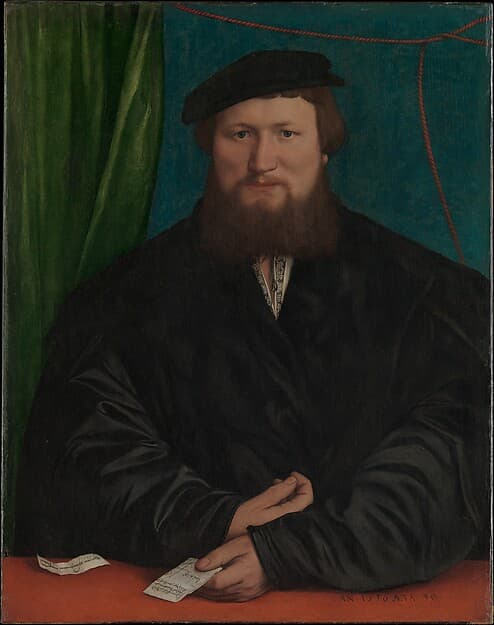
In early 1532 he left for England again. More had by then resigned as Lord Chancellor, and Holbein found patrons in the circle of the Boleyns and Thomas Cromwell. He painted merchants of the Steelyard, the German trading compound on the Thames, and decorated their guildhall. In 1533 he painted “The Ambassadors”: Jean de Dinteville, ambassador of Francis I, and Georges de Selve, Bishop of Lavaur. Between them stands a table crowded with objects, and in the foreground lies an anamorphic skull. By 1536 Holbein was King’s Painter on a salary of thirty pounds a year, though he was never the best-paid artist at court. He painted portraits and drew designs for cups, jewellery, weapons and decorations for court festivities. In 1537 he made the design for a wall painting at Whitehall Palace: Henry VIII in a heroic pose, with his feet planted wide apart. The mural burned in 1698; the cartoon and copies remain. For the king, who was looking for a bride, he painted Christina of Denmark and Anne of Cleves. Henry soon had the marriage to Anne annulled.
In 1540 Cromwell was arrested and executed on charges of heresy and treason. Holbein kept his post, but no patron of that standing replaced him. He took private commissions, painted miniatures and a portrait of Anthony Denny, and in 1543 a group portrait of Henry VIII with the Barber Surgeons’ Company.
He died between 7 October and 29 November 1543, at the age of forty-five.
Artist works
Works by the artist
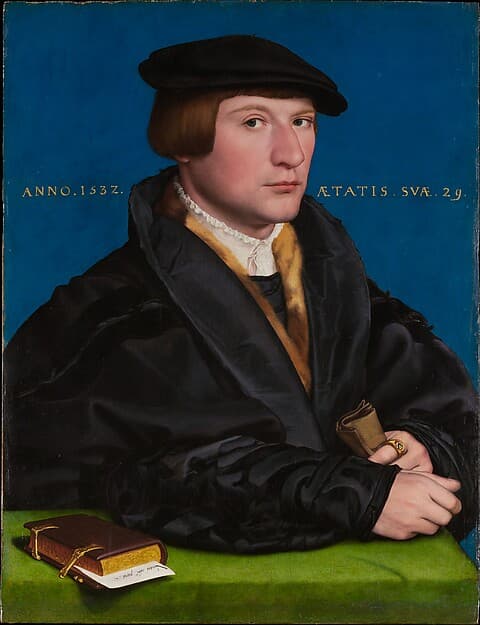
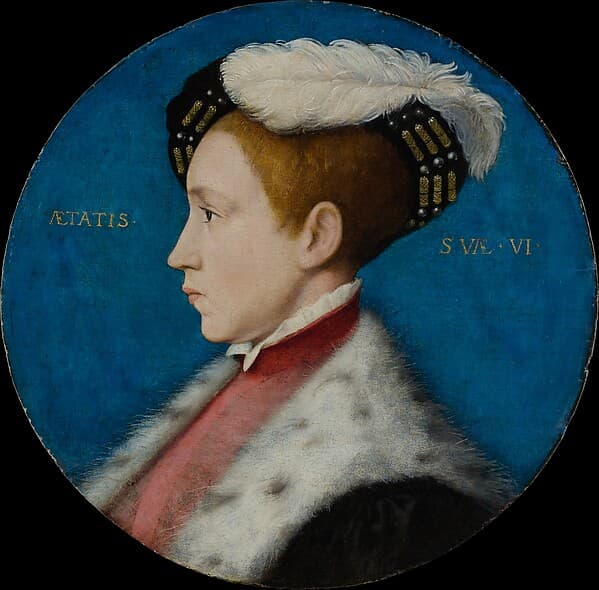
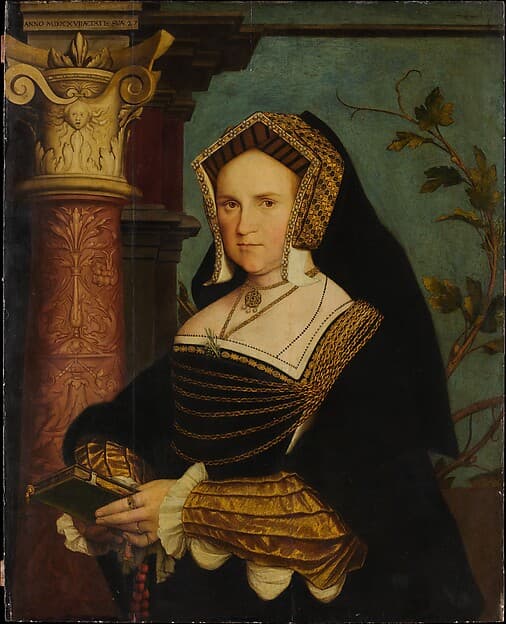
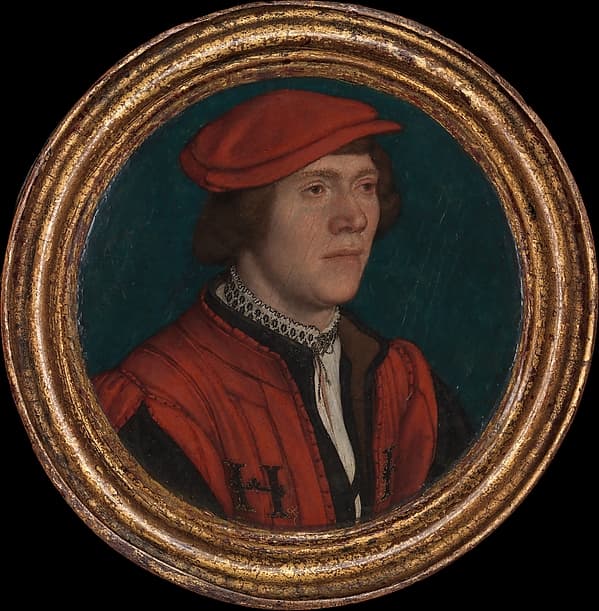
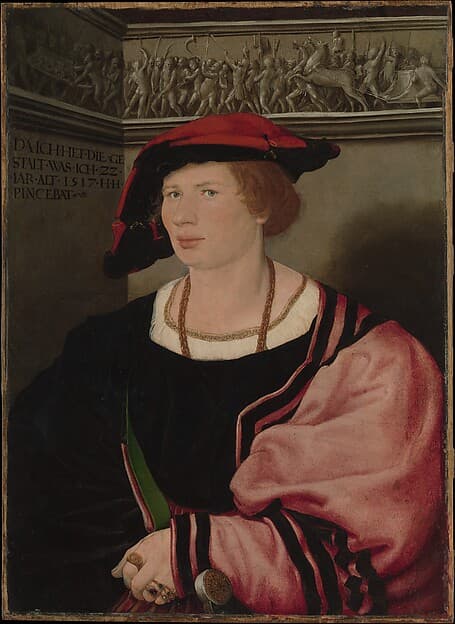
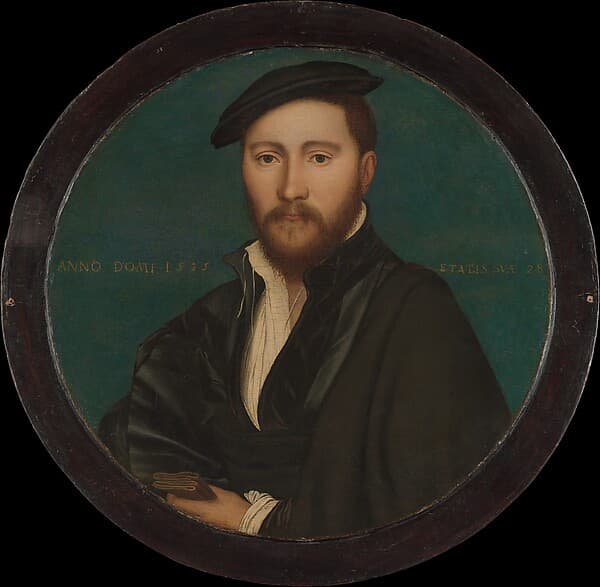
Works by Hans Holbein the Younger available in this edition of NEOARCA.
Profile notes