
28.01.1844–16.07.1920
Gyula Benczúr
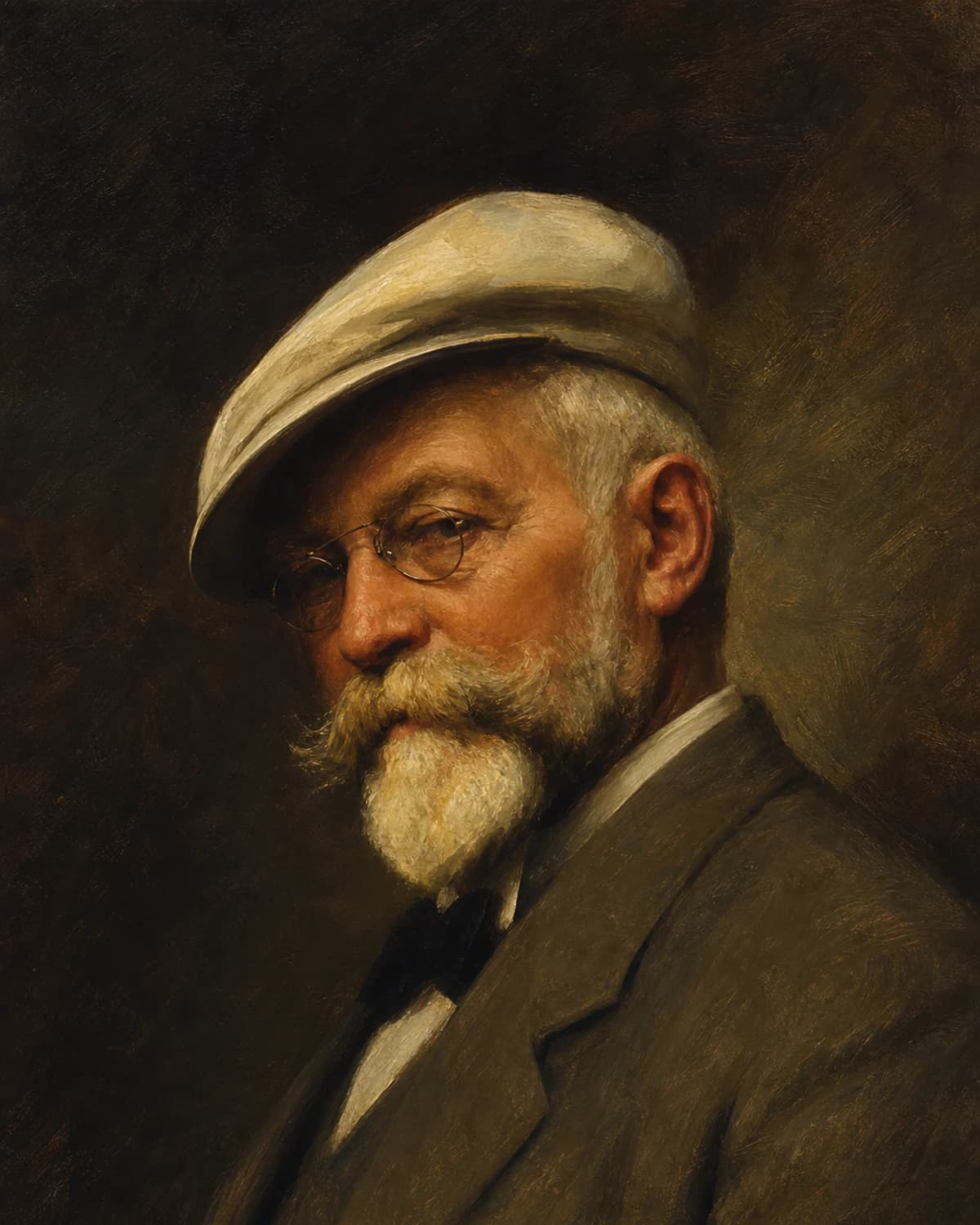
Gyula Benczúr (1844–1920) grew up in Kassa, studied in Munich under Karl von Piloty and helped him paint murals in public buildings. In Munich he made his name with “The Baptism of Vajk” and taught at the academy until 1883. Back in Hungary he headed an art school in Budapest for the rest of his life and painted portraits, historical and religious scenes.
Biography
His first notable success came early: the canvas “The Departure of László Hunyadi” (1866) made him known in Pest, although he was still a student in Munich at the time.
He was born on 28 January 1844 in Nyíregyháza, the son of Vilmos Benczúr and Paulina Laszgallner; on his father’s side the family was an old noble one. As a child he was taken to Kassa (now Košice), where his childhood and early years were spent. His talent for drawing showed early. His parents, according to some accounts, meant to make an engineer of him but changed their minds and gave their son a thorough early training, including at the private school of the Klimkovics brothers. From 1861 Benczúr studied at the Academy of Fine Arts in Munich under Hermann Anschütz and Johann Georg Hiltensperger, and then under Karl von Piloty. Sources date the start of his work with Piloty differently: 1865 or 1869. Among Piloty’s students in those years were other future Hungarian painters, for example Mihály Munkácsy. In 1869 Benczúr travelled to Italy. In 1870 he visited Paris, and in the same year he won the Hungarian national competition for historical painting with a scene of the baptism of King Stephen.
Staying on in Munich, he helped Piloty with the frescoes of the Maximilianeum and the new Town Hall, illustrated works by Friedrich Schiller and received commissions from King Ludwig II of Bavaria. In 1873 he married Lina, the sister of the Munich painter Gabriel von Max. In the summer of 1874 the king sent him to France, to Fontainebleau.
In 1875 Benczúr painted “The Baptism of Vajk”: Prince Vajk, the future King Stephen I, receives Catholicism from Adalbert, Archbishop of Prague (traditionally in 985). The painting won a silver medal at the Paris World’s Fair of 1878. After this, several academies offered him chairs; he declined the offers from Weimar and Prague and, in 1875 or 1876 (the dates differ), became a professor at the Munich Academy. Among his Munich students was the Swiss-born American painter Adolfo Müller-Ury. He built a house at Ambach on Lake Starnberg, designed by his brother Béla.
In 1883 Benczúr returned to Hungary and took charge of an art school in Budapest, later the Academy of Fine Arts; he remained its director to the end of his life. Here he became a favourite portraitist of the Hungarian upper class, painting royalty and aristocrats as well as historical and mythological scenes. He painted altarpieces for St Stephen’s Basilica in Budapest and for the Hunyadi Hall in the royal palace at Buda. Among his historical canvases, “The Recapture of Buda Castle” (1896) is also known.
He received the Order of Franz Joseph (1879) and the gold medal “Pro Litteris et Artibus” (1887), was an honorary member of the Hungarian Academy of Sciences, and in 1906 entered the upper house of the Hungarian parliament. His daughters Olga (1875–1962) and Ida (1876–1970) also became well-known painters.
Benczúr spent his last years in Dolány, in Nógrád county. He died there on 16 July 1920. After his death the village was renamed Benczúrfalva; it is now part of Szécsény.
Artist works
Works by the artist
Works by Gyula Benczúr available in this edition of NEOARCA.
Related context
Associations
Works connected through artistic movements, cultural context and period. Priced works available in this market appear first.








Profile notes
Profile and sources
Image
Artist image
На основе открытого изображения: Gyula Benczúr; Wikimedia Commons; Public domain.
