
10.06.1819–31.12.1877
Gustave Courbet
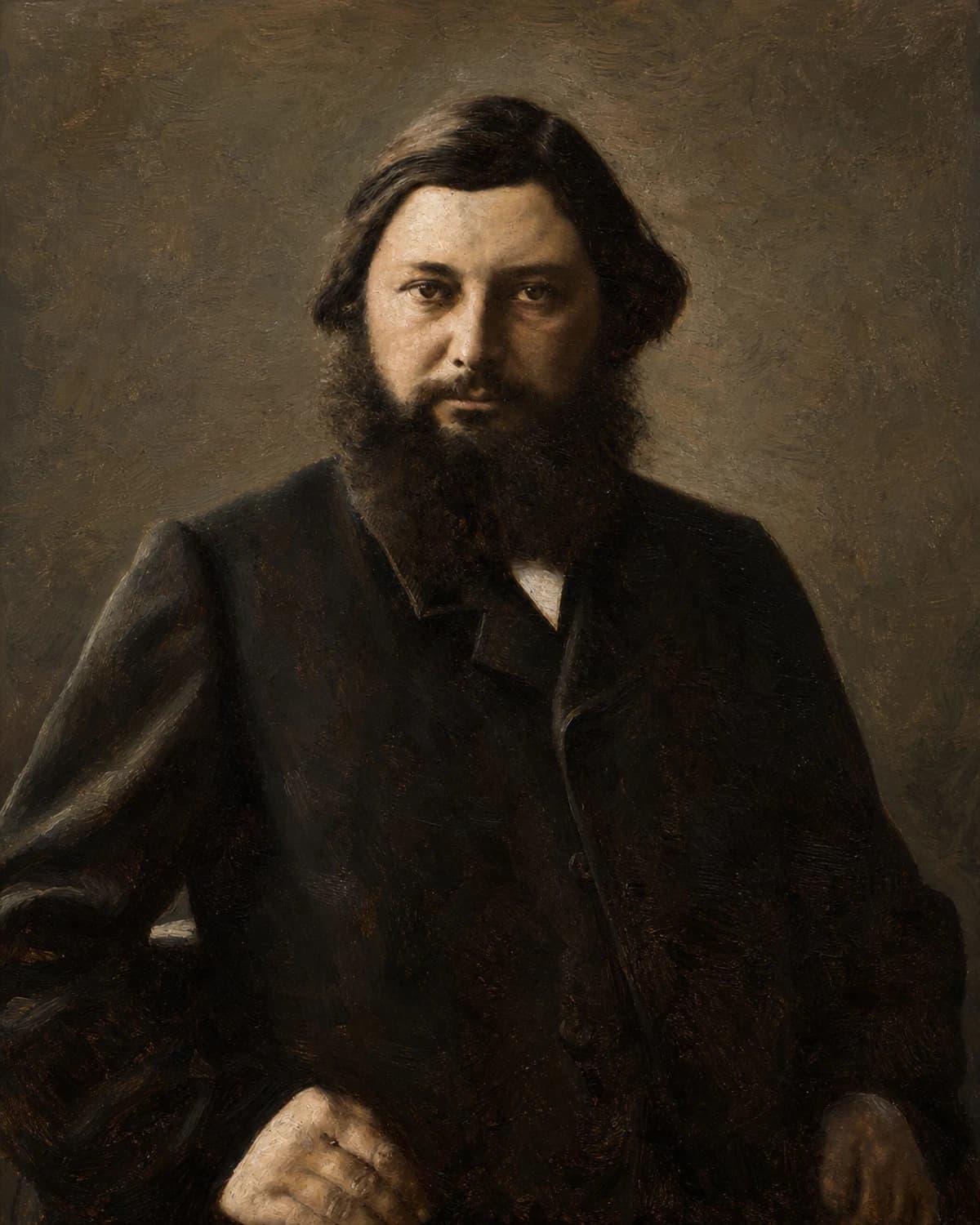
Gustave Courbet (1819–1877), the son of a well-to-do landowner from Ornans in the Franche-Comté, painted the funeral of his own great-uncle on a canvas the size of a history painting, and in 1855 built his own “Pavilion of Realism” next to the Exposition Universelle. For his part in the Paris Commune and the toppling of the Vendôme Column he was imprisoned and ordered to pay for its reconstruction; he spent his last four years in Switzerland.
Biography
On 4 September 1870, the day the Second Empire fell, citizen Courbet wrote a letter to the Government of National Defence: the Vendôme Column was devoid of all artistic value and perpetuated the ideas of war and conquest, and so he asked permission to take it apart. The government left the letter unanswered. Seven years later that piece of paper would cost him 323,000 francs.
But one has to begin with Ornans.
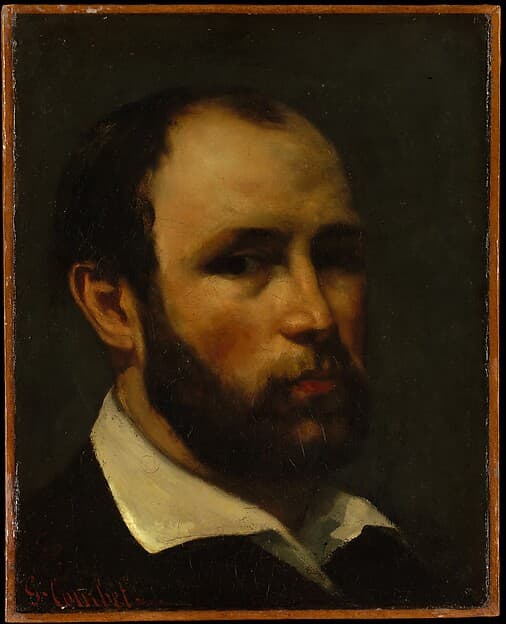
Jean Désiré Gustave Courbet was born on 10 June 1819 in Ornans, a town in the Franche-Comté, twenty-five kilometres from Besançon. His father, Régis Courbet, kept vineyards in the neighbouring village of Flagey; his mother was Sylvie Oudot; of the younger children three daughters survived, their brother's first models. In 1831 the boy was sent to the seminary in Ornans, and in 1837, at his father's insistence, to the Collège Royal in Besançon to prepare for a career in law; there he spent more time at the drawing lessons of Claude-Antoine Beau, a pupil of Gros. In 1839 he left for Paris, having promised his father to study law, spent a short while in Steuben's studio and chose the Académie Suisse instead, where nobody taught anything and the students simply painted from the nude. His schooling was the Louvre, the Spaniards and the Dutch minor masters; a journey to Holland and Belgium in 1846–1847 confirmed him in the belief that one should paint the life around one, like Hals and Rembrandt. The early pictures are self-portraits in roles: “The Desperate Man”, “The Wounded Man”, “Man with a Pipe”. In 1847 the Salon jury rejected all three of his submissions; in 1848 it accepted all seven, but none of them sold. At the Brasserie Andler he sat with Baudelaire, Daumier and Champfleury.
The turn came quickly. “After Dinner at Ornans” won a gold medal at the Salon of 1849, the state bought the picture, and until 1857 Courbet could exhibit without going before the jury. In the autumn of 1848 he went home for eight months and saw on the road two stone breakers, an old man and a boy; “it is not often that one encounters so complete an expression of poverty,” he later explained to Champfleury and Francis Wey, and the next day he asked them both to his studio. “The Stone Breakers” perished in February 1945 near Dresden, when the lorry carrying the paintings to the fortress of Königstein was bombed. The models for “A Burial at Ornans” were the very townspeople who had buried his great-uncle in September 1848: a canvas three metres by six and a half, no theatrical gestures, faces that the critics took for caricatures. At the Salon of 1850–1851 he was accused of a deliberate pursuit of ugliness; Courbet himself said that it had been the burial of Romanticism.
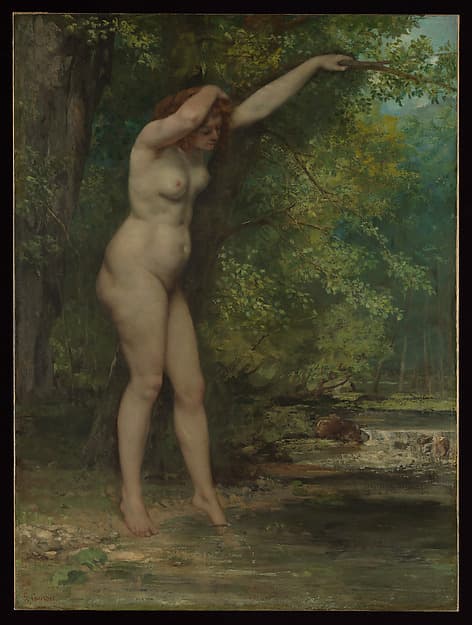
In 1855 he submitted fourteen paintings to the Exposition Universelle; the “Burial” and “The Artist's Studio” were not taken. So he built his own pavilion next door, called it the Pavilion of Realism, hung about forty canvases there and printed a catalogue with a manifesto: “to create living art – this is my goal.” The public came to laugh; Delacroix, Baudelaire and Champfleury thought the “Studio” a masterpiece. In this enormous allegory the friends stand on the right, Champfleury, Baudelaire, the collector Bruyas; on the left are a priest, a gravedigger, a prostitute; the man with dogs at the left edge, added later, is generally taken for Napoleon III. Proudhon recalled how the Empress Eugénie, who had just been examining Rosa Bonheur's “The Horse Fair” with its draught horses, stopped before the peasant body of the “Bathers” and asked: “Is that a Percheron too?”
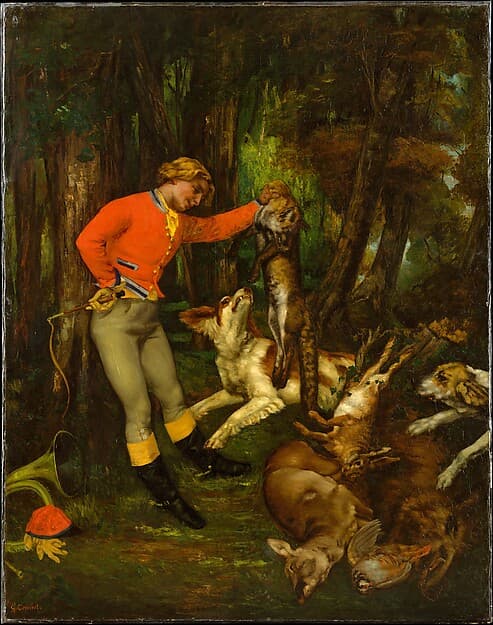
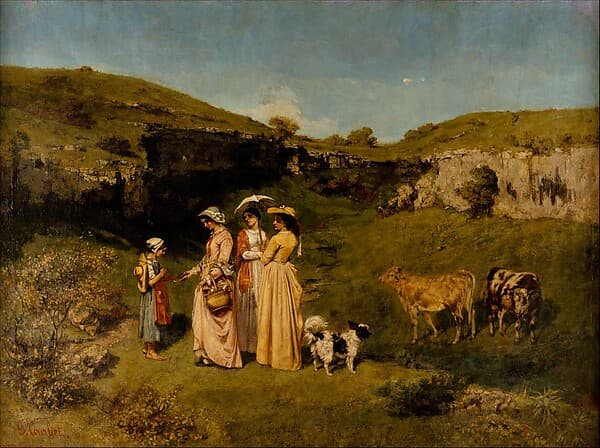
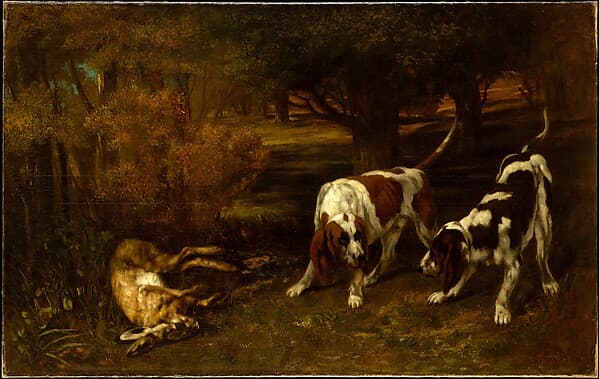
At the Salon of 1857 he showed “Young Ladies on the Banks of the Seine”, two modern women in their petticoats under a tree, and his first hunting scenes, “Hind at Bay in the Snow” and “The Quarry”; from then on scandal and sales went hand in hand. The 1860s brought “The Origin of the World” (1866), not shown in public until 1988, and “Sleep” of the same year, which in 1872 landed a picture dealer in a police report. In 1862–1863 he worked in the Saintonge with Corot, and at the end of the decade painted the sea on the Normandy coast. In 1870 Napoleon III nominated him for the Legion of Honour; Courbet refused.
On 18 March 1871 the Commune was proclaimed in Paris. On 5 April Courbet chaired the first meeting of the Federation of Artists; he proposed reopening the Louvre and the Luxembourg, holding a Salon without medals or state commissions, and abolishing the École des Beaux-Arts. On 16 April he was elected delegate for the sixth arrondissement and put in charge of fine arts. He parted company with the majority of the Commune: he voted against the Committee of Public Safety and pleaded in vain for his friend Gustave Chaudey, who was shot on 23 May. The column was pulled down on 16 May; whether Courbet was there, witnesses disagree. After the defeat he hid with friends, was arrested on 7 June, and on 14 August received six months in prison and a fine of five hundred francs from a military tribunal. At Sainte-Pélagie he was allowed an easel but not models, and he painted flowers and fruit.
He came out on 2 March 1872. The worst was still to come.
In 1873 the new president, MacMahon, decided to rebuild the column at Courbet's expense, and to avoid ruin Courbet left for Switzerland, for La Tour-de-Peilz on Lake Geneva. Young Swiss painters, Baud-Bovy and Ferdinand Hodler, looked to him as the head of a school; he showed at local exhibitions, painted trout with a hook in the mouth and blood at the gills, which are read as self-portraits of the exile (rightly, to my mind), and springs in the Jura mountains. He also took up sculpture: a figure of a fisherman, which he had given to Ornans for a fountain back in 1862, was removed after his arrest. In May 1877 the state named the final sum: 323,000 francs, at ten thousand a year for thirty-three years. The first instalment fell due on 1 January 1878. Courbet died the day before, on 31 December 1877, at fifty-eight. In 1919 his remains were moved to Ornans.
Artist works
Works by the artist
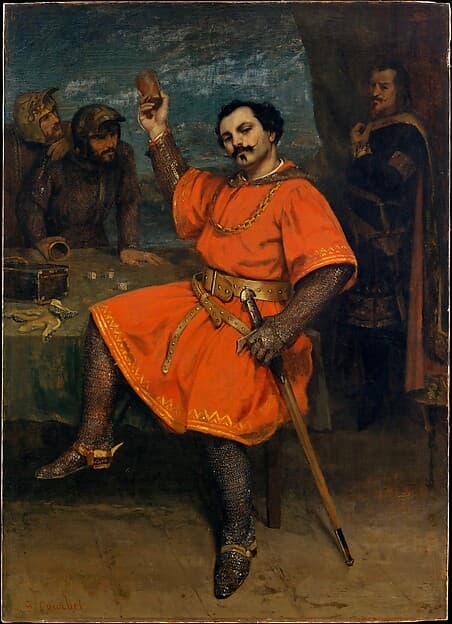
Works by Gustave Courbet available in this edition of NEOARCA.
Related context
Associations
Works connected through artistic movements, cultural context and period. Priced works available in this market appear first.








Profile notes
Profile and sources
Image
Artist image
На основе открытого изображения: Nadar; Wikimedia Commons; Public domain.
