
14.07.1862–06.02.1918
Gustav Klimt
Gustav Klimt (1862–1918) began as a successful decorator of Viennese theatres, in 1897 became the first president of the Vienna Secession, and after the scandal over his ceiling paintings for the university stopped accepting state commissions. His fame rests on his portraits of women and the paintings of his “golden phase”, “The Kiss”, “Portrait of Adele Bloch-Bauer I” and the frieze for the Stoclet Palace, as well as on his landscapes of the Attersee.
Biography
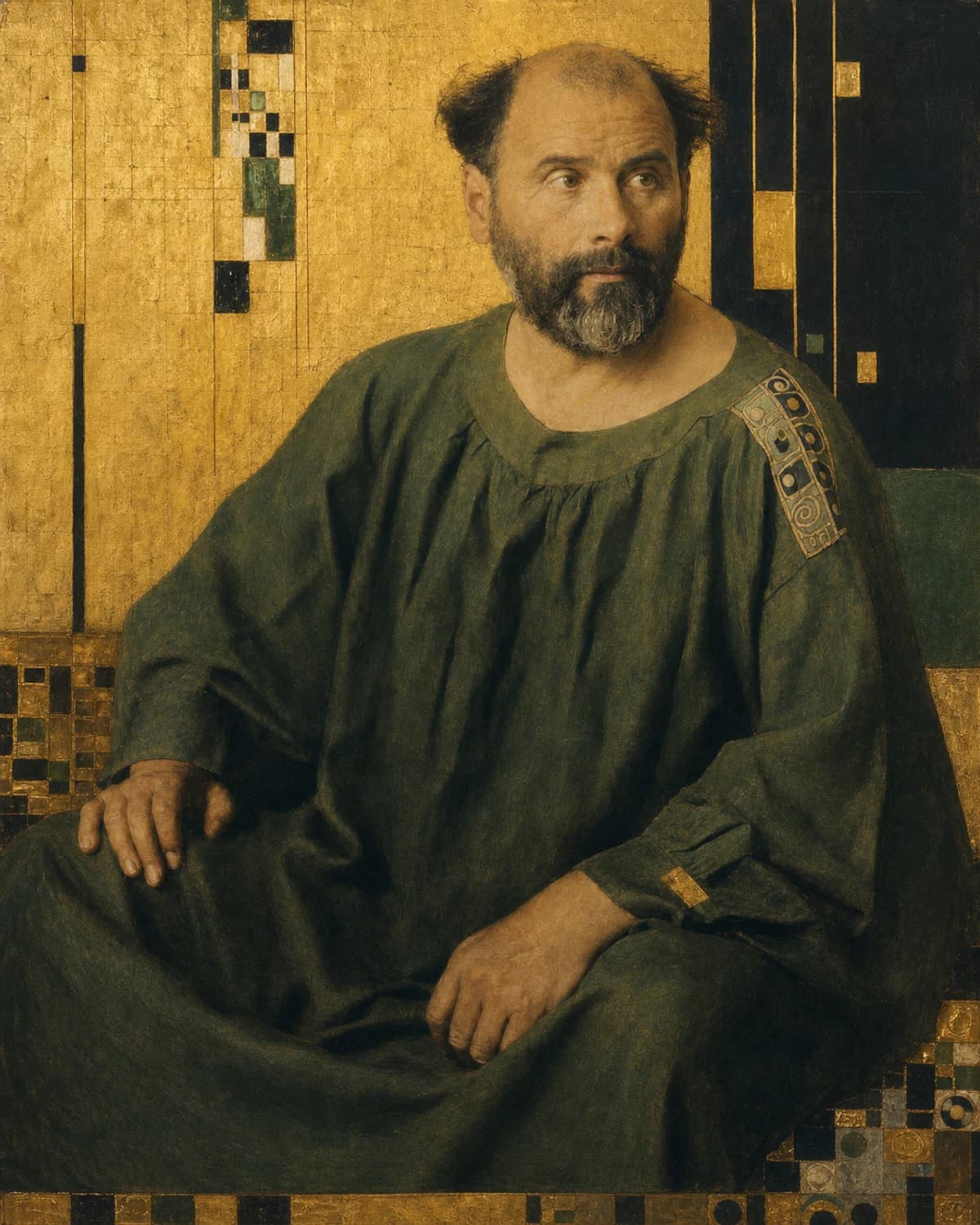
In a rare piece of writing, the “Commentary on a Non-Existent Self-Portrait”, Gustav Klimt stated that he had never painted a self-portrait: he was less interested in himself as a subject than in other people, above all women, and whoever wanted to know something about him should look carefully at his pictures. He kept no diary and wrote mostly postcards to Emilie Flöge.
He did, however, paint himself once. In the fresco “The Globe Theatre in London” on the grand staircase of the Vienna Burgtheater (1886–1888), Klimt stands on the right in a starched ruff, next to his brother Ernst in a red doublet.
He was born on 14 July 1862 in Baumgarten near Vienna, the second of seven children. His father, Ernst Klimt, who came from a peasant family in Bohemia, was a gold engraver; his mother, Anna, née Finster, had dreamed in her youth of singing in opera. His father often lacked work, the family was poor and by 1884 had moved at least five times; his sister Hermine remembered Christmases when there was no money for presents, or even for bread. At fourteen Gustav was accepted into the Vienna School of Arts and Crafts, where until 1883 he studied architectural painting under Ferdinand Laufberger and, after Laufberger's death, under Julius Victor Berger. His idol at the time was Hans Makart, and Klimt's early work is thoroughly academic.
With his brother Ernst and his friend Franz Matsch he had founded the “Company of Artists” by 1880. They helped their teacher paint murals in the Kunsthistorisches Museum, on Laufberger's recommendation worked for the Viennese firm of theatre architects Fellner & Helmer in Fiume, Reichenberg, Karlsbad and Bucharest, and painted ancestral portraits for Peleș Castle in Romania. For the murals on the two staircases of the Burgtheater, Emperor Franz Joseph awarded Klimt the Gold Cross of Merit, and the painting “Auditorium of the Old Burgtheater” won him the newly created Kaiserpreis in 1890. In 1892 his father and his brother Ernst died, and Gustav took on both families. At the same time he grew close to Emilie Flöge, the sister of Ernst's widow; Emilie, a fashion designer, remained his companion for the rest of his life.
In 1894 the Ministry of Education commissioned Matsch and Klimt to paint the Great Hall of the University of Vienna. Klimt was given three large ceiling paintings, “Philosophy”, “Medicine” and “Jurisprudence”, and ten pictures for the lunettes. When they were finished around the turn of the century, they were called pornographic; politicians, critics and the Church all protested, and the paintings never reached the ceiling. Klimt accepted no more state commissions. All three “Faculty Paintings” were burned in May 1945 at Schloss Immendorf, together with other works of his.
The scandal coincided with a new venture. In 1897 Klimt became one of the founders and the first president of the Vienna Secession and of its journal “Ver Sacrum”, “Sacred Spring”. The association had no manifesto, and Naturalists, Realists and Symbolists exhibited side by side. His “Pallas Athene” (1898) became the group's emblem; in “Nuda Veritas” (1899) a red-haired nude holds the mirror of truth, and above her are Schiller's words to the effect that if you cannot please everyone, you should please the few. For the fourteenth Secession exhibition in 1902 he painted the “Beethoven Frieze” directly onto the walls, intended as a temporary decoration; the frieze survived, but it was not shown again until after its restoration in 1986. In 1905 the Secession split, and Klimt's group went its own way.
Gold came to him from his father's workshop, and he was finally won over by the mosaics of St Mark's in Venice and San Vitale in Ravenna, which he saw in 1899 and 1903. The “golden phase” begins around 1900: “Judith I” (1901), “The Three Ages of Woman” (1905), “Portrait of Adele Bloch-Bauer I” (1907), “The Kiss” (1907–1908), and the frieze for the dining room of the Stoclet Palace in Brussels (1905–1911), which Klimt himself called probably the ultimate stage of his development of ornament. A large portrait of a woman appeared roughly once a year. At the Kunstschau of 1908 he was given Room 22, designed by Koloman Moser, and Peter Altenberg called it the Gustav Klimt church of modern art: it held “The Kiss”, “Adele”, “Danaë” and “The Three Ages of Woman”. His sitters had to pose for long periods; he worked slowly and could choose his clients.
Every summer from the late 1890s he spent with the Flöge family on the Attersee, and he painted more than fifty landscapes there: the lake itself, woods, farm gardens, flowers, houses. Space in them is flattened almost to a single plane, and it is believed that he looked at his subjects through a telescope. For his long morning walks in the woods the locals nicknamed him the Waldschrat, the forest sprite. I think these landscapes come closest to his request that people look at his pictures: there are no people in them, only the pattern of leaves and water.
In 1911 “Death and Life” won first prize at the international exhibition in Rome, and in the same year Klimt moved his studio to Hietzing, to a single-storey house on Feldmühlgasse near the park of Schönbrunn. In May 1914 he saw the finished frieze in Brussels for the first time. In 1915 his mother died; at the same time he repainted “Death and Life”, replacing the gold background with blue. In January 1918 he fell seriously ill.
Gustav Klimt died in Vienna on 6 February 1918, leaving many paintings unfinished. The next day Egon Schiele drew him in the hospital mortuary. On 9 February Klimt was buried in Hietzing Cemetery.
Artist works
Works by the artist
Works by Gustav Klimt available in this edition of NEOARCA.


Related context
Associations
Works connected through artistic movements, cultural context and period. Priced works available in this market appear first.






Profile notes
Profile and sources
Image
Artist image
На основе открытого изображения: Josef Anton Trčka; Wikimedia Commons; Public domain.
